


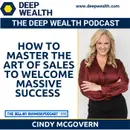
Coach And Best Selling Author Dr. Cindy McGovern On How To Master The Art Of Sales To Welcome Massive Success (#202)
 Apple Podcasts Apple Podcasts
  Spotify Spotify
  RSS Feed RSS Feed
  Amazon Music Amazon Music
  Podcast Addict Podcast Addict
  iHeartRadio iHeartRadio
  Castro Castro
  PlayerFM PlayerFM
  Podchaser Podchaser
  Overcast Overcast
  RadioPublic RadioPublic
  PocketCasts PocketCasts
  Audible Audible
  Pandora Pandora
  YouTube YouTube
 “Sales is the life skill that you need to help you reach your professional goals." - Cindy McGovern
Known as the “First Lady of Sales” Dr. Cindy has worked with major organizations for the last 14 years to not only help them grow, but also turn their human capital into confident salespeople at every level of their company. Using tools from her Doctorate in Organizational Communication and years of consulting, Dr. Cindy developed sales cultures across various industries to change human behavior at a fundamental level.
Top-rated speaker, bestselling author, Forbes contributor, and valued consultant, Dr. Cindy is the CEO and Founder of Orange Leaf Consulting, and the author of the Wall Street Journal bestseller, Every Job is a Sales Job.
Click here to subscribe to The Sell My Business Podcast to save time and effort.
SELECTED LINKS FOR THIS EPISODE
drcindy[at]drcindy[dot]com
Every Job Is A Sales Job: How To Use The Art Of Selling To Win At Work
Dr. Cindy (@1stladyofsales) / Twitter
Dr Cindy McGovern (@1stladyofsales) • Instagram photos and videos
Dr. Cindy McGovern - Chief Executive Officer - Orange Leaf Academy | LinkedIn
Cockroach Startups: What You Need To Know To Succeed And Prosper
FREE Deep Wealth eBook on Why You Suck At Selling Your Business And What You Can Do About It (Today)
Book Your FREE Deep Wealth Strategy Call
Contact Deep Wealth:
- Tweet @JeffreyFeldberg
- Subscribe to The Deep Wealth Podcast
- Email podcast@deepwealth.com
Help us pay it forward by leaving a review.
Here's to you and your success!
As always, please stay healthy and safe.
Loved this Deep Wealth Podcast episode?
You built your business from nothing.
Now make it pay off big.
📱 Subscribe Now
As a bootstrapper, every move counts. Subscribe on your favorite platform for Jeffrey Feldberg’s 9-figure exit strategies. From your morning grind to late-night planning, get insights from founders who did it without investors. These tips could change your future.
Drop a Quick Review
Got 30 seconds? Leave a 5-star review. It helps us make better episodes and reach entrepreneurs like you, hustling without a safety net.
Don’t Lose Your Exit (And Your Financial Freedom)
You’ve poured everything into your business. A bad exit could cost you millions. Most deals fail, and even “successful” ones lose half their value. The 90-day Deep Wealth Mastery program teaches you to make your business run without you and boost profits so you capture the best deal instead of any deal.
What Others Say
“Deep Wealth Mastery is pure gold. I wish I’d had it before my exit,” says Stacey C. “The value I’ve gained dwarfs the investment,” adds Sanjay S. “It makes my business great to own and sell,” shares William S.
📘 Grab Free Tools
Check out client success stories for proof. Master the Deep Wealth Strategy Map to plan your exit. Or snag the eBook, From 7 to 9 Figures: The Exit Playbook, for a clear guide.
Click here to start your legacy-defining exit today.
[00:00:00] Jeffrey Feldberg: Welcome to the Deep Wealth Podcast where you learn how to extract your business and personal Deep Wealth.
I'm your host Jeffrey Feldberg.
This podcast is brought to you by Deep Wealth and the 90-day Deep Wealth Experience.
When it comes to your business deep wealth, your exit or liquidity event is the most important financial decision of your life.
But unfortunately, up to 90% of liquidity events fail. Think about all that time and your hard earned money wasted.
Of the quote unquote "successful" liquidity events, most business owners leave 50% to over 100% of the deal value in the buyer's pocket and don't even know it.
I should know. I said "no" to a seven-figure offer. And "yes" to mastering the art and the science of a liquidity event. Two years later, I said "yes" to a different buyer with a nine figure deal.
Are you thinking about an exit or liquidity event?
Don't become a statistic and make the fatal mistake of believing the skills that built your business are the same ones to sell it.
After all, how can you master something you've never done before?
Let the 90-day Deep Wealth Experience and the 9-step roadmap of preparation help you capture the best deal instead of any deal.
At the end of this episode, take a moment and hear from business owners like you, who went through the Deep Wealth Experience.
Known as the First Lady of Sales. Dr. Cindy has worked with major organizations for the last 14 years to not only help them grow but also turn their human capital into confidence salespeople at every level of their company. Using tools from her Doctorate in Organizational Communication and years of consulting, Dr. Cindy developed sales cultures across various industries to change human behavior at a fundamental level.
Top-rated speaker, bestselling author, Forbes Contributor, and valued consultant Dr. Cindy is the CEO and founder of Orange Leaf Consulting and the author of the Wall Street Journal bestseller Every Job is A Sales Job.
Welcome to the Deep Wealth podcast, and as you heard from the official introduction, the doctor is in the house, but a very special doctor, not only a doctor, a bestselling author, thought leader, and the First Lady of Sales.
Dr. Cindy, welcome to the Deep Wealth podcast, an absolute pleasure to have you with us. And Dr. Cindy, there's always a story behind the story. I'd love to hear your story, Dr. Cindy, what got you to where you are today?
[00:02:47] Dr. Cindy: Well, First of all, thank you so much for having me. I am so excited to be here. And the story behind the story is I became the first lady of sales. Funny enough, because I never wanted to be in sales I thought it was icky and pushy and manipulative and cheesy, and you had to be that guy so I ended up in a sales role.
About six months into it, wait a minute, I've been doing this my entire life. I just didn't call it sales. It's helping people. And when I realized that it changed everything, it changed the mission, it changed my intention, it changed my goals. And I was like, I have got to tell the rest of the world that sales is not just a business skill, it's a life skill, and I gotta help 'em.
[00:03:31] Jeffrey Feldberg: Absolutely. And you know, I'm sure we'll get to this. We'll talk a lot about your book and for the listeners in the show notes, we'll have a link to Dr. Cindy's book, Sell Yourself: How to Create Live and Sell A Powerful Personal Brand. Just saying that gets me all energized. But most people don't realize we are born selling right from the very start.
We talk about a movie that we really liked or a restaurant that we went to so dr. Cindy, before we dive into some of the details, I would love to hear your thoughts on dispelling some myths that, hey, you know what? I'm not really a salesperson. It's not in me, or I wasn't born with it. I'll never be able to do that.
What would you say to that, to that listener who's thinking that.
[00:04:08] Dr. Cindy: I would say exactly what you just said, which is you literally came out of the womb selling when you were crying and couldn't speak. You were selling that you needed attention. It is absolutely within us, it's an instinctual piece, and anybody that knows a five-year-old or has a five-year-old, they're the best salesperson on the planet.
They're singularly focused on their goal. They're not afraid of no. And then when you say no, they're like, but why? But why? We all have that in us. But somewhere along the way, we were told no, or we were told we didn't deserve it, or we started having these imposter syndrome.
You know how to sell. You're doing it by convincing your partner to go for pizza instead of salad. You literally are selling in and out every single day in every communication you have.
[00:04:53] Jeffrey Feldberg: And Dr. Cindy, speaking of selling, because we're gonna start going into your foundational work with all of the strategies and tactics that you have, but kind of the what's in it for the listeners in terms of, I know you have coaching and consulting and all kinds of programs for business owners who work with you, and they're the benefactors of that so, the carrot for everyone who's listening.
When they follow your system, they'll pick up the book, they'll master the strategies. What could they expect from the sales side of things that perhaps we're not seeing right now?
[00:05:23] Dr. Cindy: More revenue, more business, more advocates to help you get more revenue and more fun doing it.
[00:05:30] Jeffrey Feldberg: Wow. Pinch me. Am I dreaming? Wouldn't we all love that? And for this one out there, as in the Deep Wealth nine-step roadmap. This is really all we talk about. How do you grow your business, realize its full potential, and then when you're there, you have the benefit of, do you keep a thriving and profitable business forever or do you sell it tomorrow?
And with Dr. Cindy, we're gonna be talking about some additional strategies and tactics to help get you there. I love how you structured your book. You put it into three parts, so with part number one create, and you're talking about creating, living, selling, knowing what you're selling, planning your brand, you know all, I'm rolling those three chapters into one, but really for our listeners who will be picking up the book, they'll be reading that.
What would be some things that you would want them to know maybe even right after our conversation, Dr. Cindy, some actionable items that they can take from part one of create? What do you think is going on there?
[00:06:19] Dr. Cindy: Part of the reason that I wrote this book is because of the changes that had happened in the world. There was the great resignation, the great remorse, the great reset. I believe we're in the great rebrand. And the reason we're in the great rebrand is because the way we communicate shifted during recent years.
The way that we are selling, the way that we're connecting with people. We're very, social media is our sixth sense now. The way that we present ourselves to the world is different.
Looking at that, recognizing what brand you're selling out there, who are you in the world? And one of the myths I'd like to dispel is people say I don't have a personal brand.
Yes you do and everybody knows it, but you, and so you've gotta know how to really create the image that you want people to know. If you've gotten funding from BC for your organization, if you sold yourself to a potential client, they're buying you, you're selling yourself before you're selling your product or service your company.
That's your brand and that's what you're creating trust in and being reliable.
That's the part you've gotta start with so you've gotta be intentional about who you wanna be known as in the world. And that's the first step I would have people do. Stop and think about it. What are the words you want them to say about you when you're not there?
And is that what the world's saying?
[00:07:34] Jeffrey Feldberg: Absolutely. And I know you did your doctorate in organizational communication and you mentioned the pandemic. And also just, in researching for the interviews, reading some of your articles, you're talking about the personal brand you didn't know that you have for the benefit of our listeners who may not realize is because it's astounding.
How quickly are people making an assessment of us, without us even speaking a word? And that goes right into what you're saying about brand.
[00:07:55] Dr. Cindy: Seven seconds.
[00:07:57] Jeffrey Feldberg: Seven seconds. Wow. Seven seconds.
[00:08:00] Dr. Cindy: And the reason I say seven seconds is because that's the attention span. We are looking whatever information my brain can take in that seven seconds is half processed that are ready, and it doesn't mean that you don't have a second chance to make an impression or a third or a fifth or whatever, but we are selling to the five senses and we recognize that all of the senses are taking that in. So, maybe you've dressed appropriately, but you're not carrying yourself appropriately, maybe dressed appropriately, but you come in with amazing confidence in swag, so, all of those things go to how you sell yourself, and it truly is in that split second, almost moment where they're deciding.
[00:08:41] Jeffrey Feldberg: And again, Dr. Cindy, you can correct me if I'm off base. To me anyways, it seems like coming out of the pandemic and thankfully it's behind us and our hearts out to everyone who was affected by that, but it seems that a corporate logo is no longer enough. A company brand is no longer enough, even if you're manufacturing widgets of all things.
It seems that people wanna know who's behind the logo, who's behind the brand, and I think that goes to part one of your create, but what's going on with that? Is there something to that or is that just a data point of one from Jeffrey, and I'm so, far off base on that?
[00:09:14] Dr. Cindy: No, Jeffrey, you're absolutely right on point with that. And part of it is the cancel culture that we have now in the world, and if we don't believe that your values are reflecting the company's values or vice versa, you're out. You're canceled. And it's so, important for business owners to recognize that each of the people within their organization, all of your team members are walking ambassadors of your brand, whether you like it or not.
Are they the right ones? Do their core values reflect yours? And that's part of the exercise about creating your personal brand as well. Your core values, do you know what they are? Are you clear on what they are? And I'll tell you a quick story. There was a tech company that came to us and they were going through a full rebrand, true rebrand, logo, name everything.
We signed all the NDAs and all the good stuff, and they had me talk to their sales team. I went in, I did training with them. I was doing some coaching and said, hey, this is how you're gonna do it. And I said, but here's the problem. You have 1700 employees I've spoken to 75.
Seventy-five, what about the others to this company's credit, we spoke to all the company.
Three different segments. We got to speak to every single person and help them embrace their personal brand, how it's reflected in the company, and how to tell their personal story. That's pretty remarkable and very forward thinking of that organization as well.
[00:10:35] Jeffrey Feldberg: Yeah, I love hearing that. And it ties nicely into a question I had for you. And for our readers, when you go through Dr. Cindy's book, Dr. Cindy. You've done a remarkable job of having it come across without the clutter. And let's not confuse simple with simplicity because to have something that looks simple is actually complex behind the scenes to have everything just right and so with create, live, sell, you later on in the book, you give three very specific steps of what you have to do for creating your personal brand but there's three things in there that you're saying if you don't do these three things, then really all the branding in the world is useless. And you're talking about, you know, devoting the time and living the brand and then selling the brand.
But can you expand upon that for the listeners in terms of what they should know with that?
[00:11:20] Dr. Cindy: If we think about someone we know in our personal life, so, take it even out of business. Your best friend. Why are they your best friend? It's because, they're reliable, they're your best friend because you know what you're getting at the end of the day. Good, bad or ugly. We know it, it's familiar and they've sold themselves to us and we trust that.
And that's really what I mean by those three things is if you're not living it and you're not proactively selling it and controlling the narrative, the brand's kind of on a shelf. And it's not gonna help you get where you want to go. And so that's also why it goes back to the creation and the brand plan.
It's gotta be something you can live. It's gotta be something that, you know, I'm originally from the south and we say you can't get too big for your britches. You know the brand that can be authentic. But it really is about building that trust piece. And that's where the living part comes in, is you're building trust in who you are out there in the world.
So, for instance, for the business owners that are listening. When you're going into any of your employees, any of your associates, and you're delivering news, good, bad, or ugly, they're trusting that you're telling the truth or they're not, and that's because you've sold your brand to them. You're reliable.
They know that you're gonna tell the truth even when it hurts or even when it's ugly, or even when the market's shifting. That's really important because it's that authenticity that you're doing every single day where leaders get in trouble is when they're either not telling the truth, not living authentically, they're not walking the talk, or they think they're immune from having a personal brand.
They think everybody else needs it, but not that.
[00:12:52] Jeffrey Feldberg: It's interesting, so, let's continue with that. So, you've gone through part one, you've concocted and come up with a brand that's really true to you and it's authentic and all the strategies that you list in the book. When it comes to your second part of the book, so, you're gonna now live the brand. Easier said than done.
Let's go with Pareto's Law, which says, 20% of my activities generate 80% of my measurable results. I really move the dial, but also 20% of perhaps things I'm not doing correctly or I'm doing wrong are gonna get me 80% of the mistakes that are going on out there.
So, the low-hanging fruits we've created the brand. That's all done. We're going to part two, we're going to live. Where are most business owners dropping the ball or missing something that they're just not doing it right and it doesn't work out for them? What are you seeing out there?
[00:13:41] Dr. Cindy: So, the biggest mistake actually takes them black back to the planning phase, which is you have to know what your brand blind spots are because those are the hardest ones to live is to recognize them. I was actually on a coaching call with a client this morning and we were having a conversation about a brand blind spot that she has around delivering feedback.
She comes across as harsh. She doesn't mean to come across as harsh, but she does. and that's feedback she's gotten so we've been working on that. How can you deliver it? so it's accepted and the person takes it as constructive criticism versus being scolded, which is exactly the feedback she's been getting.
The interesting part about your brand blind spot is you're not gonna be able to live it if you don't know it's there.
[00:14:23] Jeffrey Feldberg: You think?
[00:14:25] Dr. Cindy: Yeah, so, that's the 20% that's wrecking it for you was that blind spot so we've gotta be aware of that so that we can mitigate it, and that's where your hardest decisions will come in as well. Those are the highest stakes because you can do 80% things, right, but you make that one piece that doesn't fit, doesn't create trust.
It could be unraveling everything else you do.
[00:14:49] Jeffrey Feldberg: And Dr. Cindy, you mentioned a word that's near and dear to us here at Deep Wealth. You mentioned blind spot. Now we call a blind spot, a skeleton in the closet that can put you outta business or can rob you of the best deal. The issue with the blind spot though it is a blind spot. We don't know that it's there.
So, what are you having? If you're consulting for me or you're my coach, what are you having me do to find and highlight those blind spots so I can eliminate them?
[00:15:15] Dr. Cindy: It's a very difficult exercise because it can be quite painful. I just, with a leadership retreat that I was running for a client of ours, I had them speak to three people and asked them to describe you in five words. And I asked them to ask a personal friend or family member, a colleague and a manager, one of their managers, and then their homework was to then take that back and ask their support. And the reason I don't have the massive subordinates first is because usually the ones that are above us and the ones that are equal to us are gonna give us the most sting, or you can ask your kids, they'll tell you the truth too but get those blind spots out because it's not intentional. A lot of times we don't even know we're doing it.
It's why it's the skeleton in the closet, but that's what's unraveling, that's your obstacle. And so, knowing it's even there is the first step in being able to do something around it.
[00:16:08] Jeffrey Feldberg: As you're walking through that you can correct me if I am correct with this. It sounds like in the book you have that always never exercise. Is that what you're referring to just now?
[00:16:17] Dr. Cindy: I always do. I never do. And it is one of those things where we have to know, where we stand with those, and always, never is a really hard thing to admit.
Because we don't always do something. We never do something. It's like, I most of the time do this. I'm sometimes don't do that. So, really being honest and getting, I call it an honest inventory about your brand and about the brand that's out there about you.
And celebrities are unbelievably diligent about this. They know the blind spots that they have and they have publicists that work around it. For us near mortals, we don't have that so we have to seek out what they are because they're there. They're there and they're not a blind spot to everybody else.
We wanna recognize it, raise our level of self-awareness, so, that we can work with it. Around it. Through it. Get it done.
[00:17:04] Jeffrey Feldberg: As for our listeners out there, check your egos at the door. You'll pick up the book, you'll learn the always, never. You'll do that exercise with the people around you. And the truth is Dr. Cindy and to what we're talking about earlier, people make a judgment about us, as you were saying, within seven seconds.
But human nature shoots the messenger, they would literally kill people back in the day. Thank goodness we got rid of that custom, where you brought bad news, but no one's gonna want to tell you. Yeah, Jeffrey, you really sucked in that presentation.
You really blew it. Like, I can't tell you how boring it was, and you put me to sleep after the first three minutes. We're just not going to hear that so they always never, and checking the ego at the door and really welcoming that feedback. And speaking of that, Dr. Cindy, what can we do as business owners and leaders and entrepreneurs and founders?
Because you referenced this, just a moment back, our staff, our team looks up to us, but sometimes it's, oh, so, hard not to take it personal. When you hear this feedback so, what advice would you give to us? We're hearing crushing feedback of we're maybe the business dropped the ball or we dropped the ball.
How can we best handle that to encourage more of that? As hard as it is so that we become better.
[00:18:09] Dr. Cindy: Well, The first thing you to do is congratulate yourself from building a culture where people feel open and honest.
The good in that, that you've actually created a space in the world where people feel brave enough to say what went wrong. That's kind of an amazing thing in and of itself. And then the second thing is looking at it through a lens of gratitude. It is the gratitude that will change exactly how you look at that. Grateful for the opportunity. It could be a client that says, we're never gonna work with you again, but here's why. I'm so, glad you told us because that was a blind spot and most of the time that kind of feedback is about a blind spot is about something that went wrong.
It's not a good thing when we're feeding that, you know, if it's good feedback, nobody has trouble taking that, but it's usually the negative, and if you look at it through that lens of gratitude and how we can to improve. I actually think that goes directly to your leadership legacy too.
Showing them that feedback is a gift. And that it's an opportunity to continue to grow and that it's okay to not be perfect, and in fact, it's welcomed here. Imperfection is welcomed because we are constantly striving for better.
[00:19:16] Jeffrey Feldberg: And speaking of striving for better, one of the things that you go to great lengths in the book to talk about, it's mixed messages of what we unintentionally do unknowingly to dilute the brand. And so I know every business is different, every person is different. Broadly speaking though, are they're the same kinds of mistakes that you're seeing time and time again?
And what would those be?
[00:19:39] Dr. Cindy: There are a lot, and I actually talk about them in the book, but some of the most common for business owners and leaders that I have found as of late, not walking the talk as I mentioned. And what I mean by that is you're saying something, but then you're getting a little loose-lipped with the ones that you're closer to. You're unraveling that brand. You can also unravel your brand, just the way you show up. And I'm actually talking about physically. I have literally had video conferences with people in their pajamas and I know they were pajamas cuz I have them. So, you know, If we're trying to put forth this casual environment, that's one thing.
But comb your hair, and I've found that with a lot of folks, especially in recent years, we're a much more casual society as a world.
However, you may be unraveling your brand simply by what you've put on.
By the way, you behaved on the weekend, simply by the way that you made a comment when you were having a bad day, and recognizing that you are selling yourself every single day in everything you do and everything you don't do.
And I have another story for you. It was another coaching call that was this morning. I was having a conversation with a group of leaders, and they have some underperforming folks on their team, and they haven't been willing to have a conversation as in yet. And I said help me understand why and what's been keeping you from this, and, oh, Sally's been here for 10 years and so, has this going on.
I'm like, okay. What message are you sending to the rest of your staff by not addressing underperforming? When everyone else is working just as hard or harder than you, and they all stop they don't realize that's them unraveling this big brand and culture that they've created simply by not taking action.
[00:21:19] Jeffrey Feldberg: Absolutely not taking action is taking action. And Dr. Cindy, I'm sure you've seen this in your coaching and consulting practice, how many times are A players leaving the company because leadership doesn't have it within them to address the B and C players and even ask 'em to leave the company? They think they're doing everyone a favor.
They're actually doing the biggest disservice to the company. But it's interesting you're tying that into the brand of the company, but also the brand of the leader and the leadership of what they stand or don't stand for in this case.
[00:21:49] Dr. Cindy: That's a hundred percent right. And it is funny that you mentioned sort of those A players, if you're really building a culture where you want everyone to see that there's room to be an A player, you have to address the underperforming assets that you have. You're not doing yourself any favors because you're actually holding back the growth of your organization.
And I understand there's emotion, and these are real people, and I'm not a robot. I do get it but it's looking at what your ultimate goal is and the mission has to be greater than the fear at the end of the day.
[00:22:16] Jeffrey Feldberg: Absolutely quick story to share. And for the listeners, my e-learning company, Embanet, that's the one that went on to the nine-figure Exit that we had. So, Embanet had a bit of a reputation in the industry of being a revolving door because to your point, Dr. Cindy, we had very high standards and every year we would top grade.
And what was an A last year or last quarter? Maybe that's only a B plus now. And what was an A maybe three years ago today, would be a C, and sticking to the brand, which was always of excellence, we would often say to whether it was internally or to clients. Tell me what you'd rather have that we keep people and not have a revolving door, and our service levels go down. We lose clients, and we go out of business or we have that revolving door, but you know, we're holding back those people from finding their destiny. Why should we be the ones to do that? And at the same time, why not get the world's best possible service with our standards?
And when people were open to listening to that it really made the difference And it also shows in the company as well. But let me ask you something because as we go to part three of the book, and parts one and two, you put the foundation in there, you've created the brand.
You're living your brand. You're talking about rebranding and being off-brand, which we're just speaking about right now, so, now part three is the sell part, and we spoke about this at the start. You already know how to sell. But I think for so many of our listeners between imposter syndrome and they're thinking of a used car salesperson when it comes to sales, what would you say to, you already know how to sell. What should we really be thinking? Let's dispel some of those myths.
[00:23:50] Dr. Cindy: So, the first thing is the term sell yourself. We throw that around, and that's actually why I wanted to name the book this because people forget that the operative war is sale. You're literally making a sale when you're having that conversation. You were selling the story of your company.
When you were having that explanation, you were selling them on the idea that in order to deliver what we are trying to do in keeping with our mission and values, we're topping up and we're gonna continue to top up unapologetically and we're not gonna hold anybody back from living their own destiny, but this is who we are.
And I think that that's really important to know that, and you can sell it when you believe in it. There are things that I won't sell because it's like I don't know. I don't care. It's not my thing. I am addicted to helping people and growing businesses. I'll sell that all day long.
You're selling yourself, whether you realize it or not, so you might as well do it on purpose, and that's really where the sales process comes into play. And people get really shy with sales, or they think they have to be that used car sales approach. I have an avatar in my mind, I call him Tommy two thumbs, and he is that, White shoes, plaid pants, gold medallions.
He's literally that used car, slimy old caricature of a human being, really, that's such a small percentage of salespeople if we really think about it.
[00:25:07] Jeffrey Feldberg: And you're talking about that and so you already know how to sell, and we spoke about that, and you go to great lengths in the book. And again, for the listeners of show notes, we have a link to the book where you can pick all of this up, take your time going through it, and master the strategies.
But what I found interesting was chapter nine. And I'm glad you put it into a chapter on its own and just not into a sentence or a paragraph. We all do this, to this day, I still do this. I still sell myself short. And that, you know, imposter syndrome, so what's going on with that?
Why does that happen for us? And if the listeners could have some solid takeaways before reading the book from chapter nine, what would those be?
[00:25:45] Dr. Cindy: So, we're taught as children that you don't brag, so this came from childhood. We're trying to be nice by not showing our accolades to the world. And in doing that, we're actually selling ourselves short. Nobody wins if we don't bring our best selves to work. Nobody wins in your organization, if you're not empowering your people to speak up and say, hey, I have this superpower.
Did y'all know that? You wanna make sure you're creating an environment for that. But so often, people sell themselves short because they think that their actions or their work is speaking for itself. I actually think that's fairly narcissistic. If you think the rest of the world is paying attention to what little old you or me is doing, we're missing the boat.
We're competing in a very crowded, noisy world. We're competing for attention; we're competing for time. When you look at that, and you really think about this, you've gotta speak louder. You've gotta stand higher. You've gotta shine brighter, and if you are not, then you really are selling yourself short, so give yourself permission to speak up about what you've done. Give yourself permission to show. I call it a multifaceted brand. Show the facets that you bring to the table. I call 'em superpowers. What are your superpowers? Stop waiting for the rest of the world to notice you and how important you are.
Tell them.
[00:27:09] Jeffrey Feldberg: Oh, Dr. Cindy, you're so spot on. And for the listeners, I'll share a quick story with you, Dr. Cindy. As you're talking about this brought it to mind. Once upon a time, I was elected president of an association in the industry, and I'm you know, around the board table, and all the members are there on the board and I had learned a short while there that one of the members hired my competitors.
And I was in shock and disbelief. A fellow board member never even spoke to me, and I approached him later, and I said, hey, so, and so I understand you went with a competition. You don't ever badmouth the competition. Great choice. We also do something similar, but different. I'm just curious. We never had that conversation.
I'm wondering, you know, what happened, and so, Jeffrey, I had no idea you did that. And I was just floored, here I was, fellow board member on the board, and to your point, Dr. Cindy, I thought I don't have to sell myself. I'm a fellow colleague, obviously, they must know what I do, but everyone is so preoccupied in their world.
They're not really paying attention to us. And the one other thing I would add of why resonates so much if somebody has a painful problem and we don't share what we do. We're depriving them of that pain relief that they would happily pay for to have us remove, yes, no.
[00:28:18] Dr. Cindy: Yes. And that's really the message I want people to take from this is you are a multifaceted, amazing human being with superpowers. that you right now, because you're not selling yourself, are not helping people with it. You have literally the pain relief. You have the solution to someone else's problem.
You have the help that someone else is needing. But unless you are the one saying, I have the bandaid, no one knows.
[00:28:47] Jeffrey Feldberg: So, to contrast that then, and you talk about this in Chapter 10, Sell like a Pro, and then it's a nice segue to see all of you, but we've all been there. You get that person who just brags till the cows come home. They don't stop talking, and you're like, get me out of this room, or get me away from this person.
I don't want another word. How do we go from not selling yourself short to selling like a pro where it's professional, it's respectful, it's value-added,what's going on there? What should we know?
[00:29:19] Dr. Cindy: There are five steps to truly selling like a pro. It's having a really solid plan, knowing the right opportunity when it presents itself, listening to the other person, which is what our braggadocious friends do not do because listening is a way you're gonna establish trust. Then asking for support or help or if you can assist them, and then there's a follow-up piece.
It's not a one-and-done. We're a very interconnected world, and what that bragger typically does is they're completely tone deaf. They're not reading the room; they're not seeing that people are disinterested. They're more concerned with hitting their word count of the day.
[00:29:56] Jeffrey Feldberg: I don't think they have a word count, Dr. Cindy. I think it's infinity.
[00:29:59] Dr. Cindy: I would agree with that, and if you're really selling like a pro, a professional salesperson knows, the less you say, the more impactful it is. It's choosing your words at the right moment. It's providing the solution as an offer, not a push. It's an invitation to buy, not a sell. And so when you sell like a pro, you're not gonna become that person. You're not gonna become that bragger because it's not in you. And by the way, I would actually tell people if you have the level of self-awareness where you have that little mechanism that goes, Ooh, but I don't wanna be a bragger, you're never gonna be, you have self-awareness around it.
[00:30:38] Jeffrey Feldberg: What I'm hearing you say is, when we're not selling ourselves short, we're educating, we're not really selling it. In fact, in my experience and you can agree or not the top percent of a percent of a percent of salespeople out there never sold a day in their life. And you're saying, Jeffrey, what are you talking about, Dr. Cindy? What are you talking about? They're educating. They're helping. And it gets to the point where when you do it right, someone says, wow, Jeffrey, that sounds terrific. Can you help me achieve what you achieved and selling like a pro? That's where you're heading in again; it's all in the book and speaking of the book, and before we start to wrap things up in your epilogue, which you don't see a lot of out there and I was really happy to see this leaving a legacy because all too often we're just so, busy and okay, I just gotta get through the to-dos and get through this day and into the next day and the next week.
Talk to us about a legacy. If there's one thing we had to remember about the legacy or what we should be doing or even not doing, what would that be?
[00:31:37] Dr. Cindy: You've already started writing it. That's the one thing I want people to realize, and that's why I left it as an epilogue because I wanted it to have that impact of that short page of saying. You are writing your legacy. It is completely up to you. And if you're not leaving the one you want behind when all is said and done, then change the script right now, and the power's within you to do it.
You don't need anybody's permission, but you are absolutely already writing it. And so, we're not promised tomorrow. And we all have opportunities in this world to continue to improve and continue and evolve. And I am a lifelong student and all of that stuff. but it's really about you're already leaving those imprints.
It's footprints behind you. Are they telling the story about you? You want told when you're gone? And if not, change it.
[00:32:26] Jeffrey Feldberg: Yeah. Wow. That really hits home offline. Dr. Cindy, you and I were talking about my uncle recently passed away, a mentor of mine, a magnificent individual, and put him right up there with my father, the two of them. And but this was, you know, just the past week or so, when you spoke with the people, people who only maybe met him once or just a few times, the legacy that he left, to your point, not through what he said, but through his actions.
So, for our listeners out there with what Dr. Cindy's saying about your legacy. Absolutely, You know, every episode, we like to encourage our listeners do something before you go on to the next item before this episode ends. Make the mental commitment, the mindset commitment to do something right now. And if it's not gonna be creating your brand, if it's not gonna be living it or selling it, any one of those would be incredible.
Then make it the legacy that you can change it today, right now, before you go on to the next task, and we'll put that out there as a mission, as a challenge for the Deep Wealth community to do that. Dr. Cindy, because of the wonderful book and the wisdom and the knowledge that you've shared, But let me ask you this, because we can just go on and go down these different rabbit holes of all these different techniques and strategies.
That said, we need to start wrapping up, and somewhat of a spoiler alert here, a bit of a competitive disadvantage. You've heard this question. You've done your homework, and you've heard some of the podcasts, but we'll throw it out there anyways. I'm really intrigued to what you're gonna say. So, our famous question that we love to ask, and I have the privilege of asking every single guest, is this?
Imagine the movie Back to the Future. And in that movie, you have the magical DeLorean car, Dr. Cindy, that will take you to any point in time. So, the fun part begins. It's tomorrow morning, Dr. Cindy. You look out your window, and there it is. The DeLorean cards, not only curbside. The door is open, it's waiting for you to hop on in, so you now hop in, and you're gonna go to any point in your life, maybe Dr. Cindy, as a child, a teenager, young, adult, whatever point in time that would be. What are you telling your younger self in terms of life wisdom or life lessons, or, hey, do this, but don't do that? What would that sound like?
[00:34:31] Dr. Cindy: The first thing that I would tell my younger self would be that sales really is a life skill. Don't shy away from it. Don't be afraid of it. You know how to do it. Learn how to do it better because it is going to influence every step of your life, every step of your career. It will help you in personal relationships, in professional relationships, and it is the skill that you will need to really be able to reach your professional goals.
[00:35:00] Jeffrey Feldberg: So, true. You know, as you're saying that, Dr. Cindy, I'm thinking of that old expression, reading, writing, arithmetic. There should be a fourth one selling.
[00:35:08] Dr. Cindy: I agree. I agree.
[00:35:09] Jeffrey Feldberg: Right, right with there. And Dr. Cindy, again, we're gonna have all this in the show notes. It'll be easy for our listeners. It'll be point-and-click.
If someone would like to reach out to you, perhaps for coaching or consulting, or they have some questions, where's the best place online to reach you?
[00:35:23] Dr. Cindy: drcindy.com and 1stladyofsales is my social media handle, and I answer all of the questions that come in so, I would encourage all of your listeners, if you've got a question as you're creating your brand. I interact with listeners and followers all the time. It's one of my favorite things when people say, oh, I heard you on this, and I have a question for you, please.
My goal is to make sure that you're reaching your own personal and professional potential by living your most powerful brand. Any way that I can help, I'm a phone call or an email away.
[00:35:55] Jeffrey Feldberg: For our listeners. You heard it straight from the First Lady of Sales, aka Dr. Cindy. It doesn't get any better than that. Everything's in the show notes. Dr. Cindy, as we wrap this up, truly a heartfelt thank you for sharing your insights, your wisdom, your experience. You've made us all better people today walking out of this, and when we first came to it, and as like to say in the Deep Wealth Podcast, as we wrap it up, please continue to say healthy and safe.
[00:36:19] Sharon S.: The Deep Wealth Experience was definitely a game-changer for me.
[00:36:22] Lyn M.: This course is one of the best investments you will ever make because you will get an ROI of a hundred times that. Anybody who doesn't go through it will lose millions.
[00:36:32] Kam H.: If you don't have time for this program, you'll never have time for a successful liquidity
[00:36:37] Sharon S.: It was the best value of any business course I've ever taken. The money was very well spent.
[00:36:43] Lyn M.: Compared to when we first began, today I feel better prepared, but in some respects, may be less prepared, not because of the course, but because the course brought to light so many things that I thought we were on top of that we need to fix.
[00:36:59] Kam H.: I 100% believe there's never a great time for a business owner to allocate extra hours into his or her week or day. So it's an investment that will yield results today. I thought I will reap the benefit of this program in three to five years down the road. But as soon as I stepped forward into the program, my mind changed immediately.
[00:37:21] Sharon S.: There was so much value in the experience that the time I invested paid back so much for the energy that was expended.
[00:37:32] Lyn M.: The Deep Wealth Experience compared to other programs is the top. What we learned is very practical. Sometimes you learn stuff that it's great to learn, but you never use it. The stuff we learned from Deep Wealth Experience, I believe it's going to benefit us a boatload.
[00:37:45] Kam H.: I've done an executive MBA. I've worked for billion-dollar companies before. I've worked for smaller companies before I started my business. I've been running my business successfully now for getting close to a decade. We're on a growth trajectory. Reflecting back on the Deep Wealth, I knew less than 10% what I know now, maybe close to 1% even.
[00:38:03] Sharon S.: Hands down the best program in which I've ever participated. And we've done a lot of different things over the years. We've been in other mastermind groups, gone to many seminars, workshops, conferences, retreats, read books. This was so different. I haven't had an experience that's anything close to this in all the years that we've been at this.
It's five-star, A-plus.
[00:38:30] Kam H.: I would highly recommend it to any super busy business owner out there.
Deep Wealth is an accurate name for it. This program leads to deeper wealth and happier wealth, not just deeper wealth. I don't think there's a dollar value that could be associated with such an experience and knowledge that could be applied today and forever.
[00:38:49] Jeffrey Feldberg: Are you leaving millions on the table?
Please visit www.deepwealth.com/success to learn more.
If you're not on my email list, you'll want to be. Sign up at www.deepwealth.com/podcast. And if you enjoyed this episode, if it added value, if you walked away with some new insights and strategies, please leave a review on your favorite podcast channel. Reviews help us reach new listeners, grow the show. And continue to create content that you'll enjoy and as we wrap up this episode as always please stay healthy and safe.
Click here to book your free exploratory strategy session.
Enjoy the interview!


