


Founder Saahil Mehta Reveals: Why Checking Every Success Box Still Leaves You Empty Inside (#552)
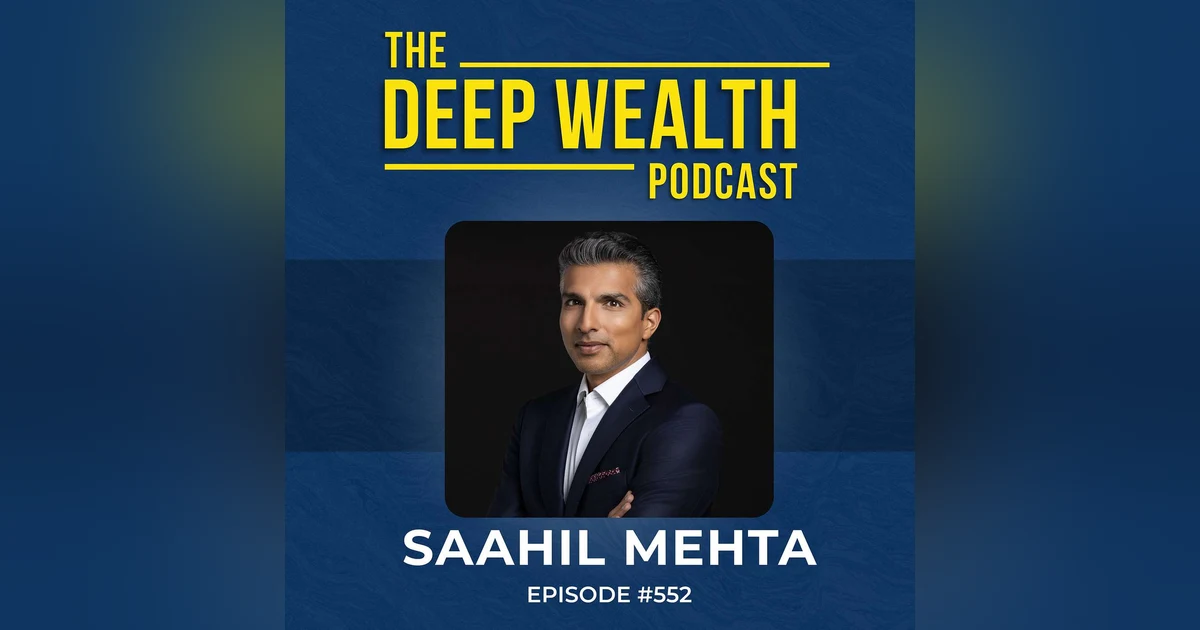

Send us Fan Mail “Have the courage to be you.”-Saahil Mehta Exclusive Insights from This Week's Episodes Success can look perfect and still feel empty. Founder and Author Saahil Mehta reveals why founders lose freedom after checking every box, and how to begin reclaiming success on your terms. Episode Highlights [00:03:00] Saahil Mehta reveals why conventional success left him feeling empty instead of free [00:06:00] The health cost of pushing harder, sleeping less, and calling it ambition [0...
 Apple Podcasts Apple Podcasts
  Spotify Spotify
  RSS Feed RSS Feed
  Amazon Music Amazon Music
  Podcast Addict Podcast Addict
  iHeartRadio iHeartRadio
  Castro Castro
  PlayerFM PlayerFM
  Podchaser Podchaser
  Overcast Overcast
  RadioPublic RadioPublic
  PocketCasts PocketCasts
  Audible Audible
  Pandora Pandora
  YouTube YouTube
 “Have the courage to be you.”-Saahil Mehta
Exclusive Insights from This Week's Episodes
Success can look perfect and still feel empty. Founder and Author Saahil Mehta reveals why founders lose freedom after checking every box, and how to begin reclaiming success on your terms.
Episode Highlights
[00:03:00] Saahil Mehta reveals why conventional success left him feeling empty instead of free
[00:06:00] The health cost of pushing harder, sleeping less, and calling it ambition
[00:10:00] The founder behavior patterns quietly blocking growth and fulfillment
[00:12:00] Why freedom turns into handcuffs when founders build from the wrong definition
[00:16:00] How asking better questions reduces pressure and strengthens team trust
[00:28:00] Why claimed priorities mean nothing when the calendar tells a different truth
[00:38:00] The freedom mistake successful founders make when they keep chasing the next summit
Full show notes, transcript, and resources for this episode:
https://podcast.deepwealth.com/552
FREE Success Audit & Session With Saahil: https://podcast.saahilmehta.com/deepwealth
The Deep Wealth Podcast
Most entrepreneurs do not fail.
They just carry too much for too long.
The business grows. Pressure grows faster. Profits get harder to predict. Decisions cost more energy. Over time, focus slips and health takes the hit.
The Deep Wealth Podcast and Deep Wealth Mastery are built from real experience. We're the only system based on a 9-figure exit. This system exists because guessing gets expensive.
🧠 Deep Wealth Mastery
This is for you if you want to:
• Grow a profitable business without becoming the bottleneck
• Build real value so selling is optional, not forced
• Optimize your health before it limits your business and life
One proven roadmap for real decisions.
⭐ Explore Deep Wealth Mastery
https://iapdw.com/idm
🎧 Subscribe
https://iapdw.com/podcast
📘 Free eBook
https://iapdw.com/ebook
💬 Have a question you keep circling back to?
Leave a short voicemail
https://podcast.deepwealth.com/voicemail/
Built by entrepreneurs. For entrepreneurs.
Loved this Deep Wealth Podcast episode?
You built your business from nothing.
Now make it pay off big.
📱 Subscribe Now
As a bootstrapper, every move counts. Subscribe on your favorite platform for Jeffrey Feldberg’s 9-figure exit strategies. From your morning grind to late-night planning, get insights from founders who did it without investors. These tips could change your future.
Drop a Quick Review
Got 30 seconds? Leave a 5-star review. It helps us make better episodes and reach entrepreneurs like you, hustling without a safety net.
Don’t Lose Your Exit (And Your Financial Freedom)
You’ve poured everything into your business. A bad exit could cost you millions. Most deals fail, and even “successful” ones lose half their value. The 90-day Deep Wealth Mastery program teaches you to make your business run without you and boost profits so you capture the best deal instead of any deal.
What Others Say
“Deep Wealth Mastery is pure gold. I wish I’d had it before my exit,” says Stacey C. “The value I’ve gained dwarfs the investment,” adds Sanjay S. “It makes my business great to own and sell,” shares William S.
📘 Grab Free Tools
Check out client success stories for proof. Master the Deep Wealth Strategy Map to plan your exit. Or snag the eBook, From 7 to 9 Figures: The Exit Playbook, for a clear guide.
Click here to start your legacy-defining exit today.
552 Saahil Mehta
Jeffrey Feldberg: [00:00:00] Success can look extraordinary from the outside and still feel misaligned on the inside. That tension sits at the heart of Saahil Mehta's story. Saahil is a serial entrepreneur, author, keynote speaker, peak performance coach for leaders and passionate mountaineer whose work is built around a question, many ambitious people avoid asking:
What if the life you're building is impressive, but not actually free?
His book Break Free, Explores how clutter in every form can quietly hold people back from greatness. What makes his perspective compelling is that it is not just philosophical. It's lived.
Saahil has built businesses across continents become known for conscious leadership and peak performance, and tied his message to a mountaineers' mindset of scaling summits with intention instead of ego.
If you've ever wondered how do you build boldly without losing yourself in the climb, then [00:01:00] this is the conversation for you.
And before we hop into the podcast, a quick word from our sponsor, Deep Wealth and the Deep Wealth Mastery Program. We have William, a graduate of Deep Both Mastery, and he says, I didn't have the time for Deep Both Mastery, but I made the time and I'm glad I did.
What I learned goes far beyond any other executive program or coach I've ever experienced. Or how about Bruce? Bruce says, before Deep Wealth Mastery, the challenge I had with most business programs, coaches, or blogs was that they were one dimensional. Through Deep Wealth Mastery, I'm part of a richer community of other successful business owners.
The idea shared forever changed the trajectory of the business and best of all, the experience was fun. And we'll round things out with Stacey.
Stacey said, I wish I had access to the Deep Wealth Mastery before my liquidity event, as it would have been extremely helpful. Deep Wealth Mastery exceeded my expectations in terms of content and quality.
And you know what, my Deep Wealth Nation, why they're saying this is because Deep Wealth Mastery, it's the only system based on a nine figure deal. That was my [00:02:00] deal. And as you know, I said no to a seven figure offer, and I created a system that we now call Deep Wealth Mastery that helped myself and my business partners, welcome from a different buyer, a different offer, a nine figure exit.
So if you're interested in growing your profits, preparing for a future liquidity event, if that's two years away or 20 years away, and you want to optimize your post exit life, Deep Wealth Mastery is for you. Please email success at deepwealth. com. Again, that's success, S U C C E S S, at deepwealth. com. We'll send you all the information about Deep Wealth Mastery, otherwise known as Scale for Ultimate Sale. That's where you want to be. You want to be with other successful business owners, entrepreneurs, and founders just like you who are looking to create market disruptions.
And they want to lock in their financial freedom and have success and fulfillment.
That's the 90 day Deep Wealth Mastery Program. It has your name on it. All you need to do is take the next step. Send an email to success at deepwealth. com.
Deep Wealth Nation welcome to another episode of the Deep Wealth Podcast. Deep Wealth [00:03:00] Nation. Let me ask you something. When it comes to your success, how are you doing? Are you looking at where you are? Yeah, Jeffrey, I've had success, but wow, there could be more. I wanna go from here to there, but.
Where do I begin? What do I do? What are the questions I should be asking? You've come to the right place. You heard the official introduction. We have an incredible guest in the House of Deep Wealth. He's a fellow founder and author, thought leader, and doing some incredible things out there. So Saahil, welcome to the Deep Wealth Podcast.
An absolute pleasure to have you with us. There's always a story behind the story. My goodness. You have quite the story. You are doing some incredible things, helping so many people out there.
What's your story behind the story?
What's going on?
Saahil Mehta: Well, First of all, Jeffrey, thank you so much for having me. I really appreciate it. And for everyone who's listening, if you get value for this from this episode, make sure you leave a five star review. So Jeffrey, getting to the story. I believe a lot of the listeners can resonate with this. I was in my mid thirties.
I checked all the [00:04:00] boxes of what I thought was the definition of success. I was living in a six bedroom villa, driving a Porsche, married with kids, seven-figure net value, traveling the world good lifestyle. You'd think I'd be popping a bottle of champagne and jumping up and down with joy, but I was just like eh, and I was thinking to myself like, what's going on? Why am I not being grateful for all these amazing things that I have in my life? And the reality was I was following this system and I was following it perfectly. You know, There was a formula work hard, study hard, get the right placements, start your business, put in systems and processes, get the right people.
I did all of that. The problem was it wasn't my system. This was a definition that I'd inherited from society, from the educational system, from community, from family, et cetera. And so I realized even though on the outside things were fantastic and I checked [00:05:00] the boxes of being successful on the inside, I didn't feel fulfilled.
And that's kind of where I started on my journey of. Asking questions, who am I? Why am I here? What is my purpose? And more importantly, what does success even mean to me?
Jeffrey Feldberg: Wow, my goodness. I love where you're going with that. And by the way, Deep Wealth Nation, when you go to the show notes, everything we're talking about is going to be there. Click on the links. One of the links will be to these incredible books, Saahil, that you have put out there for all of us from Find Your Voice, save Your Life, transcendent Men Real Stories.
Absolutely love that. And then break free. So click on the link, pick up the book, you'll be the better for it. And what was missing from you? If you can put what you were feeling into words, because you're right, you had from the outside looking in all the trappings of what people would consider success.
You had all the toys and the material things, but what was missing from that? That [00:06:00] something's not quite right here.
Saahil Mehta: There were a lot of things I just was not facing. let's call it clutter and my definition of clutter is nothing more than shunned confrontations. I was facing health issues, but they weren't bad enough where I said, you know, I need to go see a doctor. At least that's what I thought.
But just to give you an example I was constantly bloated because my body was just inflamed. I was waking up with a heavy head. My nose was blocked, all that I could manage somehow. The worst was I would have these energy dips. I would just get through the day, but there were points where the energy dips were so low.
I was so lethargic. And just to make the listeners understand, anything that would take me 15 minutes, would take me over an hour to complete,
Jeffrey Feldberg: Wow. lot going on there. Yeah. What do you think was behind that?
Saahil Mehta: The body was just drained. I was pushing myself too hard. I wasn't focusing on taking care of myself. I was just saying, I gotta work harder. I gotta push faster. Those are my belief system. If it's not working work more hours, sleep [00:07:00] less. It's okay if you skip the meals, just work, work go. But what I didn't realize is I was just running faster to, and digging an earlier grave. That's the direction I was headed in.
Jeffrey Feldberg: So Saahil, let me ask you this, because when you look at that version of yourself back in the day, you are chasing success then from the conventional wisdom, which you're talking about. Offline isn't so wise, usually wrong. You had captured that success. You're working really hard to get that. What were you hoping that the achievement would give you or have you feel free?
Saahil Mehta: That's when I realized that success is not. A destination. It's a feeling by having a seven-figure net value. Okay, I got a million or 10 million in the bank, or a hundred million, whatever that number is, great, I can enjoy that for a few days, but how is that gonna make me feel long term? my company is mentioned in some article number one in its industry, in the region, for example.[00:08:00]
Great. I can celebrate for that moment, but what happens next? I buy a Porsche. Wonderful. I enjoy it for the first week, two weeks, six months after that. It's just a car. So I realized that it, I'm chasing a feeling. I want to feel good. However, I was chasing money and fame, and by fame, I don't mean like a rock star or an actor on tv, but fame to be recognized for the work that I do in my industry.
Jeffrey Feldberg: Yeah, and by the way, again, to both nations pick up the book. In this instance, break free. And so he'll, we'll talk more about this from a very high level though, when going through break free. For me, it was not a manual. Okay, do this, do that. A to-do list for me, it was, wow. This is really a mirror for me, Jeffrey, and for the reader.
And putting my own experience aside for just a moment, let me zoom out because you have that fancy law, PTOs law, otherwise known as the 80 20 [00:09:00] principle. And so when you're speaking with fellow founders and they've gone through your system, they've heard you talk, they've read break free, what do you think is the hardest truth?
That a reader is gonna come out with once they finish going through your systems and break free of, okay, this is what I'm currently living. I thought it was something else. It really isn't. And there's a gap. Are there patterns that you're seeing? Yeah. You know, Jeffrey, 80% of the people, it's 20% of this one issue or these few issues here, this is where the gap's coming from.
Or maybe it's 90% of the people, or it is just this one issue, it's a 90 10 kind of thing. What is that? If you could put some words around that.
Saahil Mehta: Look, one of the first things that pops up, and I was very guilty of this myself, was. I was always pointing outwards. It was never my fault. It was always something else that was causing a disruption in my life. It was the spouse, it was the parents, it was the government, it was the weather, it was the traffic.
I mean, You name it. There was all these reasons because it's so much easier to do that than to look at the man in the [00:10:00] mirror. And so the first step, which I, noticed was hard for folks was to just look in the mirror and say, let's stop pointing outwards and let's see what I can do about this. Because ultimately.
I have a choice of how my life is gonna turn out. It's my choice. It's not what someone's doing to me, it's what I can do to myself. So that was the first thing. And the second, which is now actually based on research for the book that's coming out, hopefully by the end of this year, which I'm co-authoring with Dr.
Marshall Goldsmith. we interviewed more than a hundred business owners. And we were looking for what are the top behavioral challenges that they're facing, which are getting in the way of their own growth. And I'll just read out the top three for now, just to give you an idea. So 50% of the audience.
just to let you know, I gave a list of about 20 behavioral traits. They picked the top seven, we combined all that together, and these were the findings of the top three that were holding them back. The first one is I'm always available, answering calls, [00:11:00] checking messages, reacting in real time. It's exhausting. The second one is even with all I've achieved, I catch myself feeling inadequate when I see others doing better. And the third one is I don't always manage my energy well. My emotional volatility spills into both work and home.
Jeffrey Feldberg: Yeah. Wow. Been there, done that. Still doing that at times, depending on the day or the day of the week. And so one of the things that you're really big on as you're talking about that, is having a life of zero regret. And I gotta share with you, founder to founder. For me, even to this day, there's times where that's such a challenge for me.
I know for Deep Wealth Nation it's very similar. It's the classic case. Okay, I'm with the team or doing some business related activities, but yeah, I'm physically there. My mind is with the family and oh my goodness, what am I missing? What's not going on? Or I'm with the family. Maybe I should be with a [00:12:00] team or in the business.
What am I missing? What's behind that? And what would be some strategies that we could think about to really have us present and in the moment, and just taking it in and yeah, I'm loving it with what I'm doing and those other things. Yeah, I will get there, but right now, this is where I'm at and this is what I'm doing.
Saahil Mehta: Yeah, I love it. And, to really answer that, I'd like to take it into, three stages. And the first stage is understanding what is the pain behind the pain. In my case, when I'm thinking I'm not there for the kids for their sporting event, for their music recital, for parent teacher day, their birthday, whatever it might be, what is the pain behind the pain?
The pain behind the pain for me, and what I see for many of the folks, the business leaders that I work with is I'm failing as a parent,
Jeffrey Feldberg: Yeah. Wow. That hits home. Yeah. Yeah. Talk to us about that.
Saahil Mehta: Yeah I'm failing as a parent, I chose this line of work as a business owner so that I would have freedom, but I'm now [00:13:00] handcuffed to my business. My choice. It wasn't, someone told me that I had to be handcuffed to the business. I need to grow, so I can provide, but at the same time, I feel I'm failing as a father.
Jeffrey Feldberg: Yeah.
Saahil Mehta: And the thing here is, what I realize is it's always the conversation we're having inside our own heads. But what I learned is why am I battling this alone? Why don't I just ask my child or my spouse, or whoever it is I'm concerned about? So in the case of the children, I would just ask them, how can I be a better father? What are the dates that are most important for you? For me to be present? Why am I assuming? And so when I ask them, how can I be a better father? And this is something I learned from my co-author, Dr. Marshall Goldsmith. When you ask them that question, they're gonna give you a bunch of answers. Now the rule is you don't respond.
You just say Thank you because whatever they're giving you, if you react to it or defend your position, et cetera, et cetera, guess [00:14:00] what? The next time you ask that question, no one's responding. But if you just take what they gave you as a gift, 'cause they were open and being honest, and you took that as a gift, just as you do.
When you receive a gift, you say thank you, and if you like that gift. Put it into action. And if you don't like the gift, just put it away. That's your choice. So every quarter I run through this exercise with the children and with the spouse as well. And sometimes I get things which are so easy, at least easy for me, and I go, wow, really?
That's it? That's all I gotta do. And that's gonna make 'em feel that I love them more and they're happier. Let's go. Let's do this. And that just takes away the pressure from my head, which is always thinking, am I being a good father? Did I fail as a father? Because there was things that my dad did to sacrifice, which I didn't understand at the time because I was too young.
But now when I look back, I'm like, wow. He wanted to give the life he could never have. And all I wanted was just him as a father. I don't want that to be the [00:15:00] same with my children. I wanna be open and transparent.
Jeffrey Feldberg: Yeah, it's incredible. I would imagine that developing that, and that's not a to-do list item that we check off. It's a ritual. I love what I'm hearing because for me, when we build rituals into our lives, into our days, those rituals, those daily rituals. Become our weeks, which become our months, our quarters, our years, our decades.
And it's really effortlessness. We don't have to think about that. And I would imagine Saahil that from asking your family members, your children, your loved ones, that we can also take that into the workplace and. Be pleasantly surprised with what we're hearing because, oh, I thought I have to be Superman and come in with all these superpowers and do this and that, and whether it's a family or my team members, actually, yeah, I can do that.
That's never would've thought of that, but yeah, I can do that. how's your experience either yourself or with founders that you're working with? They take that into the workplace as well with their teams and even their stakeholders.
Saahil Mehta: Absolutely. As a [00:16:00] founder, I find that, and working with so many founders, they have this thing like, I need to have all the answers. I need to solve all the problems. I, I. But the reality is, it's not, I, it's a team. You've hired some phenomenal people. Tap into that, because it takes so much pressure off of you.
When someone comes to me and asks the question, I'm like, what would you do? Come up with three options. And then even when they come up with three options like, which one would you choose from? Those options? And usually they come up with options that I've never thought of or I didn't necessarily see. And I go, wow, that's amazing.
But coming back to this exercise that you asked about, I would ask them, how can I be a better boss? And then I encourage them. Have the same exercise with their teams, and then so it almost becomes cultural in the company. Like you said, it becomes a ritual rather than just a one-off exercise.
But here's the thing, when they tell me something, I then say for example, it might be something you don't listen. I wish you would listen better when we were sharing [00:17:00] things with you. I would then openly admit it in front of the company. Now, thank you for this gift that you've given me. I understand that I can improve on my listening skills.
This is what I'm going to do moving forward. I would like you to hold me accountable for it. So they see it's not just a wishy-washy conversation, it's something that I will actually put into practice, and then they come to me and I check in with them every month. Hey, I just wanna check in with you. How am I doing on the listening?
How would you rate me outta 10? Is it better than last, month? and then, a few months later I'll ask again, how can I be an even better listener?
Jeffrey Feldberg: Yeah, my goodness. And what I'm loving about that. Firstly, it's a little bit of a twist, a subtle twist. We've all heard of the golden rule. Treat others as you would want to be treated. That's never really sat well with me and you're high this right now because what I want may be completely different than what someone else wants.
And you know, when you're speaking to your family members or to your team members, you're doing what my mentor said, Jeffrey, [00:18:00] you have two ears and a mouth. So follow that ratio, talk less, listen more. And I love how you're being completely vulnerable. It takes a really strong person to show up and say, Hey, what can I be doing better?
Or, what are your expectations? Or What do you want? And then you're listening. You're not rebuffing it back or no, no, no. That's not the case. You're wrong. It's, oh, okay. I'm not listening here. Okay. I, I hear you on that. Thank you. Thank you for sharing that.
Saahil Mehta: Jeffrey, I wanna add to that. There's a big no-no. Do not go into that zone. Do not ask this question because you want to get the question asked back at you. This is not about their journey. This is about your journey. You want to become a better version of your. I asked my wife this question.
I even told her, I said, this does not mean I expect you to ask me this question. This is for me. And it wasn't until about three years later, she actually asked, I guess, you know, she saw that how I was improving, and she's like, whoa, this is actually a pretty cool exercise. Maybe I should try it myself. But I [00:19:00] had no expectations.
This was about me, about me getting becoming a better version of myself.
Jeffrey Feldberg: And Saahil with what I'm gonna share next. It's as much to do with business as it is in our personal life, because as you're talking about this ritual that you have now, of what do you think of me as a leader or as a parent or a loved one, what can I be doing better? What's going on? Tell me. I'm thinking very specifically in the Deep Wealth nine step roadmap.
When you go through the Deep Wealth Mastery program, I'm thinking of step two. These are X-Factors now an X-Factor. Sure. On the business side, where is the business world class and what are we doing that no one else is doing either as well or they're not even doing it at all. We can also apply that to the personal side because the very act of asking that question.
It says, I'm here, you're important. Your feedback's important. I see you. I hear you. And then by listening and acknowledging and hey, if there's some things that maybe didn't even realize you're doing, you're owning it. It, to me, it's a positive [00:20:00] feedback loop. On the business side, it's, let's have, to your point, let's have a culture of trust and transparency and hey, maybe.
From my actions, from my initiative, you'll now take this to your direct reports and they'll take it to theirs and it goes on throughout the entire organization or even in the family. I have a family dynamic. We can speak to each other. Honestly, may not like what we hear, but that's out there and we can speak about it and I feel safe.
I feel comfortable that I can talk about these things. Thoughts about that?
Saahil Mehta: Listen, it's all about transparency. It's, it humanizes. Let me just take a step back. I find that the lack of communication is the cause of pretty much most problems that people face in the world or misunderstanding. So by having these open and transparent conversations. You are allowing to bridge the gap, create more trust, make it safe to communicate openly and freely, and that bond, not just humanizes the relationships, whether it's a employee, a co-founder, a family member, [00:21:00] but then you grow together.
I.
Jeffrey Feldberg: Yeah, and speaking of growing together. In your book, again, Deep Wealth Nation Pick Up, break Free. And honestly, Saahil, I could take each of the chapters that you have and there's nine chapters. It's not like there's 900 chapters, there's nine cha. I love the way you put all that in there. Each chapter could easily be an episode.
I wanna zoom in for just a moment on forgiveness, because at least from my perspective, data point of one, generally speaking, a lot of people think of forgiveness as well. It means that I am a weak person to forgive because what was done to me was so wrong and I'm gonna condone the other person's behavior or what they did, and it's really not right and forgiveness doesn't happen.
And that's could be, again, a whole other episode is like this bitter poison that we're swallowing, expecting that it's going to affect the other person involved in the situation. So talk to us about forgiveness. What do you want us to know?
Saahil Mehta: Let me [00:22:00] start with a, quote and the quote is as follows. To forgive is to set a prisoner free and discover that the prisoner was you.
Jeffrey Feldberg: Yeah.
Saahil Mehta: You
Jeffrey Feldberg: that the truth? Yeah.
Saahil Mehta: yeah, it's not about them. Whatever happened, I'm not trying to say it was right or it was wrong. I don't know the details, but what I can say is. Time does not necessarily heal. Time suppresses, and so there are triggers. You might hear a song and it takes you back to that moment. You might hear a name.
It takes you back to that moment. You might see a photograph or you see something on the streets while you're walking or driving. It takes you back to that moment. But who's suffering you? And I know that I've gone through my fair share of backstabbing, but here's the thing, I don't know what they're doing.
And I realized in one particular case, 10 years on, I was still suffering that other person's probably enjoying their life, having a nice pina colada on the beach. I don't know. [00:23:00] But I was still suffering. That's when it hit me. I said, Sal, what's going on here? you, You're not in communication with them anymore.
The event happened 10 years ago, and yet it's causing pain in you. It's taking up time in your head when you could be thinking about other things. And I realized I had to forgive. That was the only way, and it wasn't about them. I'm not calling them up and saying, I forgive you. Let's hug again. You're my best friend.
I love you. No. It's not about them. This is about me. It's my journey.
Jeffrey Feldberg: Yeah, spot on. And Pulp Nation, newsflash. When it comes to other people, they're probably not even thinking of you. You're not even the top of the radar. And in this instance, a hill, this. Individual that you're talking about here, 10 years later, you've been thinking about it. Clearly it's affecting you, it's negatively impacting you.
Chances are, and there are probably great chances you weren't even top of mind for them. They've just like your point, they're having a pina colada. They're enjoying their life. And life is going [00:24:00] on for them. So it's all about us with forgiveness, being a strong person, not condoning what was done, but it's freeing ourselves.
And it actually, it's a great segue into something that you talk about in break Free, and it's all about the concept of decluttering. To use your words, whether it's decluttering. People or having a life about decluttering and simplifying that. And when it does come to decluttering for me, the social programming of what we're told.
I know as a founder, it's as though I get some invisible gold star or some reward. The more complicated my life, the busier I am. Clearly you're doing everything right. You're successful, you're doing all these things. But I'm wondering when people are choosing to say cluttered. What's so hard to give that up?
What aren't they seeing? When they can understand, yeah, if I can declutter or when I declutter, [00:25:00] I'm gonna get back some peace. Peace of mind health. I'll be a better person yet for so many of us. Yeah. Yeah. Not gonna do that. It's some kind of hidden emotional payoff. I'm gonna say cluttered. What's going on there?
Saahil Mehta: So I've seen one of two things happen with most folks, and the first one is. It's a bit like the frog in boiling water. They don't realize it's clutter until it's too late. The water kept heating up. Heating up, okay, it's getting a bit warmer, but then at some point it's so hot the frog dies. And that's what's happening.
It's, you get poked. If you don't feel that, then you get a bit of, you know, a stronger nudge. If you don't feel that you get a punch. If you don't get that, you get a couple of punches and you get knocked down and you're like, my health is gone, or my relationship is gone, or whatever it is that happens, but it wasn't felt or understood because it was gradually increasing over time.
So it's almost like you're blindsided to it. So that was one. And the second is, I'm just too afraid to face it, [00:26:00] or I don't have time for it yet. I'll get to it later.
Jeffrey Feldberg: Mm-hmm.
Saahil Mehta: just. Check that bucket down the road. So these are one of the two things that I constantly see with founders. And by the way, including myself, I was 100% guilty of that, which is why I had so many challenges in my life.
Jeffrey Feldberg: Yeah. And you know, as you're going through that with the decluttering and we're starting to get some clarity in our lives and some time to think and having a better mindset because physically we're in a better place. There's so much that's coming from that. also wanna ask you though, as we're talking about this, again, social programming expectations.
Usually it's all wrong. It's not what we think it is. You start off break free with what I thought was just a brilliant strategy and with a question as how you framed it in and who or what is your number one priority. And I always suspect and would love to hear your thoughts when you're working with founders.
And successful people in their own [00:27:00] right doing some incredible things. My goodness you've helped so many people. I'm wondering when you ask that question and what they tell you and what actually is, and it's probably not what they're telling you again, the good old Prial law, the 80 20 principle, are you seeing some common patterns for us as founders?
Yeah. Saahil, this is my number one priority, but actually it isn't. So if we look at that gap. Between what I think it is, what it actually is. Are there some common patterns that you can educate us on that we can have a blind spot now become front and center so we can really look into it and address it?
Saahil Mehta: Absolutely. So, you know, Earlier we talked about regret and one of the things, and just to answer this question, lemme just take you through this process. So we talked about regret and my belief is. Is that in order to feel fulfilled, which is the opposite of regret, you have to become successful and not successful by external measures, but by successful, by your own measure.
And that means you have to start to define it. as a mountaineer, I came up with this framework. When you climb the seven [00:28:00] summits, the tallest mountain in each summit, it's like you've conquered the world. But what about your internal seven summits? So I take these founders through this exercise of defining what are the seven most important things in their life, because it's never one thing that's gonna make you successful.
You can't have all the money in the world and have nothing else, for example. That's just not success. At least for most of the people, it's not success. So by defining the seven areas which are most important, they now get a macro level view of now when I make a decision, how is it affecting these seven different areas?
Because before they might say, oh, let me just zoom in on, finance or Wealth. But they, when you say yes to something, what are you saying no to? So when they're doing this exercise, most people, not all, most people, the top two from the seven are health and family or health and relationships, and then I go, ah, interesting. Let's have a look at your calendar and explain to me how your day looks. And as they're going through it, you [00:29:00] realize that it doesn't look like a priority, even though it's said it's a priority because they're not giving much time to their health or their family.
And then I ask them, and they go no, no, I have this important project right now, so I have to sacrifice those areas. I'll get to it once I'm done with this project or this initiative, or this expansion, whatever it is, you meet them a month later, it's another sacrifice. You meet 'em another month later, it's another sacrifice.
And at one point, I just put the mirror up and I go, Hey, it's not a sacrifice. It's a lifestyle choice.
Jeffrey Feldberg: Yeah.
Saahil Mehta: claiming that family and health are your top two priorities, but your actions are pointing elsewhere.
Jeffrey Feldberg: It so interesting because as you're saying that, and I may not get it quite right, I believe it was Ralph Waldo Emerson, he said something along the lines of, Hey, what you're doing, it's speaking so loudly. I can't hear what you're saying. So in other words that our actions, not our words, our actions are what's really going [00:30:00] on.
And when you talk about in break free and also in your coaching and your success systems, you put a concept out there for a lot of people they have difficulty with because again, social programming and it's a simple message not to confuse simple with simplicity. Your number one priority should be you, not should be, but your number one priority is you.
And for a lot of people, again, the social programming well, Jeffrey, if I make myself the number one priority, that's being selfish. That's not right. So Saahil, can we debunk that myth right here and now why it's not being selfish, and why it absolutely has to be us as the number one priority.
Saahil Mehta: I'm so glad you brought that up. And I got validation from so many other founders. I was even on Necker Island a few months ago, and Richard Branson was giving a talk about this very topic. And what we realized is, yes, you might say it's selfish, you should look after your business, you should look after your family, et cetera.[00:31:00]
But here's the thing. Here's a perspective that I'd like to offer a fresh one. If you take better care of yourself so that you're mentally, physically, and emotionally in a better state, now you're a better parent, a better child, a better friend, a better boss, a better board member, whatever label you have, you're better at all of them.
So now you're able to serve even at a higher frequency than before. Because it all starts with you and we've all heard this saying, if your cup is empty, you have very little to share with everyone around you, but if your cup is overflowing, you can give and perform at levels you can't even imagine.
Jeffrey Feldberg: Yeah, and I am reminded of this every time I step onto a plane and before it takes off the safety announcement, should the masks drop down. Put it on yourself first before the person beside you. And it gets exactly to that point. If we don't take care of ourselves, how in the world [00:32:00] can we take care of other people?
And to put this out there in, in a non-judgmental way? As I look at my daughters two incredible young women, more so by the day, but it seems that their generation for being a self-advocate of themselves and looking after themselves is almost like some kind of unspoken message. You just don't do it.
And I see it in all kinds of things I mentioned in there. Daddy, what are you talking about? That's gonna be rude and you can't do that. And who do you think you are? And it's an interesting conversation. They're slowly starting to come around to being more open to that. What do you think is going on with that?
Saahil Mehta: I dunno if it's the conditioning. I don't know if it's the media that they're consuming It could be so many different things, Jeffrey. However, the one thing I do know, and again, it's that perspective that I just shared earlier. Think of it as I want to serve, and I believe most people who are successful, they do want to serve.
They wanna make a difference in the world. I mean, Look at you. You sold your business for nine figures. You don't have to continue working, but yet you're coming up with [00:33:00] these systems, you're coming up with this podcast all to benefit others. You know, It's an act of service. Now imagine if you didn't take care of your health.
You had major stress in your life, you had all these things going on 'cause you kept ignoring them. How are you going to serve all these people? You can't. And so I look at it from a place of love that I want to serve the people that I care about. And the way I can do that is first by serving myself because then I have more energy.
I'm more efficient. I don't have as many distractions. And that's how they're gonna be able to get benefit from everything that I do.
Jeffrey Feldberg: Yeah, well said. And when I was going through break free and even your systems, what you're all about it, it's really decluttering our lives. It gives us space, head, space, mental space, emotional space to really look around and reprioritize. And I know from a business side of things, this was always one of the toughest things for me as a founder.
Especially when we were in startup mode, the [00:34:00] people who were right there in the trenches with me, it was the blood, sweat, and tears as the saying goes to help get the company to where it needed to get to. So to you as the mountain or summit climber to get to the top of the summit. And then, you know, we're enjoying, we're celebrating, and now we're looking at the next goal.
And I realize that to get to the next summit. The people around me didn't necessarily have that skillset or the experience, and it's a painful thing because I couldn't have gotten the company to where we got to without them. But now realizing that they aren't gonna be the ones, they don't have it within them to get to the top of the next summit or in this case a goal or whatever our vision is.
And so I'm thinking of someone in Deep Wealth Nation. Who has really mastered these strategies. Now they've worked with you, they've gone through the books, perhaps even had you come in to give a keynote or speak to the organization, and they're now realizing that there's parts in their lives that they've outgrown.
Maybe it's relationships [00:35:00] or perhaps some of their ambitions. How do I start changing these areas without destroying? Everything I've built, especially when it comes to my people relationships and those around me.
Saahil Mehta: Wow, that's a very powerful question. So I can start on the per. Snow side when you're evolving, when you start prioritizing yourself and eliminating that clutter, and just to give you a mental note, you're climbing these mountains, right? You're climbing these mountains. You've got a backpack, you've got stuff in there.
If it's filled with too many things, it's gonna slow you down. It's gonna slow you down. So as you are evolving, as you're starting to identify and eliminate this clutter that's in your backpack, and then you get to a stage where you're like, okay, everything in there is useful, but then you go what's.
Giving me enough benefit to stay in my backpack. 'cause everything in there now has benefit, but how do I ensure that it's enough benefit? So then you get even lighter. So you're able to scale faster. Now if you're scaling faster and everyone else is hovering at the same level or just went up a few more [00:36:00] steps, the gap between you and them has increased significantly. So one is you give the opportunity for others to. Eliminate the clutter in their backpack and grow as well. But the reality is some people may not want to do that because it requires effort, it requires time. It requires facing yourself in the mirror. You might have had the courage, you might have had the discipline or the humility to face that person in the mirror, but they may not.
You can't change that. You can only change you. I don't know about you, but I've never been able to successfully change anyone who did not want to be changed. It's a lose situation and I know it, it feels tough because they brought you to where you are, but as my mentor always tells me, what got you here won't get you there.
And the same set of behaviors that got you to from zero to, let's say a company that's with a revenue of $10 million is not the same skillset from 10 to 50. It's not the same skillset from 50 to a hundred. And [00:37:00] so if the people wish to grow with you, I'm about that. Yeah, let's go together. But if someone just refuses, I have to respect that as well.
Jeffrey Feldberg: Yeah, so we interested in going back to what we can and can't do and having to respect the other person Also goes back to we have to be our own number one priority, because if not for us. Who's it gonna be? And so from that, it leads me to this next question, when, especially for successful people, they have an idea of what freedom is.
And again more times than not is from social programming. It's probably not right. In terms of what that is. So successful people, what do you suspect or have seen that they are misunderstanding about freedom? Especially when it's keeping their lives busy, they look successful. But wow, I can't even take a breath of fresh air inside of my own life with it.
So what's that misunderstanding of what [00:38:00] freedom actually is from what they believe it is?
Saahil Mehta: It is reminding me of a, a statement I hear very often and it's, I will be happy when, and then you fill in the blanks, right? I. I just need to cross that next mountain, and then I'll be free. I just need to get the next million and then I'll be free. I just need to get the next, whatever it is, and I'll be free.
I had dinner with a friend of mine recently and he said, Saahil, why don't you come over for dinner at eight 30? I said, look that's not so far from my bedtime. I'm usually in bed by nine 30, max 10. That's too late for me. just to put in perspective, this is a fellow business owner, very successful, lives in a $15 million mansion, at least, if not more.
And he goes I said, how about six 30? 'cause that's usually when I eat. He goes, no, no, that's too early. I can't leave my office. I've got too much work. I said, who's the boss? And we eventually settled for seven 30 and when we got there, the wife had this big smile on her face and she goes, Sal, please can you [00:39:00] come over more often? I haven't seen my husband come home at this time in the longest, for months and months. So now I'm not judging here.
Maybe that works for them and if it works for them, great. It didn't work for me.
Jeffrey Feldberg: Yeah.
Saahil Mehta: I define what freedom or what success meant to me, and part of that was being able to have dinner with my children and not come home and it's too late and they're about to go to bed, which is how my life looked like before.
So again, you have to have clarity first on what's. And define what success means to you, because that then allows you to understand so many other aspects of your life and make the decisions that are right for you.
Jeffrey Feldberg: Saahil. What I love about that, as you're sharing that story, what's fresh in my mind behind the scenes and offline, I was sharing with you that we're creating our newest mastery series, Deep Wealth, Mastery Health, and that very topic of knowing exactly what we want. Because [00:40:00] if we don't do it, it impacts our health and all too often.
I'll make an exception this one time because I don't have any. Boundaries. I don't have any rules, so to speak, that I'm gonna be following. Well, I'll make this exception one time. I haven't seen this friend and it'll be wonderful to catch up and I'll be in beautiful surroundings just this one time.
I'll make the exception. But where do we stop? So you do that dinner at eight 30 and you come home next morning, you feel terrible. You slept right before bed. It's past your bedtime. Now your whole day is off, and probably not just your whole day, but probably the next few days as your body begins to recover, and then another exception comes up and it's a terrible slippery slope.
It's all downhill. That we're putting ourselves in. So I loved number one, the love and care that you had for yourself. It made yourself number one, Hey, that's right before my bedtime. And so you were open and vulnerable and courageous enough to share, Hey, I'm early to rise, early to bed. That doesn't work for me.[00:41:00]
And then you actually had the confidence to challenge your friend. Who's the boss? Even though this is a successful person and maybe even well known out there and who's the boss? And giving a little bit of pushback on that. Absolutely love that in terms of what you're doing. And it shows that when we have our rituals, yeah, I'm in bed early, I eat dinner early, I'm gonna stick by that.
And so he, I'll tell you, I've lost friends along the way because I don't do the late dinners and it's, Hey. Friend instead of that late dinner, why don't we do a walk? I'll even come to your office. We can go around the block and walk and talk and catch up no longer on their social list. Hey, that's okay.
If that's how they wanna play it, that's okay, because they're looking after themselves. I'm looking after myself. No judgment, no hard feeling. So I love how you're the advocate for you. That's about
that,
Saahil Mehta: that made decluttering people a lot easier. You didn't even have to choose. They made the choice for you.
Jeffrey Feldberg: Yeah, it goes back to Jim RoHS. I love the quote. We are the average of the five people that we spend the most amount of time with, and who do I wanna be around? People that [00:42:00] support me, that see me, who I truly am, that are down the path further along of where I want to be, or people that are taking me off my game, not necessarily intentionally or maybe as intentional, who knows, but being able to do that, we're about to go into wrap up mode, and I still have another few questions lined up, but before I ask a question, let me ask you a question with a question.
Is there a question, and I know I have my list of questions, there's so many I haven't gotten to yet, but is there an important question that you and I haven't yet asked, and you wanna get that out there to Deep Wealth Nation? Or if not a question, even a thought or a message, a theme that you can share with us before we go into wrap up mode?
Saahil Mehta: The one thing that I've learned from the mountains is. Just take one step at a time. Many times as a, myself, as a founder and the very successful people that I work with, when they think of something like, oh the summit is just so far away, I, and then that just puts them off and they don't take the first step.
You've picked up many nuggets in from this episode. Whichever one resonated with you, [00:43:00] just take one step forward in that direction. It's not about leaps and bounds, it's not about the summit. It's just put your right foot in front of your left foot and then the left in front of the right, and then repeat.
That's it. Just one step forward every day, and you eventually get there.
Jeffrey Feldberg: That's a great metaphor for life as much as it is in business, one foot in front of the other. And as someone like yourself, you're scaling all these summits, you're getting to the top. How do you avoid, it's this type A personality that as founders tend to have? As soon as I get to the top of one summit, okay, what's the next one?
I'm gonna be climbing. Let's start planning for that. It's great that I'm here, but yeah, been there, done that. Let's move forward instead of celebrating the moment. Literally when you're on top of one summit, what have you done to really take that in and, okay, Chuck, I've done this in hell. It's gonna be the next one that's even bigger.
Even better. What are you doing when you get to the top of that one summit to really take that in? To be in the moment?
Saahil Mehta: Celebrate.
That's it. Celebrate. It's so easy to. Not look back and [00:44:00] see what you've achieved, the peaks and valleys you had to go through in order to get to that summit. The people you wanna acknowledge, be grateful for, including yourself. The learnings from all the failures. It's a journey. Savor it.
Celebrate it. Enjoy it. Enjoy the view. Versus what I see many people do. Okay next mountain. Let's go celebrate. And celebrate in whichever way you want. It's up to you. It's your celebration.
Jeffrey Feldberg: Some great advice, and actually it's a perfect segue as we're going into wrap up mode, so he'll hear on the deep podcast. It's our tradition. It's really my privilege and my honor, where every guest I ask the same question and it's a fun question. Let me set this up for you. When you think of the movie Back to the Future, you have that magical DeLorean car that will take you to any point in time.
So this is the fun part, Saahil. It's tomorrow morning. You look outside your window. Not only is the DeLorean car curbside, the door's open and you [00:45:00] hop in, you're now gonna go to any point in your life, Saahil, as a young child, a teenager, whatever point in time it would be. What are you telling your younger self in terms of life lessons or life wisdom or he said he'll do this but don't do that.
What would it sound like?
Saahil Mehta: As someone who went through a lot of pain as a result of people pleasing, I would say Saahil have the courage. To be you. It's so much better to have people that hate the real you than have friends who love the inauthentic version of you. Just be. You have that courage.
Jeffrey Feldberg: What terrific insights and it's implicit in what you're saying. It's an important one though. When we have the courage to be us and in terms of decluttering something that we spoke about earlier, we will automatically begin to exclude people who. Don't want us to be us or who don't celebrate for who we are.
So having the courage to be ourselves and showing up [00:46:00] as ourselves as different or as weird as a baby to other people is adding so much value to our lives. I absolutely love that. And for someone in Deep Wealth Nation, and I know you have a very special offer for them, so many Deep Wealth Nation, they have a question for you.
They wanna speak with you, they wanna work with you, have you become their coach and their mentor, or speak to their company? Where would be the best place online to reach you?
Saahil Mehta: So Jeffrey, I want to give everyone this. Something which I normally reserve for my private coaching clients, and that's called the Zero Regret Success Kit. If you've built the business, you've got the net worth, you've checked the boxes you were told to check, and there's still a quiet voice saying something's missing, then this is for you.
The first piece is the success audit. What I use with my private clients on day one, you complete it in about 10 minutes and it's gonna show you where the gaps across seven dimensions a fulfilling life, are which areas you've been neglecting, while building the business and which ones to focus on first.
Most people [00:47:00] tell me it gives them more clarity about their life than the last decade did. The second piece is the Success Redefinition session. This is the exact starting point. That I use before we go deeper with my coaching engagements. It's a private 45 minute call where I'll personally walk through your audit results with you and map out the path from where you are to where you actually want to be.
And this is only available to the first five people who grab it. And once you have both of these, you'll know exactly what's been off and you'll have a clear first step towards building a life of success on your terms. So if you want the link, it's go to. Podcast dot Saahil method.com/ Deep Wealth. I set it up exclusively for this audience.
And grab it. Make sure you grab it before the five spots are gone.
Jeffrey Feldberg: Absolutely love that Deep Wealth Nation again. It doesn't get any easier. This is all in the show notes. Go there. In fact, I just may take one of those myself. So now we're down to four. So Deep Wealth Nation or we have [00:48:00] go there, click on the link, it'll be in the show notes and get that. Well Saahil, it's official.
Congratulations. This is a wrap. And as we love to say here at Deep Wealth, may you continue to thrive and prosper while you remain healthy and safe. Thank you so much.
So there you have it, Deep Wealth Nation.
What did you think?
So with all that said and as we wrap it up, I have another question for you.
Actually, it's more of a personal favor.
Did you find this episode helpful?
Have you found other episodes of the Deep Wealth Podcast empowering and a game changer for your journey?
And if you said yes, and I really hope you did, I have a small but really meaningful way that you can actually help us out and keep these episodes coming to you.
Are you ready for it?
The dramatic pause. I'll just wait a moment. Drumroll, please. Subscribe. Please subscribe to the Deep Wealth podcast on your favorite podcast channel. When you subscribe to the Deep Wealth Podcast, you're saving yourself time. Every episode automatically comes to you, and I want you to know that we meticulously craft Every one of our episodes to have impactful strategies, stories, expert insights [00:49:00] that are designed to help you grow your profits, increase the value of your business, and yes, even optimize your post exit life and your life right now, whatever you want that to look like.
And every time you subscribe and a fellow entrepreneur subscribe, it's a testament to how together, Yes, we are. We are changing the social fabric of society. One business owner at a time, one liquidity event at a time. So don't let the momentum stop here. Subscribe now on your favorite podcast channel.
You'll never miss an episode. You'll be the first to hear from the top industry leaders, the innovators, the disruptors that are really changing and shaping the business world, and maybe you're commuting, maybe you're at the gym, maybe you're taking a well deserved break that we spoke all about on this episode.
The Deep Wealth Podcast, it's your reliable source for the next big idea that could literally revolutionize your business. So once again, please hit that subscribe button, stay connected, inspired, and ahead of the curve. And again, your next big breakthrough moment, it might just be one episode away. Maybe it was even this episode.
So all that said. Thank [00:50:00] you so much for listening. And remember your wealth isn't just about the money in the bank. It's about the depth of your journey and the impact that you're creating. So let's continue this journey together. And from the bottom of my heart, thank you so much for listening to this episode.
And as we love to say here at Deep Wealth, may you continue to thrive and prosper while you remain healthy and safe.
Thank you so much.
God bless.

Success can look extraordinary from the outside and still feel misaligned on the inside. That tension sits at the heart of Saahil Mehta's story. Saahil is a serial entrepreneur, author, keynote speaker, peak performance coach for leaders and passionate mountaineer whose work is built around a question, many ambitious people avoid asking:
What if the life you're building is impressive, but not actually free?
His book Break Free, Explores how clutter in every form can quietly hold people back from greatness. What makes his perspective compelling is that it is not just philosophical. It's lived.
Saahil has built businesses across continents become known for conscious leadership and peak performance, and tied his message to a mountaineers' mindset of scaling summits with intention instead of ego.
If you've ever wondered how do you build boldly without losing yourself in the climb, then this is the conversation for you.


