

VC Ben Wiener Reveals The Presentation Playbook That Wins Deals And Raises Capital (#557)
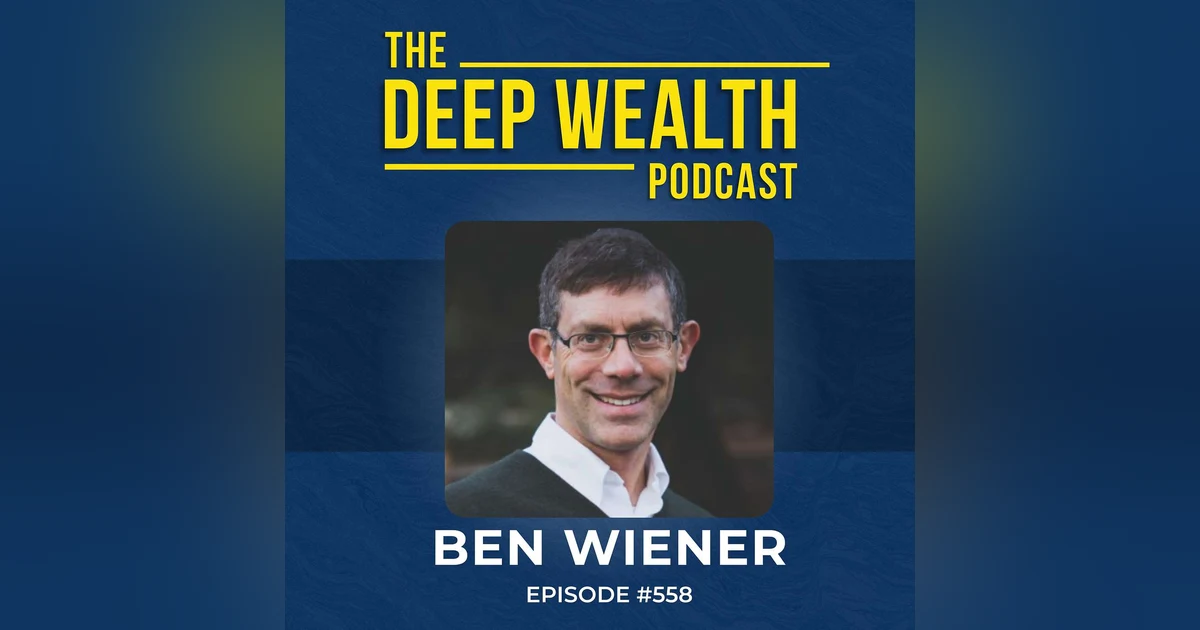

Send us Fan Mail “Reading is a superpower.”-Ben Wiener Exclusive Insights from This Week's Episodes VC Ben Wiener Reveals The Presentation Playbook That Wins Deals And Raises Capital Episode Highlights [00:06:00] Ben shares how 27 investor rejections forced him to rebuild his entire pitch [00:11:00] Why non-consensus but right is where real investor interest begins [00:18:00] The red flag mindset investors bring into most founder presentations [00:23:00] The dangerous balance between founder ...
 Apple Podcasts Apple Podcasts
  Spotify Spotify
  RSS Feed RSS Feed
  Amazon Music Amazon Music
  Podcast Addict Podcast Addict
  iHeartRadio iHeartRadio
  Castro Castro
  PlayerFM PlayerFM
  Podchaser Podchaser
  Overcast Overcast
  RadioPublic RadioPublic
  PocketCasts PocketCasts
  Audible Audible
  Pandora Pandora
  YouTube YouTube
 “Reading is a superpower.”-Ben Wiener
Exclusive Insights from This Week's Episodes
VC Ben Wiener Reveals The Presentation Playbook That Wins Deals And Raises Capital
Episode Highlights
[00:06:00] Ben shares how 27 investor rejections forced him to rebuild his entire pitch
[00:11:00] Why non-consensus but right is where real investor interest begins
[00:18:00] The red flag mindset investors bring into most founder presentations
[00:23:00] The dangerous balance between founder vision and self-deception
[00:31:00] Why most founders present their team the wrong way
[00:35:00] The pitch slide investors need before they hear your solution
[00:59:00] Ben reveals why reading became a career-changing founder superpower
Full show notes, transcript, and resources for this episode:
https://podcast.deepwealth.com/558
The Deep Wealth Podcast
Most entrepreneurs do not fail.
They just carry too much for too long.
The business grows. Pressure grows faster. Profits get harder to predict. Decisions cost more energy. Over time, focus slips and health takes the hit.
The Deep Wealth Podcast and Deep Wealth Mastery are built from real experience. We're the only system based on a 9-figure exit. This system exists because guessing gets expensive.
🧠 Deep Wealth Mastery
This is for you if you want to:
• Grow a profitable business without becoming the bottleneck
• Build real value so selling is optional, not forced
• Optimize your health before it limits your business and life
One proven roadmap for real decisions.
⭐ Explore Deep Wealth Mastery
https://iapdw.com/idm
🎧 Subscribe
https://iapdw.com/podcast
📘 Free eBook
https://iapdw.com/ebook
💬 Have a question you keep circling back to?
Leave a short voicemail
https://podcast.deepwealth.com/voicemail/
Built by entrepreneurs. For entrepreneurs.
Loved this Deep Wealth Podcast episode?
You built your business from nothing.
Now make it pay off big.
📱 Subscribe Now
As a bootstrapper, every move counts. Subscribe on your favorite platform for Jeffrey Feldberg’s 9-figure exit strategies. From your morning grind to late-night planning, get insights from founders who did it without investors. These tips could change your future.
Drop a Quick Review
Got 30 seconds? Leave a 5-star review. It helps us make better episodes and reach entrepreneurs like you, hustling without a safety net.
Don’t Lose Your Exit (And Your Financial Freedom)
You’ve poured everything into your business. A bad exit could cost you millions. Most deals fail, and even “successful” ones lose half their value. The 90-day Deep Wealth Mastery program teaches you to make your business run without you and boost profits so you capture the best deal instead of any deal.
What Others Say
“Deep Wealth Mastery is pure gold. I wish I’d had it before my exit,” says Stacey C. “The value I’ve gained dwarfs the investment,” adds Sanjay S. “It makes my business great to own and sell,” shares William S.
📘 Grab Free Tools
Check out client success stories for proof. Master the Deep Wealth Strategy Map to plan your exit. Or snag the eBook, From 7 to 9 Figures: The Exit Playbook, for a clear guide.
Click here to start your legacy-defining exit today.
558 Ben Wiener
Jeffrey Feldberg: [00:00:00] Most founders think the pitch is about the deck. Ben Wiener has spent years seeing what most founders miss. The real pitch begins long before the first slide and often breaks down in the places founders least expect. Ben is a managing partner of JumpSpeed Ventures, an early-stage venture capital fund focused on Jerusalem-founded startups.
Since 2014, he's invested in dozens of startups, often providing their very first capital, and has become a thoughtful voice on startup strategy, founder storytelling, and what makes investors lean in or quietly walk away. He's the author of Fever Pitch, a novel about Selling Your Vision, Raising Venture Capital, and Launching Your Startup, a business fable wrapped inside a startup thriller.
The book follows a founder whose pitch almost works, but almost is not enough when the money's running out and survival depends on hearing one word: yes.
What makes [00:01:00] Ben's work so compelling is how deeply he understands the founder's invisible battle. The pressure to sound certain when the future is uncertain. The need to sell a vision before the proof has fully arrived. The painful gap having a strong idea and making someone else believe in it enough to write a check.
This is a conversation about persuasion, rejection, belief, timing, and the quiet moments where founders either sharpen their story or lose the room.
And before we start the episode, a quick word from our sponsor, Deep Wealth and the Deep Wealth Mastery Program. Here's Bill, a graduate, who says, the Deep Wealth Mastery Program has transformed the KPIs we're using to accelerate growth and profits.
Or how about Emry, who says, and I love this, and I quote, the Deep Wealth Mastery Program helped me create the right mindset for both growing my business and later my future exit. I now know what questions to ask, what to do and what not to do, which is priceless. The team and I [00:02:00] have found dangerous skeletons and gaps that we're now addressing due to the Deep Wealth program. Today, our actions have a massive ROI.
Absolutely love that.
And now, speaking of growth and adding value, check out what Bruce says, and I quote, As a business owner, I'm always looking for new programs, systems, CEO peer groups, and strategies to improve my business. Hands down, the Deep Wealth Mastery program is the absolute best. I'm both growing my business and preparing for a future exit at the same time. It doesn't get any better.
And I gotta tell you, as I hear these testimonials, this is exactly why I do what I do. My mission, the team's mission here at Deep Wealth, is to literally change the social fabric of society, one business owner at a time and one liquidity event at a time.
The Deep Wealth Mastery program, it's the only one based on a nine figure deal. And that deal, that was my deal. You know my story. I said no to a seven figure offer. I created a system that we now call Deep Wealth Mastery [00:03:00] and that's exactly what helped myself and my business partners welcome from a different buyer, a different offer, a nine figure deal.
So if you're interested in growing your profits, preparing for a future liquidity event, Whether that's three years away or 33 years away, and if you want to optimize your post exit life, Deep Wealth Mastery is for you.
Please email success at deepwealth. com. Again, that's success, S U C C E S S at deepwealth. com.
We'll send you all the information about the Deep Wealth Mastery Program, otherwise known as the Scale for Ultimate Sales System. Better yet, why not hop on a complimentary strategy call? We'll see where you are at your business and what's standing between you and your financial independence and your dreams.
So that's where you want to be. You want to be with other successful business owners, entrepreneurs, and founders, just like you, who are looking to create market disruptions, whether you're a startup, whether you've been in business for three or four decades, whether you're manufacturing, whether you're a high tech, SaaS, low tech, whatever the case may be.
Come [00:04:00] on in and network with other business owners, with other businesses, just like you, because they all want to lock in their financial freedom and enjoy both success and fulfillment. Again, the 90 day Deep Wealth Mastery Program, it has your name on it. All you need to do is take the next step. Please send an email to success at deepwealth. com.
Deep Wealth Nation, welcome to another episode of the Deep Wealth Podcast. Deep Wealth Nation, let me ask you this: Are you looking to raise capital? Are you looking to have an exit a year from now or 50 years from now or somewhere in between? You're probably saying yes, and if you are, you're saying "Well, what do I do?
Where do I begin?" How would you like to have a view from the other side of the table, from an investor and from a buyer? And by the way, a little bit of a spoiler alert, are you a rock and roll fan, particularly a Rush rock and roll fan? If you are, in addition to all the other things, you're gonna have a lot of fun with this interview and listening in.
We have an incredible guest in the house of Deep Wealth. We have a fellow founder, also an investor in private equity, venture [00:05:00] capital, whatever you'd like to call it. He's all in one, but he's paying it forward. Also wrote an incredible, not just business book, but a novel, an actual story. Figure that all in one.
So that said, Ben, welcome to Deep Wealth Podcast. An absolute pleasure to have you with us. There's always a story behind the story. What's your story? What got you from where you were to where you are today?
Ben Wiener: So first of all, Jeffrey, thank you so much for having me on. I appreciate the invite. My story is long. 55, so I'm gonna spare you like, the beginning. I'll bring you forward to the moment of crisis that launched this part of my career.
So prior to the crisis, I was a highly educated, successful student. I got into Columbia Law School in New York. I became a corporate lawyer. I clerked on the Israeli Supreme Court for a year as a visiting clerk. I had all the trappings of somebody who was gonna be successful. And then when I went into my business career, everything fell apart.
No matter what I got into, every job was a dead-end job, and that persisted for about, I don't know, 16 years until I was [00:06:00] 43 and had very little clue about what I was gonna do next, and I kinda stumbled into a venture capital opportunity. I stumbled into an opportunity to invest locally in the city where I live in a startup community that I had spotted was reviving when a lot of people didn't see that coming yet.
So that was the opportunity where I was about 13 years ago, in a local community, seeing something that other people don't see. And my thesis was I need a little bit of money to capitalize on some of the early opportunities that I'm seeing. That that was the setup. The problem was that I just assumed...
I had never been a venture capitalist before. I'd never invested anybody's money before, but I assumed that my credibility, I'm an honest guy, I'm a straight talker, highly educated. I just assumed that some wealthy people would have mercy on me and give me some money, and I was 0 for 27 in my first investor pitches.
27 wealthy families, individuals turned me down, and about 26 or 27 was a friend of mine whose family's extremely [00:07:00] wealthy. I took him out for coffee, and he literally called like a basketball timeout during the meeting, stood up in the coffee shop, literally looked down at me over his glasses and said, "Ben, this is the stupidest pitch I've ever heard.
This will never work. You're a good guy. You have a wife. You have kids. we're not gonna give you money. Nobody's gonna give you money. Go get a job." And he stood up and walked out. Fast-forward to last year, I published a book that you see on the, the shelf, which you mentioned a novel, a full-length novel about a startup founder who can't pitch his startup to save his life until he actually needs to pitch his startup to save his life.
And the book is a fun teaching tool to teach this framework that I developed over the last 13 years, which I believe is the optimal framework for pitching your entrepreneurial idea. And that framework was born out of the crisis of me striking out over 27 in my initial pitch, going back to the drawing board and saying, "Okay, I still believe in this thing, but clearly I'm not presenting it correctly.
I'm presenting it the way [00:08:00] I wanna tell people, but I'm not presenting it the way their questions are forming in their head." And that forced me to not only redo the pitch and then successfully raise a little bit of capital from people, which turned out to be one of the most successful venture capital funds of its vintage, but also be able to coach the founders that I was investing in to optimize their pitches to have better success raising money from other investors down the line.
And it wasn't just based on... i'll go into how I developed the framework. It wasn't just based on my own, whatever brain matter is between these two ears, which is not enough. I spent probably more time than any human on the planet researching every aspect of business presentation way beyond business, like into sociology and mythology and psychology and movie writing and screenwriting and book writing, because I found that there were these narrative arcs that overlapped, and then I just translated that into startup speak to help [00:09:00] entrepreneurs, reframe their pitches.
So again, we're gonna talk about, this framework was born of my own experience of necessity, and then years and years of research, and then refinement, and then a book that became a number one Amazon bestseller, and then a lot of these fun presentations and podcasts and lectures teaching that framework to any entrepreneur that is interested in listening and using it.
Jeffrey Feldberg: And by the way, Deep Wealth Nation, just before we continue, go to the show notes. All the links, everything that we're talking about is there. It's a point and click. Buy the book. Buy the novel, Fever Pitch, a novel about selling your vision, raising venture capital, and launching your startup. And Deep Wealth Nation, even if you have no plans to raise capital or to sell your startup, you're trying to get new businesses, right?
You're trying to get new customers on board. Not much of a difference in terms of how you present yourselves. And so before we talk about Fever Pitch, let's go back, Ben, to something that you shared. "Hey, Jeffrey, I was failing miserably and then took a step back. I got some honest advice from a good [00:10:00] friend, a true friend, who didn't just give me platitudes, told me where it was really at, and I decided to do a deep dive."
Was there any one, two, or three things as an example that was a eureka moment of, "Wow, never really thought about it that way, but I'm gonna try this," that began to make the breakthrough for you?
Ben Wiener: Definitely. I think, while I do have a framework, I think every entrepreneur, every business leader has to be authentic. You need to have your personal style in your presentation. For me, what matched really well with my personality was also what was happening with the investors.
lots of different ways to explain this, but I would quote Howard Marks, the famous investor. He has a very famous four-quadrant matrix for, business opportunities, investment opportunities. And the four quadrants are consensus, non-consensus, wrong, and right. So what Howard Marks says is y-you wanna be doing something and certainly pitching something that turns out to be right.
If it's wrong, it doesn't matter whether it's consensus or non-consensus. If it's wrong, we're gonna lose. the insight is even if you're [00:11:00] right directionally as an entrepreneur, as a business leader, even if you're right about the future, if everybody already assumes that about the future, we're probably not gonna make a lot of money together because it's already baked into the future expectations of that market.
And you can think of all sorts of examples today with maybe AI or other things like that. So what that drives you to is trying to find things that are non-consensus, but where you believe that you're right. And if you find yourself in that quadrant, A, that could be amazing. Now, it could be terrible because 9 times out of 10 the market is right and you're gonna lose.
But if you are that one out of a 10 or, 5 out of 100 that are non-consensus but right, what I'm saying is you wanna embrace that and present that to the investors because the people that you're pitching, they are the market and they are the consensus. So if you come blazing at them trying to, convince them of something that they're not convinced of, their natural reaction is to push back.
But if you simply just throw down the gauntlet, it can be as simple as, "I know this might sound crazy, but..." Or, I know you're probably thinking, [00:12:00] are you kidding me? This is nuts. Just stay with me for five, 10 minutes and see if I can, change your mind." It's a very soothing thing for an investor to hear because They understand that you understand, empathy.
They understand that you understand what they're thinking and that you're in sync with them. They may not ultimately agree with what you're doing. You're not gonna get a yes every time, but at least you start off the pitch where the train is leaving the station and they're on the train with you.
If you start off the pitch and you're shooting off trying to talk to them about a world that they don't believe in, what happens is your pitch just shoots out like a train out of the station, and they're back on the platform. And you don't even realize that they're not... You're just waving your hands and yelling and screaming, and they're not with you because they have all these, questions.
So what the framework is about, what pitching is about, and everybody has their different style. we have our own framework to try to deal with that, is try to align early on with the investor and just signal what it is that you believe about the future, and put it out there for them to be [00:13:00] open-minded about listening to what you have to say, recognizing that they may be extremely skeptical from the beginning and call that out.
Say, "I know you may be skeptical about this," and that's a good thing. I guess another way of saying it is one of the worst pitches I hear as an investor is a pitch that starts off with, "Everybody knows that," or, "Everybody believes that." Entrepreneurs think that's great if they are pitching you on something that they believe everybody else already believes, 'cause that gives them credibility.
What I'm saying is an astute investor is looking for the thing that everybody doesn't believe yet, because that's futuristic, that's opportunistic. So e- people don't realize that, or you may, find this a little strange, but that gets me much more interested as an investor because now maybe this entrepreneur has a secret about the future that I'm gonna be, after the next 15, 20 minutes, privy to and maybe get to participate in.
It's just one example of inverting the pitch to start off with something that might be a little bit provocative or [00:14:00] controversial, recognizing that the person listening may not yet believe that, and say, "I understand you may not be there yet, but if you give me five, 10, 15 minutes of your time, I'd love to walk you through why I think...
And here are the facts. I'm gonna present you some facts and evidence that this thing could be true. So it's just one way of highlighting, I think, the answer to your question. There's lots of different ways to do it, but that's one example.
Jeffrey Feldberg: Ben, what I love about that, two things. Firstly, as you're talking about almost being that contrarian, you're taking me to, selfishly, the Deep Wealth 9-step Roadmap, actually step one, big picture, and this is where we're looking for that inflection point. It's still a whisper right now. It's happening, but it's not happening tomorrow.
It may not even be happening next year or beyond. Perhaps seven years ago or 10 years ago or five years ago, it was artificial intelligence. Back in the day in the Deep Wealth Mastery Program, we're talking about back in the day with Netflix, where this thing called the high-speed internet bandwidth was coming along, and eventually you'd be able to stream.
[00:15:00] And Netflix, it's so easy today to look at it, they were the contrarians of what? You're gonna be able to watch your movies in your house? Impossible. Never gonna happen. Let me tell you all the reasons why. But that also leads to your second point. You're taking me down memory lane. When we started the first company, Embanet, and then Embanet two, so Embanet one was, okay, how do we keep the seats filled for an e-learning company working with universities and colleges?
And then Embanet two, how do we fill the seats? Like you, Ben, you had 27 presentations. I'm exaggerating a little bit. We had 270, and we failed at all of them. And out of desperation near the end, I was with my business partner, Steve Alda, said, "You know what? We're gonna be speaking to these faculty.
They're grumpy. They're probably gonna say no anyways. I don't care. I'm just gonna tell them why this isn't gonna work." And we started by saying, "Let's address the elephant in the room. Here's what you're probably thinking. E-learning sucks. It can't possibly work. It's not legitimate." And we went down all of that.
The heads were nodding and everything else. And by the time that we were done, it was like a balloon had [00:16:00] deflated. All of that angst and energy was out, and now they were open to hearing what it was actually about, and we stumbled on that. It wasn't that we're so smart that we thought about that. It-- we just stepped into it.
But to your point, "Hey, you're probably gonna think it's crazy. May not even be right, but let me tell you about this. Let me hear what you think." So there's a lot to what you're saying. Why do you think that works so well? It's counterintuitive.
Ben Wiener: sales is empathy. What we're talking about is sales, It's just a specific type of sale where you're selling not an air conditioner or a car, you're selling the opportunity to partner in your business or something like that. So it's a sale, and sales done properly is about not trying to convince somebody to do something that they don't wanna do, but understanding...
this is ABCs of sales, is first, customer understanding or appreciation. Th- understanding what the customer actually is thinking or looking for, and then saying, "Hey, I may have the thing that you're looking for." And that's a much more beautiful, empathetic sale. So we're just doing the same thing here.
We're saying I wouldn't go [00:17:00] so far as to be absolute or say, "I know what you're thinking," or even, "You're probably thinking." I say, "You may be thinking." I'm guessing you might be thinking, that's a like, a respectful way of saying I'm inside your head. I'm where you are. I see you."
And I'm not trying to extract money from you that you don't want to give me. I'm trying to say, "I think that we possibly may both ultimately share a vision of this future. I would love for you to share this journey with me." And it's just a much more sincere, empathetic sell. And it feels good too.
Like you're not trying to squeeze money out of the rich investor. You're trying to say, "I've got something you want, which is business opportunity. You've got something I want, which is the capital I need. Your chocolate, my peanut butter let's go. If we both see the future the same way, we could be a great partnership."
I think that's a much more balanced, empathetic way of, selling things.
Jeffrey Feldberg: And Ben, you talk all about this in Fever Pitch, and we're gonna get there in just a moment, but I wanna talk now really as you as the investor, as someone who's looking across the table from the [00:18:00] founder. As we say here at Deep Wealth, the skill set to start a business are very different to grow a business, and that's very different than raising capital or even exiting the business.
They're all different skill sets. And when you're sitting across from a founder, every founder's gonna be different, I get that. But is there a Pareto's law, the good old 80/20 principle? Yeah, Jeffrey, you know what? 80% of the founders that I sit across the table from are making the same mistake. It's either A, B, or C.
I see this pattern. They don't even realize it. Is there a pattern? If there is, what is it, and what would you share with Deep Wealth Nation of what they should know that they probably don't know?
Ben Wiener: Yeah. there's one answer to that question. I think, you know, entrepreneurs come in all shapes and sizes, and they're like snowflakes. If you're asking me, is there a common denominator to a mistake that people make, I think it does relate to some of the stuff we were talking about.
Just misconception that if I or if another investor invites an entrepreneur to present to them, that's to-- that they're already inclined to believe them. [00:19:00] It's not true. I'm gonna invest in one out of 100 things that I see, and that's a pretty good rule for professional venture capitalists.
One to 100, that means 99 are either not even gonna get the meeting or nine out of 10 that get the meeting are gonna get a no. And it doesn't mean that I'm inclined, that I'm starting off the meeting thinking that I'm going to invest and then nine times out of 10 I change my mind. It means I think 10 out of 10 times I'm probably not going to invest, and I'm looking for the one that will lift its head up and convince me that this is the right one.
So there's a misconception, I think, a basic misconception when an investor invites an entrepreneur to present to them, that the investor is inclined to believe them or, Not be skeptical. It's other way around. The investor... The best way that this is described is in an, in a recent book called "The Venture Mindset" by two researchers that came out of Stanford, and they did a very deep academic dive into the mindset of venture capitalists and investors, and they call it the red flag mindset, [00:20:00] and it's sort of like a dirty little secret.
I think a lot of VCs or investors would get upset at the, at this description, but I think it's often true, which is when you hear a lot of pitches, what you're really trying to do is light up the red flags early, and if you get to like three or four strikes, you just go into sleep mode because you found enough reasons to say no, 'cause you know that nine times out of 10 it's gonna be no.
So the faster you can get there as an investor, the less brain cells you have to burn in a meeting. And again, this is not me speaking, this is the book, I tend to agree with it. And that's it's unfortunate. I feel bad for entrepreneurs that make a bunch of mistakes in the pitch because they're causing those red flags to light up in the investor's brain maybe earlier than they should.
But if that's the game, then the game as the entrepreneur is just to make sure that those red flags don't pop up. And like you said in the beginning, if there's an elephant in the room, then Don't leave that or sweep it under the rug. If you believe that most of the time investors are gonna have two or three or four major concerns, then don't let them linger in the back of the [00:21:00] brain of the investor while you're talking.
You gotta deal with them right up front, even if they're a little bit uncomfortable, and even if you have other things you wanna say. I think you wanna call them out early and say, " I know you're probably concerned about this or this and this. Either here's my initial answers to them, or I'm gonna get to those soon.
Stay with me." And even that just reduces, like it pops the balloon. It takes those red balloons that are inflating, I'm mixing a lot of metaphors, but those big red flag balloons you just hear the fss and the investor's like leaning forward because you're in their head.
you have empathy, you understand how they're thinking, and now they're gonna at least be giving you, as the entrepreneur, a little more latitude to try to explain to them or convince them what you have. So again, common theme is coming out of the gate, shooting out of the gate on the pitch.
Train leaves the station, investor's still back at the station, red flags popping up all over the place. Avoid that. Restructure the pitch so that you're dealing with the primary questions early, even if it means delaying [00:22:00] what you actually do which is very counterintuitive, but it's a huge ninja move.
Jeffrey Feldberg: Absolutely. It takes a strong person to be vulnerable. A lot of people think being vulnerable is weak. Actually, very strong person to do it. I would imagine if I'm sitting across the table from you, I'm vulnerable. "Hey, Ben, I don't know the answer to the question. I'll find out, though." Or you might be thinking to your wording earlier, it's not going to work.
And you might be right with that. Here's something to think about. And, And so going down that path, I found a lot of success with that Let me ask you though with Fever Pitch, because the main character, Mark Edmund, and he's a founder like so many here in Deep Wealth Nation, and he's racing to try and sell a future that doesn't yet fully exist.
And we've all been there as founders. And where do we draw the line, or do we draw the line of, okay, there's the vision part, there's a persuasion part, and potentially self-deception. And they can be so interlaced, [00:23:00] very difficult at times to stop drinking our own Kool-Aid and get the perspective from your side, the other side of the table.
What would you want us to know about that?
Ben Wiener: Yeah, a lot to unpack. There's a lot of complication there. I think everyone always talks about the reality distortion field of Steve Jobs. as an entrepreneur, you are... the short answer to your question is there has to be, like, a little bit of a split personality in a healthy way in the brain of a good entrepreneur.
And the split is half rooted in reality and half embracing a dream of a future that can't yet be proven but is based on a firm belief. And you wanna try to keep... those two things are at odds, they're in conflict, but yet they have to coexist. if you're, like, a square accountant and you've never taken any risks, I'm just making fun of accountants, but if you've never taken a- you're, you might not be a great entrepreneur.
If you're a crazy, dreamy, not rooted, dreamer, you're not gonna be able to run a business. So you have to fuse those two sides of a persona into the ideal brain of an entrepreneur and try to project that to the [00:24:00] investor. doing a tango. You're balancing between here's the facts, here's the reality on the ground, here's some evidence of what I'm talking about, and here's this dream of a future that I can't yet prove because it doesn't exist yet, but you can see the early steps of what I can do, what the team can do, what the market's doing, what my initial product beta is doing.
What- whatever it is that you're bringing to the table, you can see how if this continues, we could, be incredibly successful, make, a lot of money. So you're constantly balancing two things that are at odds, a dream and reality, and that's okay. That's healthy. That balance of conflict is totally...
Not only is it okay, that's actually what we're looking for. And so you just, as long as you can keep jumping back and forth between those things, you're fine. If you tip too far to one side or too far to the other- Then you get into trouble. But it's maintaining that balance, which is incredibly difficult, but incredibly rewarding if you can pull it off, that I think is the secret to the question that you're asking.
in the book, Mark is just too far to one side. In the beginning of the [00:25:00] book, we're setting him up for failure. He's just way too convinced that everyone's gonna see what the future is of what he's trying to do, and he doesn't understand that he needs to do a better job of explaining it.
Jeffrey Feldberg: And so to that point, it's a tough question to answer. You can't really answer it. I'm gonna ask it anyways to get that out there because it's the founder's dilemma. When we pick up on what we call that inflection point or that blind spot, so as an example, if I'm talking about a high-speed bandwidth this year I've already missed that particular opportunity.
If I talked about it back in the 1970s, okay, I'm onto something. It's way too early, and no amount of capital is going to sustain a company like that has to wait a quarter century for that to come around. And so how do we find that interplay to the best of our ability is, okay, I'm not too late. It's the Goldilocks.
I'm not too late, but I'm not that early either. It's just the right place where I'm [00:26:00] early enough with some patience, I can pounce on this and create a market disruption.
Ben Wiener: I think that's the answer. You have to be able to explain that. And every case is different. So whatever industry you're in, you wanna bring factual evidence, some factual evidence from something that you built in your lab or some other stuff that other companies are doing, or articles that have been in the newspaper or on the internet or whatever.
What- whatever you're using as a third party external evidence that the first couple steps... We need to go from A to Z, but we're not... But A, B, and C already exist, I need your money, or I need you to join with me so that we can start at D and get as, as quickly as possible, forward.
So yeah, every case is different, but yeah, y- you do wanna bring some evidence pretty early on in the pitch that the timing for this is right, that there's a why now that's implicit in the pitch, and you have to work in that evidence at the right place in the pitch. [00:27:00] It can move depending on what kind of industry it is.
There's not a specific place where you deal with that in the pitch in my framework, but it has to be in there somewhere pretty early on. Some sort of call-out to why this is not just the right thing for the future, but now is the right time, and we're the right people to pounce on this opportunity now.
Jeffrey Feldberg: And what's so interesting about that, then I can have the best strategy, the absolute best idea. If it's me as my personality or as a person, it's just not getting across the right way. You may say no, even though I may be right in every other way. And so again, it's a tough question to answer because every founder's different, every situation's different.
That said, is there a certain tell that you're looking for? So in other words, a founder sitting across the table, it's not what they're saying. Maybe it's what they're not saying. Maybe it's the body language. I loved at the beginning where you said, "Jeffrey, I looked at everything from storytelling to psychology to everything else in between."
What have you picked up and along the way as an [00:28:00] investor, have you noticed some things that, "Oh my goodness, Jeffrey did this or he didn't do that. Okay, red flag"?
Ben Wiener: I try not to read, i've fallen into that trap where I've read into body language too much. I'm not a, CIA interrogator where I have high confidence. No, and there are people who claim to be. I'm not one of those people. So I've invested in a range of founders that you'd find surprising, like older, younger, male, female really super articulate, struggle sometimes with words.
But what-- the common theme between them is that they all had clear insight and expertise into what they were doing. maybe not in the first 10 minutes. Sometimes I'll give them a pass on the first meeting if they can't explain it. But if I can't jog it out of them in the first, 20, 30 minutes, and they're still struggling to explain to me even after some questioning, what's wrong with the current situation in the market, why the alternatives are terrible, why their thing, if they can build it, is just whiz-bang crazy 10X order of magnitude better.
if they can't naturally explain that either maybe [00:29:00] with a little prompting but hopefully without prompting, then they're just not gonna be able to, sell this to investors, customers, down the line. And I believe this may sound harsh, but I believe that in the graveyard of failed startups, there is a small but not insignificant section of startups that you and I never heard of that could have really changed the world, that had really game-changing potential technologies or solutions, but the founder could not tell the story straight and therefore did not raise the money that he or she needed, or did not raise it from the right people, and the company failed, and we never heard about it.
And that's unfortunate. I wanna try to, prevent that. I wanna try to help solve that for that category of founders that could use help explaining what they do. Just a little more help, like a little bit of a framework. Like me. I didn't need to change my thesis. I was over 27 'cause I just-- I didn't change what I was trying to pitch.
I just changed the way I pitched it. It was the same idea. It was the same person. I just hit some points in my narrative earlier Rather than letting [00:30:00] them be understood. So we're trying to give those tools to founders to avoid those pitfalls as well.
Jeffrey Feldberg: And Deep Wealth Nation, Ben really means what he was saying offline before I pressed the record button. I was asking Ben what he is really looking for. He said, "Jeffrey, this has nothing to do with JumpSpeed Ventures." That's Ben's company. It's not about getting another client or growing the business. It's not even about the book itself, although I love the novel and, and the book.
I want to help other founders because when it comes to raising capital investments or even selling down the road- It's an art form, and you can't just wake up one day and say, "I'm gonna do it." And I've put together that formula. I'm putting my own words in there, Ben, and correct me if I'm off base with any of this, but I've put together a certain systematic way of doing this.
I want other founders to know what it is and what to do, what not to do, and that's what I really like about what you're bringing to the table is you're coming out there saying, "Hey, this is at least me, data point of one. As an investor, here's what I'm looking for, here's what I'm not looking for."
And Ben, speaking of that, [00:31:00] where are you on the founder's team in terms of, hey, this is a great founder, terrific idea.
They've got an inflection point early. Perhaps they don't have a team, or perhaps they have a team that not so sure about. How does that play in terms of I'm gonna write the check here or not?
Ben Wiener: The framework for pitching is a five-part framework, which conveniently I shoehorned into an acronym called HEART, the heart of the perfect pitch. The T, which is the fifth part of the framework, is the team, but specifically the traits and skills of the team.
So to answer your question, to jump all the way to, number five, to point number five in the framework, I believe that nine out of 10 founders, or maybe even 10 out of 10, present the team incorrectly to investors. And here's what the investor, I think, is really looking for. The investor wants to believe that the founding team...
Again, if we're talking about an early-stage startup, which is my world, but it could apply broadly to other business contexts. The partner, the investor, the person on the other side of the table wants to believe that this [00:32:00] team has the credibility and the ability to design, build, and sell this thing that they're claiming they're gonna bring into the world.
And those three things are three personas, the persona who's going to design it, the person who's gonna build it, and the person who's gonna sell it. Who's gonna be the seller is typically the hustler the leader of the usually what we would call the CEO. Now, a couple important nuances to what I just said.
These are three personas. They're not necessarily three people. I've invested in a single founder where she had all three of those personalities baked in. She was an expert in her field. She was incredibly articulate. She was able to design the product. of course, she needed money to build a whole team.
She wasn't gonna stay by herself, but she could run out of the gate and get going with a little bit of money without having other co-founders on the team. But typically, we see two or usually three, sometimes even four co-founders on the team because consciously or subconsciously, they've subdivided themselves into these roles of [00:33:00] product or design, technology, which build and sell, which is the storyteller, the leader, the one who's gonna be in front of investors, customers, manage the team, et cetera.
And one of the common ways to describe that is the Hacker, Hustler, Hipster model of personas. The hustler is the CEO, the hacker is the person who's gonna build it, and the hipster is the the persona who's got like the design product element to it.
And again, like I said, I think Steve Jobs was a hustler and a hipster, so he was two of those personas. Sometimes you have a founder who has all three personas. It doesn't have to be three people, but those three personas need to be in front of me in order for me to invest. And if the founder comes and says, " I'm the hustler.
I can design the product. I just need a technical co-founder, so give me some money and I'm gonna go find a technical founder," three strikes. I can't fund an entrepreneur who's on a journey that may [00:34:00] actually take six months, 12 months, may never find the right partner, and then we've blown our money on this bridge to nowhere.
Those three, roles need to be in front of us with sufficient capability to get the job done. So this is your... second part of your question is how good do they have to be? Do they all have to be A+? No. They have to have A+ passion and A+ commitment.
They could be B+ players, 'cause B+ could be good. If you have something amazing, B+ players could be good enough to get that over the hump and into the market. And then with time, we'll bring on a whole bunch of A+ players, into the company. I don't need to see the best people in the world. I just need to be the best people for this thing at this place at this time to get this off the ground into the market sufficiently to have it work.
Jeffrey Feldberg: Love that in terms of what you're sharing and how you're looking at that. And to circle back to the HEART framework, and if I got this right, memory serves, H, hypothesis; E, enormous stakes; A, alternatives; R, radically different solution; and T is the team. A bit of an unfair question. It's like asking you if you have children, what's your favorite [00:35:00] child?
But of the five, is there one that stands out for you more than the others?
Ben Wiener: We have think I do have an answer to that. I think the answer is yes. think the most provocative one in there is the A, alternatives terrible, in the-- right in the middle of the five-part framework. Because I can explain this in different ways, but I'll just give you one example.
In a typical startup pitch deck the competition slide is usually towards the back. It's usually slide nine or thirteen or fifteen in a 20-slide deck, which by the way is too long. And it's typically the same chart all the time with Google and Microsoft, and they have all these red X's, and then miraculously your startup has all these green checks because somehow, and it's all the features and functions.
it's a waste of time, and it doesn't work, and it's way, way too late. What we proved through my research, through surveying anonymous surveys of other VCs, is that one of the biggest red flags that goes off in an investor's mind when the entrepreneur's off to the races in their pitch, one of the reasons why the investor is [00:36:00] back at the station is this nagging question of, wait a second, even if I'm willing to believe this founder that there is some future opportunity, aren't there other people working on this now?
Isn't Google working on this now? What about OpenAI? What about Amazon? Didn't I read about three companies last week in TechCrunch that are doing...? the question of what the current alter- even if you're right, there's close to eight billion people on this planet. A lot of them are really smart.
I think I read about some people that are working on this, or I already know a bunch of companies that are working on this, or surely somebody's... Th-those-- That category of questions is so intense that it fogs the perception of the investor, and they lose attention while the entrepreneur is off to the races and is only gonna get to that competition slide much later, and by then the investor's tuned out.
So what we do is in the framework, which is very controversial, very provocative, but it's a ninja move and it works really well, is we start off with the H, hypothesis, which is our belief statement. Simon Sinek, Start with Why. Hi, I'm Ben. [00:37:00] I believe that the market for general matrix multiplication in compute is completely broken.
That, that's a statement that requires attention. I believe something about the future. You may not even know what I'm talking about, but at least now I know you know what I want you to get to believe by the time I'm done talking. I've set the course for what's driving me and what I want you to get to believe if you listen to me.
based on Simon Sinek, Golden Circle, one of the most famous TED Talks in the world. The book Start with Why. Can't stress it enough. It really works. Next is enormous stakes. If I'm right about this belief, there's a lot of money to be made or a lot of people to be helped, human life, dollars, whatever.
That's all in the first 20 seconds of the pitch, first slide. But then we get to alternatives grossly inadequate. This is the surprise because at this point, every investor expects you to jump right from problem to what? Solution. And e-even investors that we asked, ninety-five out of a hundred said, "Yeah, slide [00:38:00] one is the problem or the opportunity.
Clearly, slide two is the solution." And nobody said competition should be the second slide. But then we asked them a different question. We said, "Okay, scenario you're at South by Southwest, you jump into an Uber, somebody else jumps into the cab next to you. You realize you're sharing a cab with an entrepreneur, and she starts telling you about some problem that she's working on, and what's your next question?
Is your next question, 'Tell me about your solution'? Is your next question, 'Tell me about your team'? Or is your next question, 'What are the current ways that people are dealing with that, and why are those grossly inadequate?'" And the vast majority of investors said, "Yeah that's, the next question in our brain."
And what we said was, "Duh, that's the competition slide." But it's not a competition slide. It's something much broader. We actually, in our decks, remove the competition slide There's no competition slide. It's buried in an appendix because that's not what the investor wants to know right now.
What the investor wants to know right now is what do you believe? What's at stake? And the next question is, okay, but if that's really a [00:39:00] problem or I'm aware that's a problem, aren't there solutions today that are good enough? Because if there are solutions that are good enough, it may not be worth it to invest in something new, even if it's in-incrementally better because if the market's kinda happy, it's gonna be hard to overcome that.
So we need to nail a slide, new slide two, which is current solutions grossly inadequate, and it's just a survey of... It's way more than competition. It's all of the different ways that humans, computers, companies deal with this problem or opportunity that we just stated on slide one that we believe is a thing.
Here's all the different ways that the world is dealing with this today or in the near future, and why all of them suck. With some factual evidence, not just... A-and types of companies. Like category number one, this and this kind of company, they don't work because they have this yield rate. This and This and this approach doesn't work because it's too expensive.
The competition slide comes much, much later, and this is what the investor really wants to know. That's the A. And then finally, [00:40:00] the fourth of the five pieces is the radical game-changing solution. we sort of like Hamilton, wait for it. We're making the investor wait for it. And this is so unusual because so many pitches start right off with, " This is what we do, and this is how it works."
The investor has a bunch of preliminary red flag questions that they need to address before you get into what you're doing. What do you believe? What's at stake? What are the alternatives, and why are they terrible? Why do we even need something new? And then once we've set up that table, then we can come riding in with the hero on her white horse, which is our product, which is Here's our radical game-changing, paradigm-shifting order of magnitude better solution that's gonna 10X slay the dragon of the current terrible solutions and save the day for the market.
And then we deal with the team at the end. And all that can be done, took me even longer to say it than to pitch it. All of that can be done in three minutes, certainly in 20 minutes. But even in a three-minute, elevator pitch, you can get all those five things in [00:41:00] very succinctly and concisely and effectively, and that's the core, that's the heart of the perfect pitch.
Jeffrey Feldberg: And to me, what's intuitive as you're walking us through that, you're not telling me as a potential investor or potential customer, "This is why we're the best." Instead, you're letting me on my own conclusion, "Okay well, they gave me the hypothesis. Sounded ridiculous at the beginning, but okay, I stayed with it.
They showed me what the stakes are, what's gonna happen if the problem's not solved. It could be productivity or money or whatever. They showed me why what's going on, the status quo or the current options, grossly insufficient." You're letting me now connect the dots. Here's a very different kind of solution, and now I'm like, "Oh, eureka.
Yeah, I can see now based on what I've come to understand from the alternatives, what's at stake, the hypothesis, yeah, I can see why this makes sense." It's as though I came up with it, and it's no longer the not invented in my backyard. Hey, I invented this. I feel like I'm part of this process.
I get it, and it's coming from me, not from you. How am I [00:42:00] doing with that?
Ben Wiener: Pretty good. Like I said, it's all about empathy. you wanna be step by step with the investor, not shouting at them or arguing with them or jamming something down their throat. You ideally want them to be tangoing with you, and you're leading them through this logical sort of I can call it an argument, this logical case for why the world is broken or why there's an opportunity that's not being capitalized upon, which is not okay.
the villain in our hero's journey, our hero is the product, not us, the product, and the villain is the status quo. There's something about the status quo that is not okay. Either there's an opportunity that's not being capitalized upon, or ideally, there's a real problem in dollars and cents or human life or happiness that is broken, that is messed up.
And we want to get the investor somewhat, you know, politely and sincerely uncomfortable about that situation as quickly as possible. I want you to agree with me. This is not okay. And the current solutions are, not answering the call. [00:43:00] Our hero needs to come riding in on her white horse and answer that call, and we're building her in the lab.
And if you invest in us, we can bring this thing to market and save the day save the damsel in distress or whatever metaphor you wanna use. And these things are very real. The narrative arc that I'm saying is not a joke. This is the way... And it's not something that we made up recently.
This is something that is embedded in our DNA from when we were in the caves. And sociologists, this is what I was referencing about sociology and mythology. George Lucas, when he was writing the script to The Empire Strikes Back, and he was only upset that he didn't find the book when he wrote Star Wars, was sitting with Joseph Campbell's book, The Hero With a Thousand Faces, which is on my shelf, one of the most famous books about narrative structure.
Campbell was a sociologist. He was a professor of mythology and sociology. Why was a movie scriptwriter sitting with that book when he was writing a, an action movie about, a space opera? Because the stories are all the same. when I'm trying to sell you [00:44:00] on an air conditioner at Best Buy, and when George Lucas is trying to get you to watch his movie, it's the same narrative structure that goes back to the people that we followed in the caves when they were trying to convince us to move camp or chase the wooly mammoth or run away from the saber-toothed tiger.
We evolved to be attracted to stories that are real, that are truthful, and that are structured in a certain way, I'm just porting that into our little narrow slice of startup land and saying, "Here's the structure for entrepreneur pitching investor over the bonfire in the cave, in the Neanderthal cave."
The scenario is investor is listening to a pitch by entrepreneur. We're in our leopard skin, togas and we need to convince that investor to run with us, and it's the same narrative arc. So it's innovative in that it, it retranslates that narrative into, startup speak, but I can't claim that I invented this.
I'm just really here to translate stuff that was proven in [00:45:00] other areas and for some reason wasn't really translated into entrepreneurship speak.
Jeffrey Feldberg: Absolutely. And Ben, what's interesting when you go to the HEART framework, we're starting with H, hypothesis. It's a very subtle nuance, but it's an important one. We're not starting with the product, as you shared with us. It's not about the product, it's about the hypothesis. Yet how many of us, whether it be in the books that we're reading or in whatever educational program, okay, you're starting with a product.
Hey, not at all. Start with a hypothesis. Love what you're sharing about that. Similar to you, Ben, for Deep Wealth Mastery, when we were putting it together, we did a deep dive on psychology and the human condition. And similar to you, and we share this in the program itself, storytelling. It's baked into our DNA.
We love stories. The greatest story ever told, the Bible, and that's how we learn. And before it was a printed book, it was stories passed along. Science has shown that an effective storyteller has the audience, we're all [00:46:00] subconsciously, unconsciously, we're syncing up together. So whatever areas in the brain are lighting up in the storyteller, if you have a really good presenter with a terrific story The same area of the listener is lighting up, and that's why, let's go back to Rush, one of your favorite rock bands.
If we're watching Rush on stage, we're live in concert, maybe it's Geddy Lee, as you've alluded to, hey, this is someone that, yeah, I really like Geddy Lee and what he's doing. Whatever Geddy's doing, you're imagining yourself, and it's as though you're right up there next to him, or maybe you are Geddy on stage and it's just a- an amazing part of the human condition of how we sync up with one another and h- how we're doing that.
Very powerful with that. Since I brought up Rush at the beginning, and I just brought them up again, this is not just a one-off, and you're not just alluding to them. The book was really, in so many ways, paced around them, from the playlist to even the chapters. The chapter titles that you have are Rush songs.
So what's going on with then [00:47:00] yourself and Fever Pitch and Rush and their songs and the playlist and the chapter titles are the songs? So what's the story behind the story on that?
Ben Wiener: there's three answers. Number one, I guess I'm a little crazy. Number two willing to admit it. Number two I started working on the book just after Neil Peart, the legendary drummer and lyricist of Rush, passed away. And it's much more than just being into a rock band.
Neil was a very unique drummer. He was arguably the greatest drummer of all time, but he was a big reader, And he was the drummer who wrote all the lyrics to the songs, which is very unusual. It's very hard to find other cases of... The drummer's usually like, banging around on the drums, and it's usually the lead who's writing the lyrics.
Neil wrote all the lyrics, and the lyrics for these songs are very complex, and they're infused with a lot of literary references. There's a lot of hidden meanings. So I was thinking about, I'm writing this book, I'm listening to a lot of Rush 'cause Neil just died. Neil said over and over again, he loved to talk about how he wanted his art to not just be entertaining, he wanted to [00:48:00] inspire through the meaning of the lyrics and I'm thinking, okay, I'm writing this book as a piece of art that I want not just to people to enjoy, but to inspire them to, be better at pitching.
Wait, am I in my small way like Neil? Am I trying to do the same thing? And I'm listening to these songs, and then, okay, fine, but who cares? Like, I was gonna write it in the author's note like, I'm partly inspired by Rush. As I'm listening to the songs and outlining the book, I started to realize that some of the chapters could be titled according to Rush songs.
And then I'm realizing, wait, if I can get like half the chapters, what if I get every chapter titled, by a Rush song? Would they fit? And then one thing led to another and pretty soon all my chapter titles were Rush songs. And then the lead character, Mark Edmund, this is a very long answer to your question but there was a lot of depth to it.
I wanted to signal to the reader that Mark, even though he was, starting off in a bad place in the beginning of the book, I'm not... No spoilers. I mean, He starts off, he's in distress like from day one, he's a Harvard-educated scientist. I wanted to make it [00:49:00] clear that this guy was not one-dimensional, that he wasn't like...
This was not a cartoon story where everybody's like in their little box doing what they're supposed to do. Mark is a little weird, like he's a little unique. He's a scientist. He's a chemist trained in Harvard, but he's also a Rush fan. He's not a Rolling Stones fan. He's not a U2 fan. There's something about him.
Rush is a very divisive band. You either love Rush or you don't love Rush. And I wasn't trying to say Rush is amazing. I'm trying to say Mark thinks that Rush is amazing. He's a guy that even though his brain is off track, his approach is off track, there's something about him that gives us hope because he's willing to take a stand on something that is a maybe a little bit provocative and unpopular.
Rush is not the number one band except for people like us who love them. And so he's willing to like believe in something that may be a little bit non-consensus, so it's a little bit of an embedded clue from the first paragraph that this guy may have some hope. Even though he's screwed up and he's-- and things are gonna get really screwed up for him before they [00:50:00] possibly get better, we can still hold out hope for him because he believes in something that's a little bit, controversial and different.
And so that was all the different Rush thematics that were going on in the book, and there's a million other Easter eggs. It was really my homage to Neil. I felt that as a fan and getting into the lyrics, it had propelled me to be more interested in some reading and some inspiration that I might not have done.
So I wanted to pay it back, not just to the entrepreneurship community, but also to them in my own little tiny way of saying, "Hey, guys, thanks. You inspired me. I'm gonna use your story and your music to help inspire other people."
Jeffrey Feldberg: And if I'm not mistaken, chapter 17, "Losing It," he's at the lowest point in his life, or at least in the book. It's just a really dark, low point, and you have the "Losing It" song. It was just nice how you tied that together and speaking straight from the source and hearing it from you brings that much more life to it.
Was there one of the chapters that was your favorite chapter of the book, one that resonated with you more than the others?
Ben Wiener: It's like asking me which one of my kids are my favorite.
Jeffrey Feldberg: We already know it's [00:51:00] your daughter, so jury's out on
Ben Wiener: I think there's a lot of, you know, we can go way beyond... if you study writing the great writers will say, "Try to make every chapter your best chapter." If it just stands alone, and I really wanted to make every chapter by itself my favorite chapter.
I didn't wanna have one that was weaker and one that was stronger. I wanted every chapter to have conflict, to have tension, to have the story either moving forward or faking you out in some way. And I think that I accomplished that. I really wanted to have a smile on my face every time finished a chapter.
You know, What happens next and was there enough angst and tension and conflict, in the story? So there are definitely a few that had some zingers in there that were a lot of fun to write. But I tried to make each one stand... didn't wanna have it to be an uneven book. I wanted to have it an evenly exciting experience, like building, one on the other.
So I'm definitely dodging your question, but I tried, to do that.
Jeffrey Feldberg: That's a great answer, and I don't know if this pun, which is intended, is a [00:52:00] good one or a bad one. It's a novel novel in terms of fever pitch, how to present in business that's actually a novel. It's not your typical self-help book or business book, and the book itself is based on Rush songs, the rock band.
And Deep Wealth Nation, whether you're a rock and roll fan, a Rush fan or not, there's so much gold in there, and you've just put it all out there. It's a terrific read, a really interesting read that you combine the two. It's edutainment at its very best.
Ben Wiener: To be clear, like you said, you don't need to be a Rush fan to appreciate the book. And the proof was my primary editor had no clue, even to this day. I never told her what I was doing with the Rush references, she enjoyed the book, and she missed the entire Rush subtext in the book.
My second editor, as the book was getting to production, I was getting the markups from my second editor, and she was making little notes. Chapter one, she writes, "Huh, that's interesting. I think this is a Rush song." by chapter three, there's a note where she writes with a [00:53:00] smiley face, "I see what you're doing here."
The first editor completely missed it, so you don't have to get these references. I really didn't wanna make it where it would , get in the way enjoying the story. It's just an added bunch of Easter eggs and things if you appreciate them. But you don't have to appreciate Rush or even like the band to like the book.
And I'll further say, to further punch a hole in my pitch, again I'm here to be helpful to entrepreneurs, so I'm not here to sell the book. I would love for you to enjoy the book. The book is a lot of fun. It hit number one on Amazon. It was an amazing weekend when it hit number one.
But the proceeds go to charity. I've given away the framework for free. If you go to feverpitchbook.com, you can of course buy the book on Amazon or whatever, but if you scroll down on that page, there's a link that says, "Access the playbook for free." I published free interactive playbook just about the H-E-A-R-T framework.
So if all you want is, "Ben, leave me alone. I don't wanna read a book. Just give me the silver bullet. I wanna pitch my startup and get money," go to the playbook, use those slides. We give you the slides. We give you a lot of, education [00:54:00] around what to put in the slides. Totally free. Enjoy it.
Buy me a cup of coffee at the end if you like it. You don't need to buy the book, but of course I'd love for people to enjoy the book. It was a lot of fun to write, and a lot of people have enjoyed it.
Jeffrey Feldberg: And you said it so well, all kinds of Easter eggs in there. If you're not a Rush fan, you're not a rock and roll fan, okay, it doesn't really matter because it's gold in there. You've taken something that is maybe just out of sight for most founders, but you made it very much in sight and understandable.
And the fact that you've shared behind the scenes and yeah, Geoffrey, it's Rush and the songs and everything else makes it that much more fun, but
not a requirement. one of the other things about the book that makes it very special for me is if you notice on the cover, it has a foreword by Guy Kawasaki. For those of you that are in the startup world, Guy Kawasaki is a legend. And among other things he was the chief evangelist under Steve Jobs at Apple.
Ben Wiener: I did not know Guy Kawasaki when I, wrote the book, and I had no intention of him adding his name to it. The book Guy Kawasaki is very famous for, until my framework, Guy Kawasaki had the [00:55:00] leading framework called the 10/20/30 rule for pitching startups. It's very famous.
There's a big YouTube video on it. It became one of his calling cards. And in the book, the 10/20/30 rule of, pitching, which is 10 slides, no more than 20 minutes, no smaller than 30 point font on the slides. It's funny, but it's very seriously true. I always felt that wasn't enough.
I always felt there was something bugging me about that framework, that it wasn't comprehensive. It was like a starting point, but it wasn't the whole thing. So in the book, in Fever Pitch, I wrote The story around Mark finding Guy Kawasaki, and I mention him by name. He's told by a mentor to use the 10/20/30 rule.
It doesn't work. His life goes into chaos. I sent the manuscript to Guy Kawasaki, not knowing him, cold, and said, "Hey, I don't know if you're even gonna get this, but blah, blah, blah. I'm a serious guy. I wrote a book about startup pitching. It mentions your framework. It builds on it. If you're still reading this and not cursing me out, I would love for you to take a look at it and consider, giving it an endorsement."
And long story short, he wrote back, [00:56:00] said, "Oh my God, this is unbelievable. I love it. Here's the forward to your book." And he just wrote the forward to the book, which actually in a way like criticizes his framework, but builds upon it. It embraces it but builds upon it. And to me, I think that was like the cherry on the top of this process to get Guy, to put his name on it and write the forward and say, "Oh my God, this is historical." I wanna be in the movie version of this book when it goes to the screen. That was the real credibility booster for me that, that made the whole thing, kinda worthwhile.
Jeffrey Feldberg: And what's so fascinating about that story is you're eating what you're baking. Because, okay, he could have taken it any other way. It was a bit of a play off of what he was doing, but it's not quite right. No offense, Guy. This is just probably where it should be, and yet he responds back. He gives you his endorsement, which doesn't get any better.
And absolutely gotta love that. Ben, we are way over time here. We're about to go into wrap-up mode. I'd be remiss, though. I have another question lined up after this question, but here's a question within a [00:57:00] question. Is there a question, an important one for you, that you and I haven't covered yet that you want to get out to Deep Wealth Nation, or even a theme or a topic before we go into wrap-up mode, and I'll ask my last question?
Ben Wiener: I think you covered so many different aspects of this story, so I'm just appreciative for you giving me the time to promote the framework and try to be helpful to other people. I think there's lots of other advice and lots of other questions that are in and around the book.
I think that, the book, the primary theme is, the startup pitch framework, but it does touch on some other misconceptions on entrepreneurship journey is meant to be a little bit chaotic. That's okay. I think if you had to ask me to give like another piece of advice, I would say if you're an entrepreneur and you're struggling with, the rollercoaster that you're on that could be that you're on the right track.
Like just the track is very windy and goes up and down. I'm sorry, but it is. So don't freak out and just try to stay grounded and keep moving forward. That's definitely what happens to Mark in the book. Like it... I really wish anybody listening, that it doesn't get as crazy [00:58:00] As it gets for him, it's a little bit extreme, but we've all been through some version of that rollercoaster the way to success.
I would just wanna send a message of encouragement to founders. It's a tough path that you've chosen. It's not for everybody. And know that people like me are rooting for you to be successful.
Jeffrey Feldberg: Well said, and it's like that old saying, "If it was easy, everyone would do it," and it certainly isn't, and everyone is certainly not doing it. So that said, let's go into wrap-up mode here. This has been a lot of fun. The F word, we were talking about that offline, and it's a tradition here on the Deep Wealth Podcast.
It's my privilege and my honor, every guest I ask the same question. It's a fun question. Let me set this up for you. When you think of the movie Back to the Future, you have that magical DeLorean car that will take you to any point in time. So imagine now, it's the fun part, it's tomorrow morning. Ben, you look outside your window, not only is the DeLorean car curbside, the door is open, it's waiting for you to hop on in, which you do.
You're now gonna go to any point in your life. Ben as a young child, a teenager, [00:59:00] whatever point in time it would be, what would you tell your younger self in terms of life lessons or life wisdom, or, "Hey, Ben, do this, but don't do that"? What would it sound like?
Ben Wiener: would definitely go back to age six and say, "Don't lie to mom about breaking the vase and blame it on the cleaning lady," 'cause she unfortunately got fired still feel bad about that for the rest of my life. but I didn't know better. I was really little. I would say the one, thing like, dear 16-year-old me or dear 20-year-old me The one piece of advice that I really bark at young people about, a-and you don't have to be young but specifically young, I did not read. I did not appreciate the superpower granted to me by becoming a voracious reader. was always, intelligent. I could read.
I just didn't read as I was embarking on my career and raising my kids and trying to make a living, why read a lot? And when I became a venture capitalist, I started to read by necessity because I just felt I needed to like get smart fast. And the only way to do that was to borrow other people's wisdom.
And oh my God the transformation that occurred in me as I [01:00:00] started to read, initially just reading about investing and startups and technology, but then just becoming an addict and branching out into other kinds of reading. I now read... Okay, I'm a little bit extreme. I read between 50 and 100 books a year plus, blogs and podcasts and stuff.
I've become like a real junkie. You don't have to go that extreme, but minute for minute time spent it's part of my professional motion. It's not a hobby. It's part of my work. I consider it part of work. And if you're a marathon runner, you need to, run a couple times a week a lot, to be able to do those two or three or even one big race a year I might be making, five or six or 10 important decisions a year, but I'm preparing for those decisions by reading hundreds of hours.
And it could be things that are not directly related to the decisions. Reading is a superpower. sounds very old man, crotchety, whatever, but trust me, if you're listening to this, minute for minute, it's one of the greatest investments of your time. It [01:01:00] will change you as a, not just as a business person, but as a human.
I've heard this from other, highly active readers as well, the changes in their personalities go beyond intellectual. And I can explain it. We don't have time, and I've heard it from other people, opening your mind to important reading change a lot of other things in your life in ways that you would be surprised discover.
So if I had to go back, I would say I missed about 15, 20 years of potential reading time that I'm catching up on now. But if I would have been doing it consistently, I probably would be even further ahead of where I am now and better prepared for some of the challenges that I think encountered along the way.
Jeffrey Feldberg: So what I'm hearing you say is reading is a superpower, probably one of the most underrated superpowers, although I'd put sleep right up there. But reading is a superpower, and I hear you loud and clear. And more so than ever, I can get on my social media soapbox in a world and an age of 30-second clips, 60-second clips.
It's such a narrow [01:02:00] range, such a narrow point of view. When we read, it's so expansive. And to your point, Ben, I love biographies. In just a few hours, it's 50, 60, 80 years of someone's life or more that I'm now absorbing all the life lessons. So reading is a superpower. Absolutely love that. And for someone in Deep Wealth Nation, they have a question for you.
They want to share an insight or hear some of your insights, whatever it may be. Where would be the best place online to reach you?
Ben Wiener: continue to be on. The rest got So you can find me there, Ben Wiener at Jump Street Ventures, W-I-E-N-E-R. You can email me at ben at jumpspeed.vc. I can't always get to everything, but I'll try. But I'm not shy about giving out the email address and you can try me.
And again, a lot of the resources that we're talking about here, I've purposely invested time and effort to make available publicly. So again, go to feverpitchbook.com. Not just about the book, the playbook, the free framework is there. There's a framework creator page where you can actually keep [01:03:00] iterating on your H-E-A-R-T pitch and make it better and better.
A lot of resources there that are free. And I put them out there specifically to be helpful to entrepreneurs. So please feel free to use them and provide feedback, especially if they're helpful. I'd love to hear about it.
Jeffrey Feldberg: And Deep Wealth Nation, the great news is it doesn't get any easier. It's a point and click. Go to the show notes. It's all there for you. Ben, it's official. Congratulations. This is a wrap. As we love to say here at Deep Wealth, may you continue to thrive and prosper while you remain healthy and safe. Thank you so much
Ben Wiener: Thank you so much
Jeffrey Feldberg: So there you have it, Deep Wealth Nation.
What did you think?
So with all that said and as we wrap it up, I have another question for you.
Actually, it's more of a personal favor.
Did you find this episode helpful?
Have you found other episodes of the Deep Wealth Podcast empowering and a game changer for your journey?
And if you said yes, and I really hope you did, I have a small but really meaningful way that you can actually help us out and keep these episodes coming to you.
Are you ready for it?
The dramatic pause. I'll just wait a moment. Drumroll, please. Subscribe. Please subscribe to the [01:04:00] Deep Wealth podcast on your favorite podcast channel. When you subscribe to the Deep Wealth Podcast, you're saving yourself time. Every episode automatically comes to you, and I want you to know that we meticulously craft Every one of our episodes to have impactful strategies, stories, expert insights that are designed to help you grow your profits, increase the value of your business, and yes, even optimize your post exit life and your life right now, whatever you want that to look like.
And every time you subscribe and a fellow entrepreneur subscribe, it's a testament to how together, Yes, we are. We are changing the social fabric of society. One business owner at a time, one liquidity event at a time. So don't let the momentum stop here. Subscribe now on your favorite podcast channel.
You'll never miss an episode. You'll be the first to hear from the top industry leaders, the innovators, the disruptors that are really changing and shaping the business world, and maybe you're commuting, maybe you're at the gym, maybe you're taking a well deserved break that we spoke all about on this episode.
The Deep Wealth Podcast, it's your reliable [01:05:00] source for the next big idea that could literally revolutionize your business. So once again, please hit that subscribe button, stay connected, inspired, and ahead of the curve. And again, your next big breakthrough moment, it might just be one episode away. Maybe it was even this episode.
So all that said. Thank you so much for listening. And remember your wealth isn't just about the money in the bank. It's about the depth of your journey and the impact that you're creating. So let's continue this journey together. And from the bottom of my heart, thank you so much for listening to this episode.
And as we love to say here at Deep Wealth, may you continue to thrive and prosper while you remain healthy and safe.
Thank you so much.
God bless.

Author / Venture Capitalist
Most founders think the pitch is about the deck. Ben Wiener has spent years seeing what most founders miss: the real pitch begins long before the first slide and often breaks down in the places founders least expect.
Ben is the Managing Partner of Jumpspeed Ventures, an early-stage venture capital fund focused on Jerusalem-founded startups. Since 2014, he has invested in dozens of startups, often providing their very first capital, and has become a thoughtful voice on startup strategy, founder storytelling, and what makes investors lean in or quietly walk away.
He is also the author of Fever Pitch: A Novel About Selling Your Vision, Raising Venture Capital, and Launching Your Startup, a business fable wrapped inside a startup thriller. The book follows a founder whose pitch almost works, but almost is not enough when the money is running out and survival depends on hearing one word: yes.
What makes Ben’s work so compelling is how deeply he understands the founder’s invisible battle. The pressure to sound certain when the future is uncertain. The need to sell a vision before the proof has fully arrived. The painful gap between having a strong idea and making someone else believe in it enough to write a check.
This is a conversation about persuasion, rejection, belief, timing, and the quiet moments where founders either sharpen their story or lose the room.


