

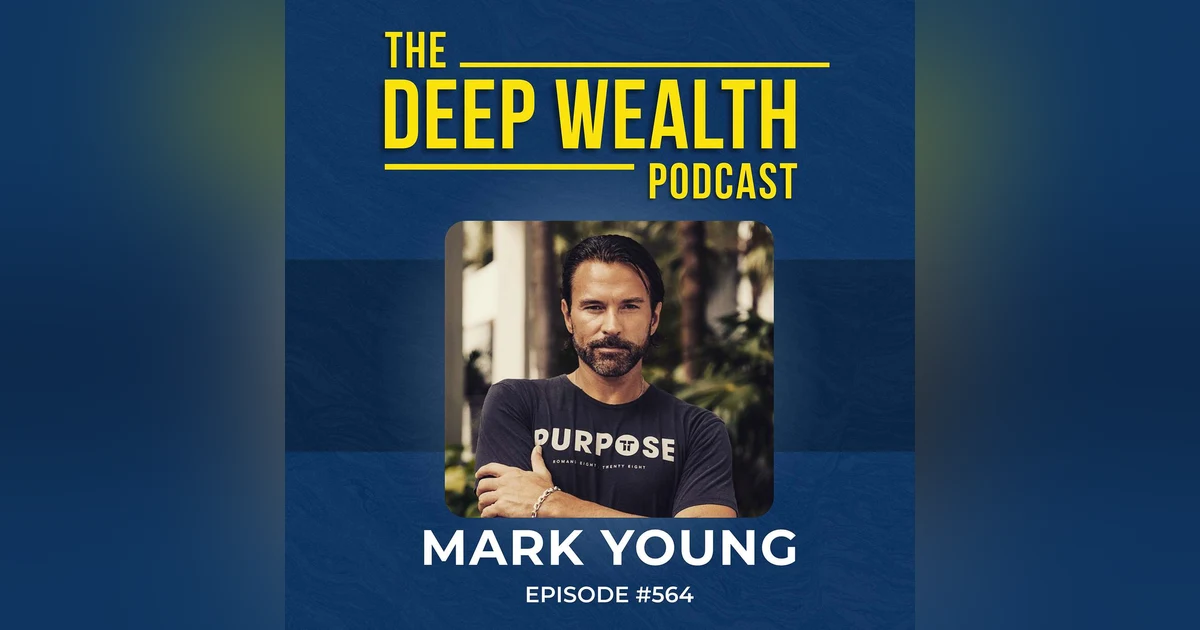
Serial Entrepreneur Mark Young Exposes The Costly Lie Founders Believe About AI (#564)

Send us Fan Mail “I wouldn’t change a thing in my journey, as I wouldn’t be where I am today.” -Mark Young Exclusive Insights from This Week's Episodes Founders fear AI will replace them, but Serial Entrepreneur Mark Young exposes the costlier threat: staying trapped in work AI should already own. Discover the 10/80/10 shift protecting growth, leadership, and relevance. Episode Highlights [00:06:00] Mark reveals how AI anxiety left him facing sleepless nights and fearing his agency had 12 mon...
 Apple Podcasts Apple Podcasts
  Spotify Spotify
  RSS Feed RSS Feed
  Amazon Music Amazon Music
  Podcast Addict Podcast Addict
  iHeartRadio iHeartRadio
  Castro Castro
  PlayerFM PlayerFM
  Podchaser Podchaser
  Overcast Overcast
  RadioPublic RadioPublic
  PocketCasts PocketCasts
  Audible Audible
  Pandora Pandora
  YouTube YouTube
 “I wouldn’t change a thing in my journey, as I wouldn’t be where I am today.” -Mark Young
Exclusive Insights from This Week's Episodes
Founders fear AI will replace them, but Serial Entrepreneur Mark Young exposes the costlier threat: staying trapped in work AI should already own. Discover the 10/80/10 shift protecting growth, leadership, and relevance.
Episode Highlights
[00:06:00] Mark reveals how AI anxiety left him facing sleepless nights and fearing his agency had 12 months left
[00:08:00] The decision that moved his agency from AI fear to the top tier of business adoption
[00:19:00] Why founders become vulnerable when marketing agencies control the language and the narrative
[00:23:00] The costly mistake of paying for cheap marketing twice and still owning the failure
[00:39:00] Why your business and health remain your responsibility when every expert walks away
[00:40:00] The 10/80/10 framework exposing why entire careers are becoming obsolete
[00:43:00] Why founders must stop doing work AI can handle and protect what only humans can do
Full show notes, transcript, and resources for this episode:
https://podcast.deepwealth.com/564
The Deep Wealth Podcast
Most entrepreneurs do not fail.
They just carry too much for too long.
The business grows. Pressure grows faster. Profits get harder to predict. Decisions cost more energy. Over time, focus slips and health takes the hit.
The Deep Wealth Podcast and Deep Wealth Mastery are built from real experience. We're the only system based on a 9-figure exit. This system exists because guessing gets expensive.
🧠 Deep Wealth Mastery
This is for you if you want to:
• Grow a profitable business without becoming the bottleneck
• Build real value so selling is optional, not forced
• Optimize your health before it limits your business and life
One proven roadmap for real decisions.
⭐ Explore Deep Wealth Mastery
https://iapdw.com/idm
🎧 Subscribe
https://iapdw.com/podcast
📘 Free eBook
https://iapdw.com/ebook
💬 Have a question you keep circling back to?
Leave a short voicemail
https://podcast.deepwealth.com/voicemail/
Built by entrepreneurs. For entrepreneurs.
Loved this Deep Wealth Podcast episode?
You built your business from nothing.
Now make it pay off big.
📱 Subscribe Now
As a bootstrapper, every move counts. Subscribe on your favorite platform for Jeffrey Feldberg’s 9-figure exit strategies. From your morning grind to late-night planning, get insights from founders who did it without investors. These tips could change your future.
Drop a Quick Review
Got 30 seconds? Leave a 5-star review. It helps us make better episodes and reach entrepreneurs like you, hustling without a safety net.
Don’t Lose Your Exit (And Your Financial Freedom)
You’ve poured everything into your business. A bad exit could cost you millions. Most deals fail, and even “successful” ones lose half their value. The 90-day Deep Wealth Mastery program teaches you to make your business run without you and boost profits so you capture the best deal instead of any deal.
What Others Say
“Deep Wealth Mastery is pure gold. I wish I’d had it before my exit,” says Stacey C. “The value I’ve gained dwarfs the investment,” adds Sanjay S. “It makes my business great to own and sell,” shares William S.
📘 Grab Free Tools
Check out client success stories for proof. Master the Deep Wealth Strategy Map to plan your exit. Or snag the eBook, From 7 to 9 Figures: The Exit Playbook, for a clear guide.
Click here to start your legacy-defining exit today.
564 Mark Young
[00:00:00]
Meet Mark Young
Jeffrey Feldberg: What if the real measure of success is not only what you build, but who you become while building it? Mark Young has lived the kind of life that refuses to fit into one category. He is a serial entrepreneur, educator, author, philanthropist, marketing strategist, doctor of functional medicine, health tech CEO, and host of Age Defiantly with Mark Young.
His work moves across business, branding, human behavior, longevity, faith, and personal transformation. Ryze Agency is where Mark helps companies sharpen their message, strengthen their brand, and turn marketing into something most businesses never fully master: a clear path to trust, action, and growth.
Mark doesn't look at marketing as decoration or noise. He sees it as psychology, trust, positioning, and connection.
It's that same thinking that runs through his five-part eCommerce Brand [00:01:00] Guide to the Galaxy Series, where he explores how eCommerce brands launch, create first impressions, build their universe, attract traffic, and recognize the clues success leaves behind.
Mark's also the CEO of Zona Health, where his work extends into cardiovascular optimization, blood pressure, longevity, and helping high performers age defiantly.
But what makes Mark's story compelling is the intersection. He understands how brands grow, how people make decisions, how health shapes performance, and how generosity can become more than an act.
In Radical Generosity, Mark challenges the scarcity ego and transactional thinking that often defines success, replacing them with a deeper question: What would change if generosity became your identity?
This is a conversation across business, marketing, health, faith, impact, and the courage to live with open hands while [00:02:00] still building something meaningful.
And before we hop into the podcast, a quick word from our sponsor, Deep Wealth and the Deep Wealth Mastery Program. We have William, a graduate of Deep Both Mastery, and he says, I didn't have the time for Deep Both Mastery, but I made the time and I'm glad I did.
What I learned goes far beyond any other executive program or coach I've ever experienced. Or how about Bruce? Bruce says, before Deep Wealth Mastery, the challenge I had with most business programs, coaches, or blogs was that they were one dimensional. Through Deep Wealth Mastery, I'm part of a richer community of other successful business owners.
The idea shared forever changed the trajectory of the business and best of all, the experience was fun. And we'll round things out with Stacey.
Stacey said, I wish I had access to the Deep Wealth Mastery before my liquidity event, as it would have been extremely helpful. Deep Wealth Mastery exceeded my expectations in terms of content and quality.
And you know what, my Deep Wealth Nation, why they're saying this is because Deep Wealth Mastery, it's the only system based on a nine figure deal. That was [00:03:00] my deal. And as you know, I said no to a seven figure offer, and I created a system that we now call Deep Wealth Mastery that helped myself and my business partners, welcome from a different buyer, a different offer, a nine figure exit.
So if you're interested in growing your profits, preparing for a future liquidity event, if that's two years away or 20 years away, and you want to optimize your post exit life, Deep Wealth Mastery is for you. Please email success at deepwealth. com. Again, that's success, S U C C E S S, at deepwealth. com. We'll send you all the information about Deep Wealth Mastery, otherwise known as Scale for Ultimate Sale. That's where you want to be. You want to be with other successful business owners, entrepreneurs, and founders just like you who are looking to create market disruptions.
And they want to lock in their financial freedom and have success and fulfillment.
That's the 90 day Deep Wealth Mastery Program. It has your name on it. All you need to do is take the next step. Send an email to success at deepwealth. com.
Podcast Welcome and Origin Story
Jeffrey Feldberg: Deep Wealth Nation, welcome to another episode of the Deep Wealth Podcast. Well, Deep Wealth Nation, we have [00:04:00] a very special guest in the House of Deep Wealth. We have a fellow entrepreneur, also a fellow biohacker, a fellow Mr. Success, a fellow everything. He is doing everything right. And if you're asking, "Okay, how do I take my health to the next level?
And while I'm at it, how do I take my business to the next level, especially in the area of marketing and get the message out there?" Maybe you're saying, "I'm the best-kept secret in the world, and also I want to take my health to make sure that I have a full, vibrant, healthy life, business, and legacy. Can I combine it all?"
And the answer is yes, you can. But you're asking, "Where do I begin? What do I do?" That's exactly what we're talking about today. So Mark, welcome to the Deep Wealth Podcast. An absolute pleasure to have you with us. There's always a story behind the story. What's your story? What got you from where you were to where you are today?
Mark Young: Oh, I wish I had a really nice linear explanation for you, Jeffrey, but I'm gonna tell you that there is nothing linear about my path. It is a fail forward story of always saying yes and figuring it out later.
Jeffrey Feldberg: Oh my goodness. Well, [00:05:00] looking back at that, any highlights that you care to share founder to founder with us? Anything that stands out for you?
Fail Forward Mindset
Mark Young: You know what I'll tell you, that one of the recommendations that I make to people on a regular basis is that success never looks like a win one time. It looks like a get back up. And as long as you get back up one more time than you got knocked down, that's a win. And I think every entrepreneur knows that.
If you've ever seen, there was a meme, and it, showed a, incredibly nonlinear line that was, like, up and down and up and down and up and down, and at the peaks it said, "I'm amazing. I can do this." And at the valleys of that graph it said, "This is horrible. I'm going bankrupt." And the beautiful part about it is, 'cause you looked at it and you're like, "Yeah, that's my journey."
And then at the bottom it was captioned, "A day in the life of an entrepreneur." And I had to laugh because I'm like, yeah, that, that kind of wraps it up. the one big thing comes in and you're on top of the world, and then something else happens and you're kicking yourself and that the cycle at the speed at which life hits you as an [00:06:00] entrepreneur it's immutable, and there isn't a day off.
And the truth of the matter is I think every entrepreneur has asked the what the hell am I doing question probably multiple times in a day, but certainly multiple times in a month or a year. And the truth of the matter is I think that's normal, and I think it's out of those moments that clarity comes.
And I think too many entrepreneurs try to tamp down that emotion rather than lean into it. And I will say some of my greatest successes have come when I just owned the crazy and leaned in.
AI Anxiety to Advantage
Mark Young: And I mean, I, I'm thinking of a situation right now that's very relevant, last year, about a year and a half ago, I would say, like with the emergence of AI technology, particularly being a person who works in the marketing space, I own an advertising agency.
And in full disclosure, about a year and a half ago I started going through an emotional meltdown, and all of this, AI stuff coming out, and I didn't know too much about it. I don't think most people knew anything about [00:07:00] it. And I literally got to the point that I'm like, "I am just shutting down."
"This is not cool. I've got 12 months probably to find a job." And I went through everything. Like it was sleepless nights, it was an, "Oh my God, the world is changing. What am I gonna do?" And as I continued to lean into this it was probably a couple of weeks of anxiety, to be honest with you.
But during those weeks was probably, I had done more research than imaginable. Because an entrepreneur also knows that entrepreneurs by their very nature find problems and solve them. That's why they're successful entrepreneurs. And I found a problem, and I've solved it. So that immediately started a journey for me to learn everything I could about how AI was impacting business.
That leaned for me into the area of doing everything I can to fireproof myself against that. And then I went to [00:08:00] work and made everybody think I was insane because I walked in the door one day and I said, "Look, like we are not going to fall behind. We are going to lead. We are not going to stand in the wake of what technology is bringing.
We're going to cause the wake." And I put some of my sharpest people in a room, and we literally had a weekly scheduled meeting, and every week we sat in the room and I'm like, "What did we learn? What can we do? what is the difference?" And it was a nonstop honestly beat my head against a wall because it was frustrating 'cause nobody got it. I didn't get it. Nobody got it. And then it's like I knew what I wanted, but I had to get them there. i'll fast-forward and tell you, Jeffrey, that today We are probably amongst the top 5% of businesses that are leaning into AI to the point that I'm consulting with other businesses and agencies on how to move themselves in that direction.
Because it is a fraction of a percentage of businesses that have actually learned how to use AI properly, and that doesn't [00:09:00] mean I asked ChatGPT some questions. That doesn't mean that we automated a process. It is leaning into the intelligence and collaboration tools that are now available to us, and our agency is growing at exponential rates, and we're getting exponential outcomes for clients simply because we're leaning into intelligence.
We're leaning into innovation. And I say all of that to say a year and a half ago, it had me practically fighting to get out of bed, worrying about where the future held. And I think maybe not in that exact instance, but I think that feeling can resonate with a lot of people who felt like at some point they were on the brink of destruction only to come out greater than before.
Jeffrey Feldberg: So let's talk about that, and I wanna talk about AI, but let's make this multidimensional. You're a smart guy, and I know you can take all this on and then some with what you're doing because you're not just a founder, you're also into health. You have a PhD in functional medicine and health companies.
And [00:10:00] so with that in mind, if we can, when we're talking about as an example, okay, so what is going on with AI and what are you doing or what did you find that most business owners are missing that's helping you leverage your business, take it to the next level? But intertwined with that, perhaps as you're sharing that with us, is, let's face it, as founders, and I'll put myself under the microscope, the more I learn about health, the more I realize I know nothing, and I thought I knew something.
And as founders we're notorious for burning the candle at both ends, as the saying goes, or the founder saying, "Okay, yeah, there's sleep, but it's for when we're no longer here." All those things that are terrible for health. So as you go along, it'd be great if you can share behind the scenes, "Okay, yeah, Jeffrey, I went like crazy in this area here.
Here's the results. Here's what you really should know about AI. And oh, by the way, here's what was going on behind the scenes with my health of here's what was happening, here's how I dealt with it," because it's never just standing still. Our health is always, our systems our body's amazing. It's always responding to different kinda stressors and [00:11:00] environments, so would love to intertwine that with what's going on with you and your journey.
So with AI, what could you share with us? What are we missing? What aren't we hearing when it comes to artificial intelligence and ourselves and marketing and business that you're able to uncover with you and your team?
Mark Young: Yeah. So many things to, comment on there.
Systems Thinking in Health
Mark Young: The first one is I will say you mentioned functional medicine, which is different than what most people understand medicine as being, and that is my time is spent in, again, functional medicine. And to many people they know the words, holistic, they know those types of things.
What functional medicine focuses on is root source and origin. And I wanna make the distinction or maybe the comparison that functional medicine to me is like running a business. my body is an ecosystem, and when something goes wrong, I need to go figure out what the ecosystem is doing and where the aggressor is.
In much the same way that if I had a problem in my human resource department, I wouldn't fire the [00:12:00] sales team. And yet we have the same problem with our bodies, right? Like for instance I have a cancer in my body, so I'm going to put chemotherapy everywhere, and my answer is, oh my God, if I found mice in the kitchen, I wouldn't go poison all the food.
And yet that's kind of the way I believe that Western medicine approaches things. And in, in the same respect, if I had one misbehaving employee in my company, I wouldn't punish the whole team. I would eradicate the one person that was causing the issue. But it would first mean I'd have to figure out the source and origin of that.
So functional medicine to me is much like running a business. It is systems-based, and business is nothing but systems. Health is systems-based, and arguably AI is systems-based. And when we approach problems with very logical mind frames or paradigms, and we think of it in those terms, AI has turned our entire ability to view systems [00:13:00] into an exponential equation.
And that is... I'll give you an example.
Health AI Case Study
Mark Young: I had someone that I've been consulting with on a health crisis, and he I'll get into another thing in a moment, but he uploaded 175 medical records and tests and every, and scans, and you name it, into a platform that I wanna talk to you about. But he uploaded all of this stuff, and I thought, "My goodness what doctor can possibly ingest 175 scans, tests, lab reports a- and have a clear picture?"
Like I'm a smart guy, I am nowhere near that smart. And the beauty of it is I work with a company- And am part of the launch team for the most sophisticated health AI platform, and this is where all these worlds collide for me. The company is, called Rooted IQ, and it's not currently available on the market.
It's in final stages before [00:14:00] launch, probably 90 days from the date of this recording. So we're actually targeting probably in August or September 1st launch date. But there is a prototype available, so some of us are using the prototype. There are practitioners that are using the prototype. But it takes all of that health information, which includes and I'm gonna say holistic again, because it's not just lab reports, it's genetic testing, it's environmental factors, it is past traumas, it's psychological issues.
It is everything that you can imagine that makes up the story of you and is able to put those into a 360, and I will say through a lens that only an intelligence like an AI is able to synthesize. So this platform was able... This is the gentleman that I'm referring to actually has a glioblastoma which is a brain tumor for people who may not know that, and has ended up moving out of [00:15:00] a state of cancerous or diagnosis, went into a recovery stage, and now has recently been re-diagnosed.
And he's 47 years old absolutely struggling, wife, small kids, so on and so forth. Terrible story. But we were able to look, and through this upload and our chief medical officer, we ended up taking a look very three-dimensionally into his profile and using a platform that, again, only AI can provide that type of insight.
We're able to take what other doctors were saying, "This is terminal." There's a trial, a clinical trial you may consider, but other than that, pack your things. And Dr. Ahmed came back and he's "Why do they keep saying this is terminal? This isn't terminal." And it was able to connect the dots and say, "Well, wait, let me look at this."
First of all, there's a chemotherapy that was working, but another doctor took him off of it, put him on three other types of [00:16:00] chemotherapy, but never paid attention to the type of cancer he had, was very responsive to these types of chemotherapy. The problem is that type of cancer, while responsive, those chemos can't cross the blood-brain barrier, which means where his cancer was located.
What you did was you ended up poisoning the entire body and never touched the cancer because it was protected behind the blood-brain barrier, which means the tumor continued to grow while the chemo weakened the immune system And we're like, wow! Imagine that kind of intelligence that's able to pull all of that together and then finding out that, well, there's another issue.
We've got anxiety immune suppression all taking place because his genetic makeup is such that he's actually prone to anxiety, or his genetic makeup, for instance, is prone to be able to deal with glucose intolerance, and this particular type of cancer is entirely glucose-dependent, [00:17:00] which means ketogenic dieting and so on.
I say all of that not to get into a medical report, but to say AI can take the things that were formerly potentially much more complicated. Like a physician who even could ingest 175 different medical reports clearly doesn't have the time to do so.
Jeffrey Feldberg: Yeah. Yeah it's amazing, and I love with what you're sharing there because with AI, something that we could never do before, and if you're a biohacker out there, you can relate to this, the, quote-unquote, "establishment" beforehand, "Jeffrey, you're just a data point of one. This means nothing. I can't help you because you're unique," and that's all fine and good, but we gotta go where the numbers are and where the studies are.
AI is taking that and decimating it because we're all really a data point of one.
Mark Young: Everything is individualized.
Jeffrey Feldberg: unique. I love with what you're sharing of how AI, and it's about systems, how marketing, it's about systems, and health, it's all about systems. And so there's a [00:18:00] theme with you in terms of how you're looking at the world and what you're doing with that.
And so when we take the AI and systems you shared on the health side... And by the way, Deep Wealth Nation, go to the show notes. Everything is there in the show notes. I don't think we're gonna have time to go over all the things that Mark is doing, but you'll have all the links. You'll learn about his company.
He's got this incredible health device. Zona Health is the company, and you can be sitting at your desk, you can be on a call, you can have this wonderful device. Actually, Mark, truth be told, I've had that device for years. I have one of the earlier versions when it first came out. You can do some incredible things with it.
You can be in a meeting and you're testing your isometric hand grip, some fancy words of just how strong is your grip on things because all kinds of studies are showing what that can do for lifespan and blood pressure, all those other types of things.
Marketing Agency Truths
Jeffrey Feldberg: But let's go back founder to founder now for Deep Wealth Nation.
So you found this thread in AI that's helping you on the functional medicine side with your companies and what you're doing on the health side get to the next level. I gotta tell you, Mark, when I'm speaking to other founders, probably the biggest pain point for them [00:19:00] is your world, the marketing world.
And I'm not pointing at you now when I say this. Where so many founders are saying, "Jeffrey, this is, I lost count of the umpteenth agency that I've brought on board. I've fired all the other ones. Came on, great promises, so much hope. I wrote the check. I've got nothing to show for it." So what's been going on out there?
Because I know for founders saying, "Jeffrey, I'm the best-kept secret. Help me change that. Let me get out there, but I don't know what to do, and apparently neither do these agencies either." So what's going on out there in terms of why are they seeing what they're seeing, and what are some of your insights of what you're doing?
Mark Young: I'll actually tell you something here, Jeffrey, and that is, first of all, the marketing world is moving at such an exponential rate right now, partially because of AI, but partially 'cause it always has. one of the mystic secrets that exists out there is that marketing people are a special breed of people, and founders have this...
they've got an intuition about their brand. The problem is they don't speak the language, and when they get into a room with professionals, they [00:20:00] get mixed up and, honestly, I'll say intimidated because of the acronyms and everything. My CAC is low, my ROAS is high my LTV is off, and it's throwing off my MER.
all these things get thrown around, and a founder has an option in that moment, either to just nod and move along, and these people sound like they know what they're talking about, or to admit that they have no idea what they're talking about, which, I'm going to say puts them in a very vulnerable position at that point.
Because if you're the person who gets to tell me what the words mean, then I'm now the authority that gets to tell you everything else in this conversation. Because if I get to write the dictionary, then I get to build the entire story. And I think what happens with companies is they hire marketing agencies.
These agencies don't tell them normal stories. They tell them only the highlight reels. And the reality is that sometimes it's the owner is doing something wrong. Sometimes it's a marketing agency that is so [00:21:00] excited about the revenue that they don't pay attention to that it's a terrible product.
I can't out-market you, and I... My first book that I wrote was called Date Your Clients and the entire book was really talking about how the business and dating world isn't that dissimilar. And that is, we as an agency are the dating service. I can get you as many first dates as you need with potential customers.
Second dates are on you. The marketing doesn't get a second date. That's all about the first experience that they had with that product. most recently, I would say within the last month or two we haven't done much promotion around it 'cause I'm still waiting for the audiobook to get edited.
I actually wrote a series of five books called The E-Commerce Brand Guide to the Galaxy, and those five books are... I say that they're intended to make a brand owner dangerous because I don't want a brand owner who doesn't know what to do in a conversation with a marketing agency. I want them to be able to hold marketing agencies accountable.
I want them to understand what the reports [00:22:00] mean. I want them to understand when it's time to scale, when it's time to pull back because often when a brand owner is helping to make those decisions, and ultimately it is their decision, it's typically fear-based, and what happens if... And the client meeting that I had this morning as an example, I've never seen numbers like we're performing for this client before.
Of any client on my roster, I wish everybody had this trajectory, and he's talking about moving into national television to drive an ad campaign. And as we're talking about moving into national TV, he's "Well, the stakes are higher. The money is higher. We can't get it wrong. We don't have that much cash that a mistake can happen."
And I'm listening to him, and I get it. He's a very successful man. He's got a very successful brand. But it was still a fear-based question, and I think what most marketing agencies don't pay attention to is the human signing the checks and that's where I spend my time. My team can execute.
My job is spending time with the human on the other end because especially [00:23:00] when you're dealing with entrepreneurs and founders, I don't take it lightly that this is their life savings that went into this business. This is their family's legacy on the line. And I think too many people play risks with it, and I know, this one costs $10,000, so I'll hire a $5,000 place, and if I get it wrong, I can still afford to hire another $5,000 place, right?
And the reality is you got what you paid for twice. And unfortunately, be honest, the failure is more the brand owner than it is on the marketing agency. And I'll make this comparison and say, if your doctor makes a mistake, your health is ultimately your price to pay.
But why do we go into a doctor's office and just believe anything that he or she says? And it's because that person has extra letters, and that person is the authority, and businesses do the same thing with marketing agencies.
Jeffrey Feldberg: interesting. We seem to outsource our health or because there's someone with a white coat and [00:24:00] no deference to doctors. They're doing the best
Mark Young: No, none at all
Jeffrey Feldberg: But Mark, as you're sharing this, what's interesting, and again, Deep Wealth Nation, please go to the show notes.
All the links are there.
Radical Generosity Framework
Jeffrey Feldberg: What's bringing me back actually to one of your more recent books, Radical Generosity: Living a Life Defined by Impact, because you're talking about with this one particular client of yours and so many founders, even myself, Mark, there's days where I have that scarcity or the identity crisis.
And I love the theme that you're talking about in the book because it's really you that you're now taking across all the different themes that we're talking about, where you're generous of giving, and you're giving not necessarily expecting something back in return. That's really what it's all supposed to be.
Go the extra mile above and beyond. Give, but do it without expecting anything back. So when it comes to founders and the narratives that we're telling ourselves or what we should be or want to be telling ourselves, but we don't know what that is, what's [00:25:00] going on with us with the myth of scarcity, as you talk about it in chapter three o- of your book?
What would you want us to know that to begin to give us the questions that... We have the answers. We just don't have the questions. You've got the questions. You've already done the work. You're living it yourself. So as you're going through all of this, when it comes to radical generosity and how we're looking at the world and how we're giving of ourselves, what would you want us to know?
Mark Young: I love Radical Generosity. That was a book that I published over a year ago, and I will say that I've-- my other books are all business-focused. They're all, focused on, on relationships and bottom line in business. Radical Generosity to me was my heartbeat very personal to write that. And the idea that I want to weave in with Radical Generosity is a former mentor of mine always used the phrase that impact is the currency of success.
And the same way that we say muscle is the currency of longevity, right? That the truth of the matter is that the impact that you're able to have on the world [00:26:00] around you is how we should be measuring success. It's not based on money. It's not based on kindness. It's based on impact. And I personally look at it that I love money.
Don't get me wrong. I don't worship money. But I also understand that the more money I have, the greater impact I can have on the world. And it's why I don't take it lightly when I'm working with people who, again, are entrepreneurs. They've put their life savings into their business, and they're trying to get this moving.
I get to have an impact on them for generations to come, that this is legacy building for them. In Radical Generosity, one of the things that, that I really-- probably the most impactful section of the book is talking about how generosity is not about money And that becomes probably the main sticking point for most people, is that when we use the word generosity, we immediately go to a financial contribution of some sort.
And the reality is that I don't believe that's the most impactful type of generosity. I think I outline five different types of generosity, and one [00:27:00] of them, of course, is financial, 'cause everybody has the ability to give financially something. But actually I believe that time is one of the greatest things because that is the great equalizer, that nobody has more time in a day than another person.
We all get the same 24 hours, but how much of that are we contributing to the lives of others worth, versus making our own lives better? And then go from our own families to the people around us, to our communities, to our nation, to our world that ripple effect moves on. People like you and me have a different type of responsibility, and I would arguably say this is why you do what you do here, is the generosity of wisdom.
And that is we've been places and done things that a lot of people haven't. Sometimes those people are younger than us, sometimes they aren't. Arguably, usually younger. But we have the ability to share wisdom, and I would say that there is this negative belief in our world that if I give away my, wisdom, I've decreased my value somehow because now more than one [00:28:00] person has my secrets.
And I argue that's not true at all because there is no degradation of my value by g- adding value to you also. Now we're both more valuable because you've gained wisdom and I've gained relationship. And then the fourth one that I highlight through there is the currency of presence.
And in a cellphone, TikTok, instant notification world just being present in a moment, like sitting here talking to you on a podcast and ignoring incoming emails and ignoring chatter in the hallway and ignoring my phone alerts, that's a generosity. That is an, unrestricted time.
And I say, when is the last time you've gone to dinner with a spouse or a friend or a family member and left the phone in the car?" And I don't mean just leave it in your pocket or put it in your purse or turn it face down on the table, but left it in the car. And for most people, just the thought of that builds anxiety.
And then the last thing that I highlight in there is the idea that we also need to be generous with ourselves. That [00:29:00] especially as entrepreneurs, as business owners, as health advocates we tend to, I call it the Schindler's List, that, the idea that there's always something we could be doing.
if you remember the movie Schindler's List, he says at the end like, "This watch could've bought two more people, and this ring could've bought one more person." And Sometimes I tell people to just take their Selah take their moment, actually have a rest moment, take care of yourself, because we can only give out of cups overflowing in particular as it relates to our health.
And as entrepreneurs, our health tends to be something that gets neglected because it's more hours in the office, it's higher anxiety, as you alluded to earlier, it's less sleep. It's that life hygiene takes a real hit when business amps up. And my encouragement, and my team knows this, 6:15, I'm leaving.
Some nights I stay late when duty calls, but 6:15, 6:30, I'm leaving the office, I'm going to the gym, and when I'm done at the gym, [00:30:00] I will log back online if there's anything pressing. But there's nothing more pressing than making sure that my health is intact, because I can't come back tomorrow and do it again without that.
Jeffrey Feldberg: Yeah. Yeah. Yeah, it's a terrific attitude, and not just an attitude, it's a way of life.
Radical Generosity Defined
Jeffrey Feldberg: And I wanna go back actually to the very first chapter in your book. I stopped and I reread this a couple times. I'm gonna quote verbatim for this right at the beginning of chapter one, and you gave a number of different quotes about, well, what really is radical generosity?
Because we've heard of all kinds of different things, but you're talking about Thomas Aquinas, and he said, "Aquinas argued that generosity was not simply a matter of giving, but a reflection of our participation in God's own nature. To give generously," he said, and this is the part here, "is to imitate God Himself, who makes His sun rise on the evil and on the good, and sends rain on the just and on the unjust," Matthew 5:45.
And people think, you know, whether you're into scripture or not into scripture, if you're not into scripture, just have some imagination with us, give the benefit of the [00:31:00] doubt, and just follow along with that. To me, as a founder, that gets to the core of what it is to the founder, that I can take literally my God-given gifts to the world.
And sure, the money's nice and that's all fine and good, but it's gotta be bigger than the money. Painful problems. As a founder, what are some painful problems that I can solve to make people's lives better? Take their pain away, regardless of my location or the industry. That to me, that's what being an entrepreneur, being a founder is all about.
And Mark, my goodness, you've done that in so many different ways through your podcast, through your books, through your many, many companies. The ones that you have now, the ones that we don't even know about that are down the road that you're gonna be putting out there. So I'm getting a sense of where that's coming from and what's driving you, but I would love to hear in your own words the radical generosity, to radically give like that. Where did that originally come from, that, that instinct?
Christmas Eve Origin Story
Mark Young: tell a story in that book. I think we all have a moment that changes life at some point, and there's probably many of them along the way. But when I think of my own bent towards generosity I literally tie it back to [00:32:00] a single Christmas Eve when I was very young. And it was a strange moment, but it was my dad actually decided that we were delivering baskets for the Salvation Army before we were having Christmas Eve dinner, and it- to me, that was so weird 'cause we'd never done that before.
This was a new thing. And in usual fashion for him, we were late getting there to Salvation Army, and there was one box left, and the staff person that was locking up said she was taking that home and said, "But if you guys wanna take it, go ahead." So we ended up taking this one box downtown Detroit and dropped it off, and we knocked on the door of this, what appeared to be an abandoned home in the middle of a bad neighborhood.
And as a kid, I was probably no more than six or seven years old, and I remember like, "What in the world is going on right now? Like, where are we? What is happening?" And again, probably seven, maybe seven or eight. my dad knocked on the door. We went inside and delivered food. We took these boxes, put them on the kitchen floor for this little frail Black lady, and she was sitting there, and my dad said, [00:33:00] "Well, Merry Christmas.
Here's a present," and handed her a wrapped gift that was given by the Salvation Army. And she looked at us and she said, "Can you stay and watch me open my gift?" And I remember as a kid, that was like the weirdest thing that an adult would ask because it was always about the kids opening their presents at my house. And she opened the gift, and as she unwrapped this gift, she treated the paper like it was part of the gift itself. And it's funny to me that sticks out so vividly to me so many years ago. And when she opened it, she pulled out a pair of pink long johns. And I vividly remember my reaction 'cause I'm thinking, "Oh, dear God, we gave her long johns for Christmas."
This lady's gonna hate us. And she just, with tears in her eyes, looked at us and went, "How did you know that pink was my favorite color?" And it still gives me chills remembering that story. And here's the funny thing. We never did that again. But that feeling that emotion of a very little sacrifice from me, and at the time zero [00:34:00] sacrifice, I was a child, had an exponential impact on her as she sat alone in this abandoned home with no friends or family around her on Christmas Eve.
And it's funny because it became part of me throughout junior high and high school. Like, I would always participate on student government because that was the group that actually got to go deliver the food baskets at Thanksgiving and Christmas. That was my reason for being on student council.
And it's just become part of, I will say, part of who I am, and I don't say that in a self promoting way. I say that and I say as soon as you get that bug, and I was very fortunate to get it early on, I don't think you ever want that feeling to go away.
Gratitude Chemistry Loop
Mark Young: And today I stand here, I'll say physiologically understanding how serotonin and how oxytocin and how dopamine all work together in this cycle of gratitude and generosity and love.
And as that cycle repeats in my emotion, it also [00:35:00] repeats in my physiology. And I have discovered through years of study and whatnot, and many people have learned this the easy way, but I learned nothing the easy way, is that we program our own physiology with our behaviors, and then we program our own behaviors with our physiology. And just that gratitude leads to that serotonin production, which then leads to a person actually feeling joy, which leads to generosity because now I give. And the more I give, more I feel bonded with the people that I gave to, which is an oxytocin release in the brain, which creates a feeling of love, and love leads to gratitude, and gratitude leads to generosity, and generosity leads to more love, and the circle repeats.
And I wish more people understood that this isn't positive psychology. Maybe I need to discover the art of positive physiology and talk about how this is not about just, wishing and praying that something were better, but [00:36:00] literally taking our behaviors to reprogram our physiology and having life experiences that follow.
Jeffrey Feldberg: And as you're talking about that, I know I'm all over the map. I promise you there is a method to the madness here because as you're,
Mark Young: with you, buddy.
Founder Playbook Five Volumes
Jeffrey Feldberg: As you're talking about that, so I now wanna go from that book to your most recent book and to something that you shared at the very start of this conversation. Again, Deep Wealth Nation, we're all over the map here, but please go to the show notes.
All the links are there. There are five volumes, not one, not two, not three, but five volumes, E-commerce Brand Guide to the Galaxy. And in the very first volume I loved how you positioned this, and again, I'm quoting, "I wrote this to make you dangerous in the best way." And you're then reaching out founder to founder, "You've gotta understand, Jeffrey, you've really gotta understand your business.
You've gotta know your business. You can't just outsource it to someone else, not yet, until you really understand your business." And I love how you methodically, through all five volumes, you begin to go through the entire [00:37:00] process of, as a founder, what I need to know before I can bring anyone on board.
Now, Mark, I gotta tell you, as you're doing that, it's also reinforcing what you and the team are doing at your agency and why you stand out from everyone else. And again, Deep Wealth Nation, you've heard me say this-
Mark Young: stupid
Jeffrey Feldberg: it's a great reminder, and I've said this on the podcast before, I'm gonna say it again. I can make the decision, it's time to file my taxes. Well, do I go and try and master the tax code and make all the mistakes and however many years or decades that's gonna take me? Or do I go to a chartered accountant who does this all day long, gets it right, I even get a refund, and I'm staying out of the IRS's hooks and all those other kinds of things.
You're doing that very methodically in this... For me, it's a founder manifesto of what you're getting out to us. And so Deep Wealth Nation, I encourage you to pick up actually all five volumes. Start with one and go through that. But let's go back to where we began. So when you put this together, these five volumes, but go back to your own eureka moment.
Okay, everyone's saying, "I'm done. My [00:38:00] agency's out of business. AI is gonna put me out of business." In fact, it's done the opposite because you've cracked the code of where you need to be, what you need to be doing, and what we're not simply doing as founders. And it's really as though you're saying, "Okay, Jeffrey, you do your part first.
Really get to understand your business first, and then I can help you in ways that you probably can't help yourself, even with all of your understanding of the business, because I've figured out the rest." So what aren't we hearing from the quote-unquote marketplace or these other so-called agencies of the power of AI in some very capable hands, Mark, like yourself, with you and the team, and at the same time, your rituals.
I, I love what you're doing behind the scenes. Okay, guys, I'm out of here, and unless something's urgent, we'll deal with it, but otherwise, I don't really expect to hear from you or want to hear from you. I have my life, and I'm gonna go live my life as you should do with yours. Another valuable lesson as founders that we can learn on the health side.
But speak to us about marketing, AI, what you're doing, the [00:39:00] formula, the Mark Young formula that you've crafted and you now continue to perfect.
AI Marketing Shift 10 80 10
Mark Young: Well, I'll start by saying one thing, and that is we talk about the founders having to know their businesses I'll make the parallel towards our own health. And I'll say the exact same thing your health is your responsibility because ultimately if someone else fails, you, only you pay the price.
And your business is the same thing. Your business, and if a marketing if your marketing company fails you, they don't go out of business, you do. Which means the stakes are higher for you than anyone else. And if the stakes are higher for you, then the responsibility to manipulate those stakes in any way you can is your responsibility.
In writing this book, and again I laughingly say I'm kind, I'm not stupid, and that is I'll give the book away. But you're right, part of giving the book away is also making sure that we're very clear about I'm also setting myself apart from everyone else. Other companies are trying to keep what they do, behind their black box.
I'll tell you exactly what we do. I will tell you the numbers, [00:40:00] I will tell you the strategies and these books literally tell you these are the seven emails that you have to set up in your sequences, and this is how to write them, and this is how to structure a correct landing page.
And, like, all of this stuff all exists in these books, and it's a playbook. You wanna go run the plays yourself? I wish you all of the success in the world. That you've gotten to the point that you can't run it yourself and you recognize the need for help, great, call.
I'll gladly walk you through and help in any way I can. Even if that's not even at a paid capacity because you just need advice. Great. Whatever. I'll add value. The story is with AI, what are people missing versus what are they getting? And one of the best phrases I've heard and I repeat feverishly in conversations is people have spent their careers being 80% of the process.
That is there is a 10%, we call it the 10/80/10. There's a 10% that happens at the front end of any assignment, and that's usually my boss figures out what needs to happen and then gives me that information. 80% [00:41:00] of the job is done by the person who's, built their career on doing the work, delivers it back to the boss, who spends that 10% evaluating to make sure that the 80% that just got completed meets the mark.
And people have built their entire careers waiting for somebody to give them the assignments, do the assignments, give them back for review. We've built our education system on it, right? The teacher teaches the assignment, gives you what to do, you have to go produce it, and then she goes and grades your paper and gives you the feedback.
Our entire society is based on this 10/80/10 type rule. Someone gives the input, someone does the grunt work, the input is then evaluated When AI has now joined the scene, and this is where my own team has struggled in this turnaround, is that if you take a look at frontline worker is the 80 and the 10% is the supervisor, AI is now the 80, which means every single person who survives this economic shift must [00:42:00] become a supervisor.
Because I'm no longer going to work to count the beans and then going home at the end of my shift. I have to go in and decide what beans need counted and why those beans need counted, and what will I do with that data after I get the full count of the beans. AI can count the beans, and then when AI gives me the answer of how many beans, it's now me to determine, now what do I do with this information?
Is this information useful to anybody? And how do I apply it for the next action step, because my last 10 should feed my next 10. And where I think people are missing that shift is They're using AI the way that they've used Google,
Jeffrey Feldberg: Mhm.
Mark Young: and that is I type in my question, it gives me my answer, and then I believe the answer and I go move my day along.
What they're missing is that often, as you mentioned, it's the wrong question.
Jeffrey Feldberg: Mhm.
Mark Young: That if you can't formulate a great question, AI is not going to provide you [00:43:00] great answers. So you as the business owner understand your business. You understand its needs better than anything. And to the extent that AI can fast-track that 80%, you are doing yourself a service, but quit trying to be the 80%.
Stop Being The 80 Percent
Mark Young: I have a client right now who he just loves writing all of the emails for his own brand. He just loves, being involved in what happens on every email flow, and he wants to pick every ad video. And it's "Dude, you are wasting your time." And then he sends me an email last night about, "I'm worried about what happens as we move into the second half of the year."
And I'm like, "I have to be real honest with you." We've just started working with him a month ago because he's just in such crisis, and I was trying to kindly help out. I'm like, "I need you to get out of your way,
are doing the things that aren't necessary for you to do while neglecting the things that only you can do.
[00:44:00] Only you can deal with retail placement. Only you can build ambassador and influencer relationships for your brand. Only you can record founder videos to make sure that you are populating all sorts of channels. Not you're not required to write the emails." And I know you want them to be heartfelt, but at the end of the day, you don't want them to be heartfelt, you want them to sell.
Jeffrey Feldberg: That's right. Ja. Ja
Mark Young: I know you want to make them genuine, but then when they don't sell things, it's the marketer's fault, but you got in the way. Go do the things that you can do, because AI has liberated us to do the things that only humans can do. And I believe that while people are fearful of AI dehumanizing the workplace and dehumanizing society, I actually think it is bringing humanity back because it has put a magnifying glass on the things that only humans can do.
Jeffrey Feldberg: Yeah. Yeah. [00:45:00] Mark, you're spot on with that. This is not a political podcast, but I will say if you follow the money, always follow the money. The negative AI message that we're getting out there, it's motivated for all the wrong reasons, that AI is the end of humanity, it's gonna take away all the jobs, and it's...
That's a whole other episode or even a series. I love AI, and I'm an optimist with it. The two downfalls of AI, getting back to what you're saying, two things. One is, and I'm gonna date myself, Al Pacino in The Devil's Advocate, 1997 movie, says, "Vanity is definitely my favorite sin." And that's, to me, one of the flaws of AI.
It pumps me up, "Oh, Jeffrey, you're so smart. That is a wonderful insight that you have, and I couldn't agree more." And then it goes on and it sounds so confident. So between the vanity and the confidence of what we're getting back from AI, to your point, Mark, it can take us down the wrong path, as opposed to what you're saying, "Hey, Jeffrey, know your business.
Hey, AI no, not so quick. That's actually wrong. Here's what I want you to look into. Look into that, not that, [00:46:00] and be brutally honest with me." And AI can take it to the next level. So really what I'm hearing you say is you've given us a playbook through five volumes. You truly have held nothing back. This is not a shiny cover and some headlines.
It's all in there. But then you're saying, "Okay, well, Jeffrey, you know how I operate. Are you really gonna be the one to do all this? And if you can, that's great. God bless you and go on and prosper. But if not, well, here, I'm here. I'm the team, and we're gonna be here. We can help get you, the company, to the next level."
Low Hanging AI Advice
Jeffrey Feldberg: For a company, for a founder that's listening to this, Mark, on the marketing side, if there was one low-hanging fruit, whether it's with AI that they can leverage or without AI, if someone could change one marketing strategy that they're doing today that could begin to start to get some meaningful results, what would that be?
Mark Young: a great question, and I will say because it's customized to whatever that business is. There are 34.8 million small businesses in the United States [00:47:00] alone.
And again, if I wanna sell 35 million copies of a book, that would be amazing. But the reality is You know, when you talk about giving, it's sure I can't take on every business that comes my way.
That's not pragmatic, nor is that a, good match all the time. But I want every business to have that knowledge. What can businesses do to tip the scales in their directions? Again I would tell you that this is gonna be the sellout answer that I'm gonna give you, and it's the one that I give most people when they say, "Well, I don't even know how to ask.
I don't even know how to use AI. How should I start?" I'm like, " Ask AI." go to Claude and tell it, " I own an ice cream parlor, and everyone's telling me I need to lean into AI. How in the world can I use AI if I own an ice cream parlor?" He'll tell you,
And he'll brainstorm with you, and then some of those ideas are going to make sense to you, and some of them are gonna seem absurd, and some of them will seem realistic for today, and some of them won't be realistic for three years.
But the reality is that we are not living in an age of disin- maybe disinformation, but lack of information, but we [00:48:00] are living in an age where intellectual curiosity will take over the world
Anybody can do anything. And I honestly believe that socioeconomics are irrelevant in class structure nowadays because I believe that anybody, even from the poorest neighborhood with an IQ and a curious mind can do anything they want to do, and the rich guy has zero advantage on them.
Jeffrey Feldberg: Yeah. Yeah. It's more of the narrative that we need to hear and we want to hear. Sadly, we're not hearing that, but you're so spot on with that. My goodness. We're gonna go into wrap-up mode. I have my list of questions, and I tell you, I've barely begun to get through them. So let me ask you this. This is not the wrap-up.
This is the pre-wrap-up before the wrap-up. Is there an important question that you and I haven't yet discussed or a message or a theme you want to get out to Deep Wealth Nation before I do get up to wrap-up mode and my, my favorite wrap-up questions?
Mark Young: I will tell you, my passion is entrepreneurs. We're all crazy, none of us make sense, and nobody gets up every morning and [00:49:00] puts all their chips on the same number and hopes it comes up without a little bit of, touch of crazy. So I love working with entrepreneurs. I love talking to entrepreneurs.
And I welcome any questions that people have for me. If I've got value that I can give, I wanna give it generously. So reach out, again, in the show notes, right?
Jeffrey Feldberg: It's all in the shows, but we're gonna get there. We're gonna circle back, repetition. As my grade seven Mr. Junkin English teacher said, "Jeffrey, tell them what you're gonna tell them. Tell them again. Tell them one more time." And so we're gonna get back to that one more time.
Back To The Future Wisdom
Jeffrey Feldberg: But before we do, we're officially in wrap-up mode now, and Mark, it's our tradition here at the Deep Wealth Podcast.
It's my privilege and honor, I ask every guest the same question. It's a fun question. Let me set this up for you. When you think of the movie Back to the Future, you have that magical DeLorean car that will take you to any point in time. Here's the fun part, Mark. It's tomorrow morning. You look outside your window.
Not only is the DeLorean car curbside, the door is open, it's waiting for you to hop in, and what you do, you can now go to Mark as a young child, a teenager, whatever point in time it would be. What are you telling your younger [00:50:00] self in terms of life wisdom or life lesson, or, "Hey, Mark, do this, but don't do that"?
What would it sound like?
Mark Young: That's a, such a good question, 'cause I'd probably wanna stop at multiple points in life and make multiple changes. But the truth is, Jeffrey, like gonna sound like a, such a sellout question. I don't know that I would change anything. I know that sounds crazy. I would've loved to have gone back and talked to my early self who ran a business for the first time and got everything wrong how to fix it, but I don't know if I'd have fixed it that I'd be where I am.
And I would've probably told my younger self how to behave in relationships differently and, where to focus attention. And I don't know. that's a tough one 'cause I'm not ... I'm very content where I am, so I don't know that I would want to change anything. Because like the movie Back to the Future, changing something that was perceived bad had the opportunity to ruin the future.
And again, the movie ended well, but you get my point.
Jeffrey Feldberg: Absolutely, and you know what, Mark? If there was one theme, that is the theme most guests say. "Jeffrey, I had dark periods of my life, and I hated what [00:51:00] I was going through at the time. I didn't even know if I can get through it. Looking back now, though, I wouldn't change a thing because I love where I am today.
I am who I am today because of that." So enjoy the journey. I wouldn't change a thing in my journey because I wouldn't be where I am today. It's great advice for Deep Wealth Nation.
Where To Reach Mark
Jeffrey Feldberg: And speaking of Deep Wealth Nation, Mark, they do have a question. They want to speak with you and the team. They really want to understand how you can help change their trajectory, whether it be on the health side or it be on the marketing side, the business side, to create a market disruption.
Where's the best place online to reach you?
Mark Young: I normally tell people to just look for me at themarkyoung.com. It's themarkyoung.com, and that way you can just have links to everything I do. All my books are available there, contact me is all available there. Anybody can find out, they can get to Rise Agency, which is my marketing agency. They can find links to that there.
But that's just a really nice centralized place. Again, just themarkyoung.com, and I own that domain because my dad didn't get to it first.
Jeffrey Feldberg: Love [00:52:00] that. Love that. And Deep Wealth Nation, the great news is it's all in the show notes. It's a point and click. It doesn't get any easier. Mark, congratulations. This is a wrap. As we love to say here at Deep Wealth, may you continue to thrive and prosper while you remain healthy and safe. Thank you so much.
Subscribe And Final Sendoff
Jeffrey Feldberg: So there you have it, Deep Wealth Nation.
What did you think?
So with all that said and as we wrap it up, I have another question for you.
Actually, it's more of a personal favor.
Did you find this episode helpful?
Have you found other episodes of the Deep Wealth Podcast empowering and a game changer for your journey?
And if you said yes, and I really hope you did, I have a small but really meaningful way that you can actually help us out and keep these episodes coming to you.
Are you ready for it?
The dramatic pause. I'll just wait a moment. Drumroll, please. Subscribe. Please subscribe to the Deep Wealth podcast on your favorite podcast channel. When you subscribe to the Deep Wealth Podcast, you're saving yourself time. Every episode automatically comes to you, and I want you to know that we meticulously craft Every one of our episodes to have impactful strategies, stories, [00:53:00] expert insights that are designed to help you grow your profits, increase the value of your business, and yes, even optimize your post exit life and your life right now, whatever you want that to look like.
And every time you subscribe and a fellow entrepreneur subscribe, it's a testament to how together, Yes, we are. We are changing the social fabric of society. One business owner at a time, one liquidity event at a time. So don't let the momentum stop here. Subscribe now on your favorite podcast channel.
You'll never miss an episode. You'll be the first to hear from the top industry leaders, the innovators, the disruptors that are really changing and shaping the business world, and maybe you're commuting, maybe you're at the gym, maybe you're taking a well deserved break that we spoke all about on this episode.
The Deep Wealth Podcast, it's your reliable source for the next big idea that could literally revolutionize your business. So once again, please hit that subscribe button, stay connected, inspired, and ahead of the curve. And again, your next big breakthrough moment, it might just be one episode away. Maybe it was even this episode.
So all [00:54:00] that said. Thank you so much for listening. And remember your wealth isn't just about the money in the bank. It's about the depth of your journey and the impact that you're creating. So let's continue this journey together. And from the bottom of my heart, thank you so much for listening to this episode.
And as we love to say here at Deep Wealth, may you continue to thrive and prosper while you remain healthy and safe.
Thank you so much.
God bless.

CEO / Author / Entrepreneur / Educator / Philantropist / Travel Nut
What if the real measure of success is not only what you build, but who you become while building it?
Mark Young has lived the kind of life that refuses to fit into one category. He is a serial entrepreneur, educator, author, philanthropist, marketing strategist, doctor of functional medicine, health-tech CEO, and host of Age Defiantly with Mark Young. His work moves across business, branding, human behavior, longevity, faith, and personal transformation.
Ryze Agency is where Mark helps companies sharpen their message, strengthen their brand, and turn marketing into something most businesses never fully master: a clear path to trust, action, and growth. Mark does not look at marketing as decoration or noise. He sees it as psychology, trust, positioning, and connection. That same thinking runs through his five-part Ecommerce Brand Guide to the Galaxy series, where he explores how ecommerce brands launch, create first impressions, build their universe, attract traffic, and recognize the clues success leaves behind.
Mark is also the CEO of Zona Health, where his work extends into cardiovascular optimization, blood pressure, longevity, and helping high performers age defiantly.
But what makes Mark’s story compelling is the intersection. He understands how brands grow, how people make decisions, how health shapes performance, and how generosity can become more than an act. In Radical Generosity, Mark challenges the scarcity, ego, and transactional thinking that often define success, replacing them with a deeper question: what would change if g… Read More


