

Harvard-Trained Psychiatrist Dr. Srini Pillay: Relentless Focus Is Robbing Your Profits, Success & Health (#579)
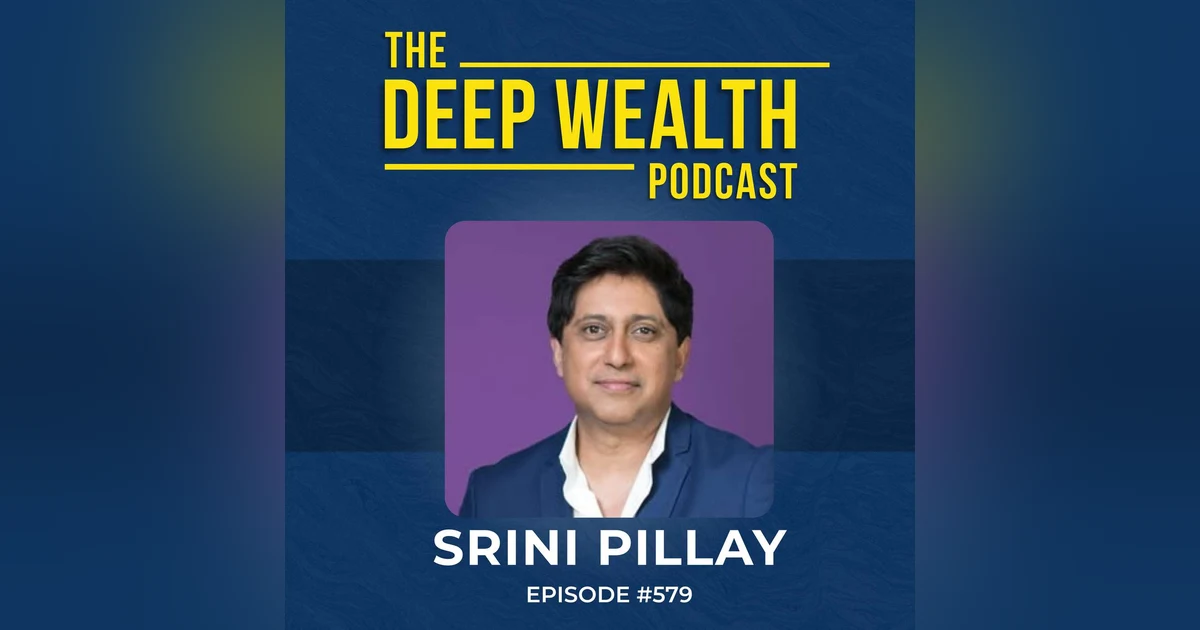
Send us Fan Mail “Possibility thinking unlocks the door to your future success.” -Srini Pillay Exclusive Insights from This Week's Episodes Relentless focus can quietly weaken a founder’s creativity, decisions, profits, and health. Harvard-trained psychiatrist Dr. Srini Pillay reveals why strategic unfocus may be the advantage high performers are missing. Episode Highlights [00:09:39] Why complex problems may require strategic unfocus instead of more concentration [00:11:19] The hidden health...
 Apple Podcasts Apple Podcasts
  Spotify Spotify
  RSS Feed RSS Feed
  Amazon Music Amazon Music
  Podcast Addict Podcast Addict
  iHeartRadio iHeartRadio
  Castro Castro
  PlayerFM PlayerFM
  Podchaser Podchaser
  Overcast Overcast
  RadioPublic RadioPublic
  PocketCasts PocketCasts
  Audible Audible
  Pandora Pandora
  YouTube YouTube
 “Possibility thinking unlocks the door to your future success.” -Srini Pillay
Exclusive Insights from This Week's Episodes
Relentless focus can quietly weaken a founder’s creativity, decisions, profits, and health. Harvard-trained psychiatrist Dr. Srini Pillay reveals why strategic unfocus may be the advantage high performers are missing.
Episode Highlights
[00:09:39] Why complex problems may require strategic unfocus instead of more concentration
[00:11:19] The hidden health cost when high performers suppress emotion and lose vitality
[00:25:15] When multitasking helps performance and when it becomes a cognitive drain
[00:40:50] Why founder fear and overload can quietly become your dangerous new normal
[00:44:00] How competing goals can sabotage execution even when the strategy looks right
[00:52:26] The one-minute identity shift that can change how you solve a difficult problem
[00:59:28] Three neuroscience-backed ways to enter a high-stakes meeting with more confidence
Full show notes, transcript, and resources for this episode:
https://podcast.deepwealth.com/579
The Deep Wealth Podcast
Most entrepreneurs do not fail.
They just carry too much for too long.
The business grows. Pressure grows faster. Profits get harder to predict. Decisions cost more energy. Over time, focus slips and health takes the hit.
The Deep Wealth Podcast and Deep Wealth Mastery are built from real experience. We're the only system based on a 9-figure exit. This system exists because guessing gets expensive.
🧠 Deep Wealth Mastery
This is for you if you want to:
• Grow a profitable business without becoming the bottleneck
• Build real value so selling is optional, not forced
• Optimize your health before it limits your business and life
One proven roadmap for real decisions.
⭐ Explore Deep Wealth Mastery
https://iapdw.com/idm
🎧 Subscribe
https://iapdw.com/podcast
📘 Free eBook
https://iapdw.com/ebook
💬 Have a question you keep circling back to?
Leave a short voicemail
https://podcast.deepwealth.com/voicemail/
Built by entrepreneurs. For entrepreneurs.
Loved this Deep Wealth Podcast episode?
You built your business from nothing.
Now make it pay off big.
📱 Subscribe Now
As a bootstrapper, every move counts. Subscribe on your favorite platform for Jeffrey Feldberg’s 9-figure exit strategies. From your morning grind to late-night planning, get insights from founders who did it without investors. These tips could change your future.
Drop a Quick Review
Got 30 seconds? Leave a 5-star review. It helps us make better episodes and reach entrepreneurs like you, hustling without a safety net.
Don’t Lose Your Exit (And Your Financial Freedom)
You’ve poured everything into your business. A bad exit could cost you millions. Most deals fail, and even “successful” ones lose half their value. The 90-day Deep Wealth Mastery program teaches you to make your business run without you and boost profits so you capture the best deal instead of any deal.
What Others Say
“Deep Wealth Mastery is pure gold. I wish I’d had it before my exit,” says Stacey C. “The value I’ve gained dwarfs the investment,” adds Sanjay S. “It makes my business great to own and sell,” shares William S.
📘 Grab Free Tools
Check out client success stories for proof. Master the Deep Wealth Strategy Map to plan your exit. Or snag the eBook, From 7 to 9 Figures: The Exit Playbook, for a clear guide.
Click here to start your legacy-defining exit today.
579 Dr. Srini Pillay
[00:00:00]
Meet Dr Srini Pillay
Jeffrey Feldberg: Dr. Srini Pillay has spent his career exploring a fascinating contradiction inside the minds of high performers. The brain that drives extraordinary achievement can also trap us in fear, overthinking, excessive focus, and patterns we can't see ourselves. Srini is a Harvard-trained psychiatrist, former brain imaging researcher, entrepreneur, executive coach, and the founder and CEO of NeuroBusiness Group.
He's advised leaders and organizations around the world, bringing neuroscience out of the laboratory and into the real decisions people make when the stakes are high. He's also the author of three acclaimed books, including Life Unlocked, the winner of a Books for a Better Life Award, Your Brain in Business, and the bestselling Tinker Dabble Doodle Try, which challenges one of our deepest assumptions about performance, that more focus is always better.
What makes Srini's [00:01:00] work so compelling is that he doesn't separate business performance from the person creating it. Behind every strategy is a brain. Behind every decision is an emotion. And behind many of our greatest breakthroughs may be the willingness to stop forcing an answer long enough for a different one to appear.
This is a conversation about what really happens inside the mind of a leader when ambition, uncertainty, fear, creativity, and possibility collide.
And before we start the episode, a quick word from our sponsor, Deep Wealth and the Deep Wealth Mastery Program. Here's Bill, a graduate, who says, the Deep Wealth Mastery Program has transformed the KPIs we're using to accelerate growth and profits.
Or how about Emry, who says, and I love this, and I quote, the Deep Wealth Mastery Program helped me create the right mindset for both growing my business and later my future exit. I now know what questions to ask, what to do and what not to do, which is priceless. The team and I have found dangerous [00:02:00] skeletons and gaps that we're now addressing due to the Deep Wealth program. Today, our actions have a massive ROI.
Absolutely love that.
And now, speaking of growth and adding value, check out what Bruce says, and I quote, As a business owner, I'm always looking for new programs, systems, CEO peer groups, and strategies to improve my business. Hands down, the Deep Wealth Mastery program is the absolute best. I'm both growing my business and preparing for a future exit at the same time. It doesn't get any better.
And I gotta tell you, as I hear these testimonials, this is exactly why I do what I do. My mission, the team's mission here at Deep Wealth, is to literally change the social fabric of society, one business owner at a time and one liquidity event at a time.
The Deep Wealth Mastery program, it's the only one based on a nine figure deal. And that deal, that was my deal. You know my story. I said no to a seven figure offer. I created a system that we now call Deep Wealth Mastery and that's [00:03:00] exactly what helped myself and my business partners welcome from a different buyer, a different offer, a nine figure deal.
So if you're interested in growing your profits, preparing for a future liquidity event, Whether that's three years away or 33 years away, and if you want to optimize your post exit life, Deep Wealth Mastery is for you.
Please email success at deepwealth. com. Again, that's success, S U C C E S S at deepwealth. com.
We'll send you all the information about the Deep Wealth Mastery Program, otherwise known as the Scale for Ultimate Sales System. Better yet, why not hop on a complimentary strategy call? We'll see where you are at your business and what's standing between you and your financial independence and your dreams.
So that's where you want to be. You want to be with other successful business owners, entrepreneurs, and founders, just like you, who are looking to create market disruptions, whether you're a startup, whether you've been in business for three or four decades, whether you're manufacturing, whether you're a high tech, SaaS, low tech, whatever the case may be.
Come on in and network [00:04:00] with other business owners, with other businesses, just like you, because they all want to lock in their financial freedom and enjoy both success and fulfillment. Again, the 90 day Deep Wealth Mastery Program, it has your name on it. All you need to do is take the next step. Please send an email to success at deepwealth. com.
Podcast Welcome And Setup
Jeffrey Feldberg: Deep Wealth Nation, welcome to another episode of the Deep Wealth Podcast. Deep Wealth Nation, let me ask you this. What if I told you what's probably holding you back from your profits, your success, is never gonna show up directly on a profit and loss or a balance sheet? In fact, it's gonna be somewhere else.
You're asking Jeffrey, where is that? How can that be? That's impossible. That's nothing that I've heard or learned." You've come to the right place because we have an incredible guest, a fellow thought leader, incredibly successful author and scientist and everything else in between. But I'm gonna put a stop in right there.
Srini, welcome. Really should be saying Dr. Srini, but you've asked me to call you Srini. But Srini, welcome to Deep Wealth Podcast. There's [00:05:00] always a story behind the story, and wow, preparing for today, you have quite the story.
Srini Origin Story
Jeffrey Feldberg: So share with us what's your story? What got you from where you were to where you are today?
Dr. Srini Pillay: Thanks, Jeffrey. It's lovely to be here. I'm excited for this conversation. As we sort of, alluded to, it's hard to know what the true story is, but I'll tell you a story that will make sense, and I'm sure the parts that are most important, which are the serendipitous parts are the parts that probably influence me more than I would say.
I'm a Harvard-trained psychiatrist. I'm also a brain researcher, and I ran the outpatient anxiety disorders program at McLean Hospital at Harvard and then also ran a part of the brain imaging center. I also consulted to investment companies looking at biotech companies that had drugs in early stage development for cancer, heart disease, stroke, and neurodegenerative disease, and that brought me to my current interest in medicine, which is psychogenic longevity, which is, what are the psychological factors that people face that actually influence immunity, [00:06:00] inflammation, health span, and longevity?
In addition to that, I'm a certified master executive coach. I'm on a think tank at McKinsey which is the Consortium for Learning Innovation. I'm on the faculty Duke Corporate Education. I did teach at Harvard Business School executive education and also Mobius Executive Leadership and now emeritus.
And what I do is I work with leaders globally, helping them build companies that are more resilient, agile and creative. Right now we have pivoted in terms of what we're focusing on, which is how do you develop human advantage in the age of AI? Because most companies are gonna have AI anyway. How do humans work alongside AI?
I'm a musician and I just finished writing a musical called Dance of the Psyche, so I'm in the process of putting together bunch of things to, pitch deck so we can start pitching that. And I'm also a technology entrepreneur. So, I was co-founder of Rulai and I'm the chief medical officer.
What Rulai is an AI-based video app that's targeting right now human advantage in the [00:07:00] age of AI. And what's interesting about it is that the mindsets that we've chosen to help people shift, from pessimism to optimism, from distraction to focus, are all actually connected to health as well.
They're connected to inflammation and immunity. And I am currently also about to release an app for ADHD, so that's early stage. And in development I have another piece of technology for psychogenic longevity. So I operate at the intersection of science, art and technology. R-right now in the business sphere and bringing together the business piece and the medical piece I've noticed that there's a lot of investment in AI and that's great and I have AI tech companies so I'm deeply appreciative of that.
But there's not a lot of investment in how people need to shift their mindsets to deal with this world of AI. And so another beginning stage project for me is the Center for Human Illumination, which I'm developing together with Warren Sadler, where we have developed a human advantage index and we are in the [00:08:00] process of wanting to then grow this because I hear so many different stories.
I myself am, I'm an optimist generally. I tend to look at things positively. I have a sense of vitality in my life. But when I look at the world and I look at the kinds of things that people are inviting me to "Can you please volunteer your services for all the people who are losing their jobs? Can you please volunteer your services for people who are stressed out of their minds?"
You look at the US optimism index and that's plummeting I feel like there's a kind of darkness that has come over much of the world that is difficult to escape, and what I want to be able to do through the Center for Human Illumination is bring some of these tools and processes to be able to create a world that actually feels promising and that actually opens doors for people and allows them to feel rewarded rather than taking away their agency.
Jeffrey Feldberg: Wow, my goodness. So much going on there. I particularly enjoy hearing right now what you're saying, especially with AI and with social media and bringing us back to the right place. There's so many [00:09:00] narratives, we don't have time to get into that, taking us down the wrong place with that. But before we get going, you've accomplished so much that there's no way we're gonna cover that all.
Deep Wealth Nation, go to the show notes. Everything is in the show notes.
Favorite Book Unfocused Mind
Jeffrey Feldberg: And Srini, before we kick things off, it's a bit of an unfair question. It's almost like asking who's your favorite friend or family member or child, but I'll throw it out there anyways. You have at least six books and counting is at least as of this interview, and you have the right to change it before the interview ends or even tomorrow.
Is one of your books something that you tend to have more of a favorite of than the other ones? Which one would that be?
Dr. Srini Pillay: I think the last one that I wrote, which is Tinker Dabble Doodle Try: Unlock the Power of the Unfocused Mind, in which I help people understand that in the brain there is a network that's responsible for rational thinking. But in today's complexity, you actually have to learn how to strategically unfocus to turn on the network [00:10:00] that is involved in creativity, complex thinking, problem-solving.
So in the book, I explain how people can initiate this change, and if we get to that in the interview, I'd be happy to touch on that as well
Jeffrey Feldberg: absolutely, and I love the six steps that you had put out there. And let me ask you this. let's actually do it. Let's pull it all together because you're really one of the few out there when I look at the landscape. You're bringing together the science, and by the way, I don't think you've come from places that we've heard of before, Harvard or McKinsey.
Who are those guys? Can't you pick more well-known entities? nudge, Nudge wink, wink. But you're out there, you're doing some incredible things. You're also from the founder world, and you're speaking about longevity, something near and dear to my heart. And so to throw a zinger of a question right out there before we get going that I would love to hear your insights from: when you look at where we are today, which is probably better said where we're not, where ideally we would like to be, what's the one thing that's perhaps [00:11:00] holding us back?
There's probably many things, and every person's journey is different. I understand that. What would be the one or two things or patterns that's holding us back? And then based on your work and your research and the science, what are some things that we can begin to think about to ideally get us to where we would want to be?
Vitality Essential Depression
Dr. Srini Pillay: Right now your question directs my attention to the work of the Parapsychosomatic Institute, where Pierre Marty and his colleagues had found that there was this sort of epidemic of a condition that they called essential depression. And in medicine, essential doesn't mean necessary, it means without a known cause.
somehow out of the blue, people were appearing to have this what they called it. But it wasn't like a classic depression the way we would describe it, in psychiatry, which is, depressed mood, feeling down, low. What they found was that the people were presenting with an absence of vitality And that this absence of vitality correlated with being overly operational.
[00:12:00] separated out their thoughts and their emotions, and their words were under-invested with emotion. And what they found was that when you are suppressing your emotion in this way, you actually end up having more medical problems, and you end up having more cosmetic surgeries, you end up having more illnesses, some problems with immunity.
And other studies in other domains have also shown that emo-emotional suppression, for-- in one study, for example, was correlated with an increase in mortality over 12 years. So for me, one big problem is this absence of vitality. And just to give you an example of what I mean, people will say, "Oh well, that's not true," "I had a good day yesterday."
y-think about the way we're communicating. How often have you heard someone say "Oh my God, that's so funny." But if it's so funny, why are you not laughing? Why are you not rolling on the floor? You've just outsourced all your emotions to your cognition, and now you're just gonna talk your way through life without actually being an emotional being.
And there is a scientist, Antonio Damasio, who wrote a beautiful book called Descartes' Error, in [00:13:00] which he pointed out that Descartes said, "I think, therefore I am." But actually, the reality of the way the brain works is that thinking and emotion are not separate. So I think people are trying to figure out what to do with the emotions that oftentimes feel, not in control.
So for example, entrepreneurs or even established business people have a sense of fear, right? They have a sense of fear that, "Am I gonna make it?" you know, When-- if they have a difficult night, get up at three AM how am I gonna make it to the front? And I think more and more it appears that the job landscape is changing.
I myself am not encouraged by the idea of universal basic income. It suggests to me that there will be massive polarization where people with means will be able to have enough money, and people without will have to do with what they've got. And I think this creates a kind of this metaphorically gray blanket over society where there isn't enough motivation and vitality to move forward.
Simply put, I often say my biggest issue with the [00:14:00] healthcare system and psychiatry, but really everywhere right now, is that the actions of the aim of everyone is to live a slightly less lame life. Who wants that? We want kickass lives. We wanna be able to engage with this vitality in a real way.
And I think not being able to be vital, not having agency, not feeling like you have autonomy, these things can take away the feeling of excitement about living a life. And to get a little philosophical on that, it was Kierkegaard who said, "Anxiety is the dizziness of freedom." That we say we wanna be free, but we often add balls and chains to our lives along the way to stop ourselves from actually anticipating this freedom.
The good news is that I think in the age of AI, with so much of AI doing the boring, menial tasks, I think we have an opportunity to grow our creativity. And I think that any entrepreneur, any established person should start thinking in highly creative ways of how they can grow their businesses.
A, a good [00:15:00] example I think that I've seen recently is how many unusual companies have decided to become media companies, because they recognize that traditional advertising is not working. So they're constructing stories to be able to draw attention to what it is they have to sell. But there are many other ways one could become creative as well.
Jeffrey Feldberg: And Srini, you can tell me if I'm on base or off base. Data point to one, a little anecdote I'll share with you. This past summer took a family trip and we went out to the East Coast, and we went to this one small town, and it, to me, I'm gonna date myself here a little bit, and I was sharing this with my daughters, it was a throwback to me to the 1970s.
It was a community that was focused on health, and you walked into this general store, it felt like actually, you know, not only in the 1970s, you could have been in the 1800s. Everything was old school. And it just so happened that it was a spotty connection for cell phones, so nothing was really working.
And I didn't realize until that [00:16:00] moment how slowly, like the frog in boiling water, at least for myself, a lot of my happiness was stolen from me from social media, from what you're talking about here, Jeffrey, you have to be so focused on what you're doing and just only look at this. And by the way, I'm gonna tell you what words you can use, what you can think, because if you think outside of those lines you're this label or that label.
And I was like, "Wow." And I was sharing with my daughters, this is what life for me was growing up, and I actually feel bad for you because you're never going to experience this except for this little hour or two hours that we're gonna be here of a much slower time, where all you have to do is talk with other people, sit down or read a good book or listen to some music or just be by yourself and take it all in or nature.
And I know it sounds like I'm getting a, a little bit out there, and perhaps I am, but going back to what you're talking about from the mental side of things and then the messaging and the social programming, [00:17:00] am I off base with that or is there something to that?
Savoring Connection In AI Age
Dr. Srini Pillay: I think there i- there is something to that, and I would add that I think for people who are just born into this age, we also wanna figure out how do we then shape that observation so that they can have opportunities that are the beautiful opportunities that you're referencing. And I think some people have begun to realize this.
S- some people have begun to realize that there is something special about human connection. Not all human beings. Sometimes people annoy you, they upset you, y- you get into fights about things. talk long enough to ChatGPT, and you'll see how irritating it, it will be when it just, doesn't argue when it should be arguing, and then when you want it to be in discourse. It's a very specific value proposition. I love AI for what it offers, but I do not think that we can just replace the idea the meaning of social interaction with AI. one important point being social isolation is actually contributes adds a 50% increased risk of mortality.
So our human-to-human connection is not [00:18:00] just, by the way. And it's not just the number of people you know, it's the quality of connections that actually make a difference. So in the times that you're referencing, there was time for social interaction. You were not just interacting with your machine.
You were... you'd go on walks. In fact, recently in my Substack, which I thought what do people want? Why don't I just give them some practical tips?" So I created this thing called Recipes for Success. There's a free part and a paid part. And I finished the 52 weeks that I promised, and then I was like, "You know what I'm gonna do?
I'm gonna change this to The Illuminated Human." I wanna change it. I wanna create a place where people who wanna think more deeply about themselves have an opportunity to do this. Because the joy of being alive is contributed to by having these moments like in the place that you referenced, where there's a slowness for human connection.
It's called savoring life And what we're doing is we're just gluttonously consuming whatever's coming our way without savoring life. And I think moments of savoring is what [00:19:00] Tinker, Dabble, Doodle, Try is about. And it's not just saying, you have to create moments of savor. It's saying it's actually critical to your survival.
If you look at brain circuits that are involved in longevity, one of the key circuits that goes wonky is the circuit that's not well-trained, is this unfocused circuit. So there's something to the fact that, you look at depression, you look at anxiety, you look at many physical diseases, somehow the circuit when it's not doing well, it correlates with any of those conditions.
So I think that savoring life is important. I can imagine a busy entrepreneur or busy business person would say, "Yeah, whatever. You savor life. I don't have time to savor life." And I get that. We all have these high-pressure moments.
Ideal Self And Reinvention
Dr. Srini Pillay: But my question is, when people often ask me "What's the most profound, advice I have for people?"
I say, "You live, you die, you do something in between. Make it count, and make it count in a way that matters for you." And, the way I like to recommend that people start this, just to be more practical about that, is Richard [00:20:00] Boyatzis and his colleagues at Case Western University looked at who solves problems better, people who are putting out fires or people who have a really clear understanding of their ideal self.
And what they found was that putting out fires is not as effective, just problem-solving, as having a navigator where you clearly understand what your ideal self is. What makes me feel good? What drains me? What are my values? And so on nas.com, Dr. Srini Pillay, I have an ideal self-guide, because I know it's, it's a hard thing to do, so to make it more concrete for people, it's free.
what you do is you download that guide, and I will walk you through questions, personal and professional values, what helps you, what drains you. And at the end, I will tell you, put it into whatever LLM you're using, get a summary back. Ask ChatGPT to draw you a picture of who you are.
The biggest mistake corporations make when I first lead them into this, is they realize it's too generic. It's like, "I wanna be happy, wealthy." Why? It's like, okay who are you? Who are you beyond your LinkedIn profile? What do you [00:21:00] actually care about? For me to make this come alive, I've been doing this work for a long time in different ways.
It was only in the last few weeks, through an incidental conversation that I was having with a colleague, where I suddenly realized-- 'cause I was feeling stuff getting disrupted, and I needed to reinvent, reposition a lot of the stuff I was doing. And I suddenly thought, "Oh, my God, this it's so cool."
I was feeling disturbed by what Dabrowski, a Polish psychiatrist and psychologist, would cause by positive disintegration. I was... Like, when you reposition and you rethink what you have to do, it's a major restructuring of not just your life, but yourself. But in this restructuring, I was talking to this colleague, and he said to me, Tri, I think we're on the same page."
And I said, "What do you mean?" He said "I, I think you and I feel we could be doing better for humans. You and I feel..." And then he said something that was even more abstract, but it really caught my attention. He said, PayPal and those kinds of companies when they started, I don't think anybody would've [00:22:00] anticipated that the growth of that era would've led to the nuances in the human experience today.
And I think what you and I have been doing is we've been shrinking away from that whole world 'cause we're like, 'I'm not an activist, I'm not gonna do anything about it.' And I don't wanna go around just saying empty things about here's how we can inspire you." But I think when he said that, I suddenly realized I don't want to shrink away from this.
My whole life I have spent in this idea of human capital, the meaning of a human life. Why would I not want to invite anyone who is from that world into a world where AI and humans can work side by side without draining the human spirit further? And I think that anyone try-- asking the question of how do I do this?"
I say start with having a clear understanding of your ideal self. In fact, brain imaging studies have shown that when you don't have a good idea of your ideal self, your problem-solving day-to-day self [00:23:00] is in conflict with this ideal self, and it's very hard to navigate forward. But when you go through this positive disintegration, this restructuring process, matter how you think about it, whether it's in terms of your business, it's in terms of your personal self, and you land on a thing, and you can feel this like ding, ding, ding.
Cause as soon as I did that, I was like, "Warren, you know what I'm gonna do? I'm gonna send you a proposal. We're gonna put together a deck, 'cause this big idea is where I think humanity is at right now and it's something I wanna do." So whenever you're feeling down or you're feeling like, something is not quite right, consider reorganizing not just what you're doing, but yourself as well.
Because the self network is this unfocused network in the brain, and you can actually reorganize those piece-
Jeffrey Feldberg: Okay, my goodness. There is a lot going on there. Let me circle back, though. Perhaps we can try it like this.
Multitasking And Founder Burnout
Jeffrey Feldberg: So in Tinker Dabble Doodle, love that, and I suspect there's a story behind the story on how [00:24:00] you got to the title itself. Two things as I was going through it jumped off the page because they're almost counterintuitive.
You're challenging the social programming, which I love. And the two things that jumped i- immediately off the page was chapter four. I really looked at each of the chapters as steps or strategies. Strategy four, mastering multitasking, even though up to this point, "Jeffrey, you can't multitask. Forget about it.
Just focus on the one thing at a time," and disenchantment to greatness. And from that side, I really thought of my daughters and their generation and the quote-unquote "younger generation." I'm making myself feel like an elder, really not. Just how far off the beaten path we've gotten, at least from my perspective, that it seems, and particularly for founders.
To your point, it's lonely at the top. There's a reason that saying has stuck around and it exists. So for the typical founder, someone in Deep Wealth Nation who's listening to us, when it comes both to [00:25:00] multitasking and from disenchantment to greatness, which to me is all about being a founder, being an entrepreneur, not so much about ourselves, but how we can triumph our companies and our solutions to make life better for people, what would you want us to know?
Dr. Srini Pillay: So when it comes to multitasking, I would say that there's necessary and effective multitasking, and there's multitasking that causes a decrement in performance. So in the research, we know that if you can't be absorbed in something you need to be absorbed in without doing something else, the quality of the product is not gonna be great.
So doing 100 things but not being able to be absorbed when you have to be absorbed is not helpful. However, two other things to say about productive multitasking. Firstly there's a group of people, small percentage of people, called super taskers, who, when they have multiple things to do, actually operate at their best.
There's a lot of times, I can't tell you how many times I've heard people say, "But you gotta choose one thing. You can't be an executive coach and a doctor and work in, [00:26:00] the medical implications of this." But if I had not kept my interest in biotechnology alive while I kept my interest in psychological phenomena alive, I would not be in this advantageous position of being able to link psychological factors with lifespan and longevity.
Had I not continued my executive coaching, I would not be in the position to approach that market where there's so much stress in the corporate world with what these solutions are. So eventually, depending on how you multitask, I think it can be super helpful. The reality is that I don't know how any business person who is currently-- a-any founder of any company is not multitasking if you're using AI.
When I run something through Claude and Claude is thinking, and then I'm wondering maybe I'll just ask ChatGPT this other question." and then I'll try to figure out while I'm doing that, why don't I just see what's happening on Instagram right now. That's an effective use of time, because what am I gonna do, sit and stare at Claude?
On the other hand, I'm not running Claude and ChatGPT while I'm talking to you [00:27:00] because I'm invested in this conversation. So I think there's a time and place for multitasking. I like to reference, wh-when I tell people about the importance of unfocusing and the importance of delegating your time, I will often show them a video of Jeff Bezos where he talks about the fact that he likes to basic-basically tinker around in the morning, read his newspaper, have his coffee, and there's a lot of processing that's happening behind the scenes from an intellectual perspective.
And then he chooses his high energy times. If something's important, he'll schedule it early in the morning 'cause that's his good thinking time. He's not gonna sc-schedule that at 4:00 PM, by the time he gets to there, he's gonna be, I don't have the energy to do that." So multitasking similarly can be easier when it's appropriate and when it's scheduled at a time where you have the energy to do that.
Now, I can tell you just from working with companies recently, that one of the biggest issues, one of the biggest cognitive drains is gonna be context switching Because when you're working with AI. So [00:28:00] let's take a recent engagement working with a marketing division of a company, and they have a workflow. And the workflow is not like, " I have eight things to do today. Why don't I do this?" And then I'm... first I've got to envision what a marketing goal is. Then I've got to ask AI to synthesize and prioritize. Then I have to use critical thinking to figure out what actually is this recommendation good or not.
And even if it's good, are my customers actually gonna buy this or not? So you have to schedule time very differently when you're working with AI, and you have to be multitasking in all these different scenarios.
Disenchantment Medical Paradoxes
Dr. Srini Pillay: Now, eventually, if there's a cognitive drain, this kind of disenchantment that I referenced does occur.
Certainly as an active entrepreneur, I can tell you there are days when I'm like, "Does this matter? like does anybody understand what's going on?" Because I feel like so often when you speak to people who are interested in the money side of the business, which is super important you also feel like I'm not sure they actually care about the health of anybody, [00:29:00] because the thing they're asking me to do is not something that's actually gonna be helpful.
You go onto social media, and the nonsense that you see on social media from a medical perspective is frightening. I don't know if you know this, but, here are some of the reasons for disenchantment, and these are things published in medical journals. Fake papers are doubling every one and a half years in published medical journals.
So in 10 years, close to 50% of anything you read in a journal is gonna be fake Which means on Instagram, and then you have Marcia Angell was the editor of the New England Journal of Medicine, widely regarded as the most prestigious journal. She said after two decades I'm not sure that I can really have any faith in the idea of a trusted physician or resource that you can actually go by.
Because if there's so many conflicts of interest which they try to catch, but they don't always catch, there's so much of what doctors hear in guidelines has been marketed to them. For example, [00:30:00] if I asked you, is there any evidence in the literature that lowering bad cholesterol might kill you?
Most people would say no. What, it's bad cholesterol, so why would lowering it kill you? There's a U-shaped curve in many instances, and there are instances where lowering bad cholesterol is good for you, and there are instances when it's not. Is there any evidence that lowering bad cholesterol might make my diabetes worse?
Yeah, plenty. Is there any evidence... Everyone says, "Oh, you gotta take your antioxidants, make sure you get your veggies." All very important, and definitely a lot of evidence to substantiate that. But is anyone aware that antioxidants also accelerate malignant progression? Medicine is very-- There's a lot of paradox built into medicine, and a lot of people are not aware of this.
So the disenchantment is gonna make people feel like I don't know if I can trust anybody. I can't trust the internet. Now I can't trust medical journals. What am I gonna do? What I suggest in "Tinker Dabble Doodle Try" is that we be honest with ourselves. a part of a background of this is that I worked with a [00:31:00] company that was very s- socially oriented.
They wanted to be number one in their space, but they said that they didn't wanna be competitive. And I was like, "I don't know what you're talking about." And they hired me for a day. They were gonna pay me for this day. We started doing the work, and I said I don't know that-- we can talk about this afterwards, but whatever's going on here needs to be examined.
I'm gonna leave you guys alone for 30 minutes. I'll come back in 30. If you feel like you've got your story straight, we can work together. If not, I don't think we're gonna be able to do this. So I came back, and they were like, "Thank you for calling us out on it." Like I said what do you want? you wanna not be competitive, or do you wanna be number one?
'Cause if you wanna be number one, competition's an important lens to be able to think about where you are in market." And they eventually were like, "Yeah." It was a senior executive team. And I said so you wanna be exceptional." And they were like, "Yeah." I said everything I've heard you say up until now is that you don't think that's realistic.
Do you know what exceptional means? It means low probability. It's an exception. It's not the rule. The rule in entrepreneurship is most companies fail. The rule in [00:32:00] businesses is most companies don't make it.
Possibility Thinking Confidence
Dr. Srini Pillay: So if you wanna be the exception, it means you wanna shift from probability thinking to possibility thinking.
And with possibility thinking, there are two broad constructs. One is hope and belief are vehicles for action. It you would not be able to do anything if you didn't believe in it. And if you look in the brain at placebo studies, what is that when people believe something that's gonna help them, even if it's placebo, if it's a sugar pill, they have increases in dopamine, so they feel more rewarded, more motivated.
They have less of the stress hormone so that they feel like they can at least manage something. So that's one piece of it. But the other piece of it is what I call existential confidence. We are moving away from a world where confidence can come from certainty because the rate of change is way too much.
But we can have confidence in our capacities where we, our commitments determine our reality, not reality determines our commitments. Because if you [00:33:00] think the market is here today, it may not be there tomorrow. Nothing is that static. So if you just made that one flip to yourself in your life, if you got up in the morning and you said, "From tomorrow, I am not going to let reality shake me up." It may shake me up, but it's gonna have to shake me up in the face of my commitment because here's my commitment, here's what I want.
Brain Categories Law Attraction
Dr. Srini Pillay: Now, a lot of people don't realize that they're going through life with their brains already deciding about their failure. Lisa Feldman Barrett a couple months ago just published a really beautiful paper, excruciating detail, showing that categorization is baked into the brain.
So we usually think we'd collect data, then we analyze the data, and then we figure out the answer based on that. But what they found was when you show up to any situation, you're already showing up with the past having influenced you. It's like people who are like anti-AI, for example.
They've had some bad experience with losing [00:34:00] this human connection, with feeling like maybe this is too much change. they bring a bunch of data and then they analyze the apparent data, the inputs But the brain has already made that up. So for anyone who is trying to up-level their game, whether you're a beginning entrepreneur or a mid-level person, or whether you have a large company, you really have to correct constantly to how am I showing up to life?
Do my commitments actually determine my reality? And in a course that I recently made, which a lot of people raised eyebrows when I told them I was gonna release this, which was implementing the science behind the law of attraction. They're like, "What do you mean? You're like a brain scientist what are you talking about the law of attraction?"
I said I'm gonna try to do a real rendition of what this is." Which is, in the introduction I say there have been identified risks in the scientific literature by just sitting in your chair and hoping for the check to land in your lap. You live a high-risk life and nothing happens.
So that's not what I'm saying. What I am saying is if you approach life with a preconceived notion that [00:35:00] things are gonna be tough and you're gonna fail, your brain is very obedient. It will find many opportunities for you to fail, and it will show you, because it likes to tell you that your categories are right.
It will show you all the negative stuff that you wanna see. If you show up to life with, "I don't know how to get where I wanna get to, but where I wanna get to is here," then your brain starts looking for evidence to support that particular path. that's one example of what I meant by implementing the law of attraction.
Also, having the sense of hope, having the sense of belief. People often say, "Oh that's not a fact," because you can't see that. And I'm like, perception is marketing's greatest tool. Because most scientists will tell you that most of what exists cannot be seen.
Why can you not hear what a dog hears? Does the sound exist? Why can you not smell what a dog smells? Because you have certain thresholds.
Quantum Mind Possibility
Dr. Srini Pillay: Perception is not the be all and end all. There's a reality beyond perception, and if you look at how neurons communicate in the brain, there's [00:36:00] increasing evidence.
If you go into AI and you ask it, it will say there's not enough evidence," but there is accumulating evidence that neurons don't just communicate causally. They don't just go from A to B to C to D. there's quantum phenomena that are active in microtubules in neurons. Now, does that mean we have to say the brain's a quantum machine?
No. Does it mean the brain operates with quantum mechanics? No. But does it mean that there are observable quantum phenomena in human tissue? Yes. And do you wanna wait for 100 years before you engage the world that way when there will probably be evidence, or do you wanna make a call and say, "Maybe there's a nonlinear way of getting to the answer"?
Insight Over Analysis
Dr. Srini Pillay: And in fact, if you look at the medical literature, there's several instances in which insight trumps analysis in problem-solving So how do you get insight? You get insight when you put two and two together, what Einstein called ... he called his theory of relativity a musical experience. Cary Banks Mullis, who discovered a way of making synthetic driving from Berkeley to Mendocino with his [00:37:00] girlfriend, had a little bit of wine, stopped, scribbled on a K-
All of a sudden this thing came out of nowhere. His lab mates hated him.
Toddler Ingenuity Leadership
Dr. Srini Pillay: They were like, "He's not a real scientist. He doesn't go from A to B to C to D." So I would strongly encourage you to think about what I call the toddler mentality. Nobody needed to go to an Ivy League school to learn how to walk, right?
Nobody was like, "I'm not going unless I go to the Harvard School of Walking." What did you do? You figured it out. Then you go through a schooling system and somehow you forget that you have ingenuity. Somehow you forget that you have an intrinsic intelligence that doesn't have to be learned from a book.
It doesn't have to be taught. And I think the more we can alert people to the fact that this intelligence is always there, the same intelligence that taught you to walk can teach you to walk through life. And if you can just rely on that intelligence, believe in your commitments, and let reality's perturbations be about reality, then you can begin to understand that you are leading your life.
One of the most [00:38:00] prominent researchers in business is Warren Bennis, who when asked what leadership was, said, "Becoming a leader is synonymous with becoming yourself. It's precisely that simple and also that difficult." And so if you can make that your charge, like who am I? Am I actually leading my life Or a life some- I think I ought to live? That's a great beginning to actually embracing your leadership potential
Jeffrey Feldberg: My goodness, there is so much there. It's precisely that simple, as you're saying, but then precisely not as, as you're saying.
Founder Pressure Patterns
Jeffrey Feldberg: A-and so as you're talking about that and rolling this back to Deep Wealth Nation, two disparate parts or points to put your way to get us really perhaps an insight. Because for founders, when I'm part of a mastermind or I'm at a meeting of founders, e-even to this day, in fact I think it's gotten perhaps a little bit worse, not necessarily better.
It's with a badge of honor that the founder's saying [00:39:00] "Well, I work well under pressure. Let me tell you about how little sleep I got," and, "I'm doing this," and, "I'm doing that." It's that whole social programming side. And then when I take it to the tinker, dabble, doodle... Try saying that 10 times fast. When I, I take it there, and it's all about the unfocused mind.
And just to throw a third thing in there I absolutely agree with what you're saying, as Napoleon Hill once said back in his day, "Hey, it's our inner thoughts that becomes our outer world." And now the field and quantum physics or spirituality or God or the reticular activation system, whatever you like to call it, they're all working together.
The short story is a story, the narrative, the story that I tell myself inwardly is what the most wonderful creation ever, otherwise known as the human and our mind and our brain, and that's a whole other episode of they're not necessarily the same thing and they're separate and everything else. But how that works [00:40:00] to manifest our own reality based on something as simple or not so simple as, "Okay, this is what I believe or this is the story that, that I'm telling myself."
So when you're working with other founders or you're giving a keynote or I'm going through one of your courses or your books, it goes back to me to one of my favorite questions, good old Pareto's law, the 80/20 principle. Are you seeing, at least in the founder's world, yes, Jeffrey, for most founders, these 20%, or it could be 10% or 5%, we'll just stick with Pareto's law of the 80/20.
Yes, these 20% of some people call them issues, I call them opportunities, are creating 80% of the challenges, otherwise known as opportunities out there. Are there patterns that you're seeing time and time again that you might be able to share with us?
CIRCA Stress Reset
Dr. Srini Pillay: Yeah, a couple of things come to mind when you ask that question. One of them is that one of the things people often find very helpful, because all founders are under pressure, is like, how do I manage this overload [00:41:00] and fear? Because in all of them, there's so much overwhelm. They have to figure out how to grow their companies.
It's difficult, even with the companies I have, to figure out, should you go direct to consumer? Should you go B2B? 'Cause there's problems with each for founders who will need too much money. So it creates a lot of fear. And one thing I like to explain to people is that when you have some fear and stress, it can be helpful.
But if you're over the limit, it starts to hurt your mind and your body. And one of the parts of the brain that processes this is the amygdala. And so the needle gets stuck in a high position. And so as a founder, you're going through every day in this activated state, and it becomes your new norm.
It's like yeah, I'm a stressed out individual. That's my thing. Heart disease doesn't start one day before you're diagnosed with it. that's when it starts, when you have this unbridled kind of fear and tension. And so one of the things I like to say to people is, it's important to actively check in with your brain's processing of your fear from ti-time to time, and there's a mnemonic [00:42:00] that I use that I encourage people to think through.
The mnemonic is CIRCA, C-I-R-C-A. The first C is chunking, which means three things. Break things up into pieces so you're not overwhelmed by everything you have to do. Secondly, delegate when you can. And thirdly, ruthlessly prioritize. When you get up on a Monday morning, you open an email box. I always say email is like Russian roulette.
You have no idea what's gonna happen. It's like good news, bad news, good news bad news. It's like, what is going on here? So if you actually chunk it, it calms your brain down. The I, which is ignore mental chatter, is really about mindfulness. And extensive research has shown that practicing mindfulness, which simply means sitting in your chair, putting your attention on your breath, like as if it's a flashlight, and then allowing your attention to stay s-still on your breath, and if your mind wanders, you bring it back to your breath.
Start with a practice of five minutes a day, increase it to twenty minutes a day. Can be super helpful in decreasing activation of the amygdala. [00:43:00] Might even help you live healthier into older age. So there have been some studies that show that. If you're like, "I'm not a meditating type," think like sighing has recently been shown at Stanford to be even more effective than mindfulness, which means you breathe to half the way through your nose, and then you breathe to the top And then you exhale through your mouth, and you go through the cycle over and over again.
It can help you calm down. So if you have a meditation practice or a breathing practice, super helpful. The R is reality check, which is reminding yourself when bad things happen, this too shall pass. Like horrible things are horrible but they don't last forever. Your brain makes you wanna feel like it's gonna last forever.
Then control check is when I absorb information from the world, what can I control, what can I not control, and what should I let go of? Because if you're not gonna be doing anything about wars in 7,000 countries, but you're occupying your attention with all of those things, then if you're not in control of it, what are you [00:44:00] putting it there for?
Lady Gaga offered a really interesting insight in a talk to Yale students about this. She talked about reaching a point in her career where she didn't wanna sing anymore. And people were like what do you mean? You have an amazing voice. You're so set up." And she said I just realized I was doing stuff I didn't wanna do.
I didn't wanna sell perfumes. I didn't wanna feel like a money-making machine for other people. And so I started to say no. And when I said no, I went home every day and I was able to look at myself in the mirror and say, 'You, I can go to bed with any night,' 'cause you have integrity. You, I believe in.'" So for anyone out there, I'd say we're not all Lady Gaga with Lady Gaga's privileges, but we can definitely say no to certain things.
What should you be saying no to? And then the last is attention shift, which is how do I go from the problem to the solution? We spend so much time talking about problems, but not enough time immersed in the possibility of the solution. So chunking, ignore mental chatter, reality check, control check, and attention shift [00:45:00] are super important.
Strategy Belief Execution
Dr. Srini Pillay: Then there's this whole other obsession that I see with founders, which is what's our goal? And then they talk about strategy, and a lot of people think strategy is the plan to reach the goal. And I think Seth Godin makes a really articulate point about this when he talks about strategy, and he says, "Strategy is not a plan to reach your goal.
It's what you dare to believe is possible." That's where it's... And then you construct whatever the stra- if you construct everything out of reality, you'll have one kind of product. If you construct out of your imagination and you try to make a call on the direction you're gonna move in, that is what the life of any business person is.
It's making that call. there's so many business examples of this where people have made calls, Bernard Arnault, for example, when he first was decided Louis Vuitton should be a bunch of different brands. Everyone was like, "You're crazy. No." How can you have this brand next to this brand?
Like Bulgari, why Bulgari? And he did it [00:46:00] 'cause he had a vision for what he wanted to do, and he often says that his success has been a combination of creativity and operational work, and that with both of those things, you can move yourself forward. From an academic perspective, there's a series of studies also out of Case Western University that show that coaching with compassion is superior in terms of its outcomes and results to coaching, to goal-directed coaching.
Now we often think if you have a goal, you gotta keep that goal in mind, and then you gotta go after it. Yes, but think about a couple of different things. There's nuances around this. If you look at tennis, for example, I'm obsessed with tennis. But if you look at tennis, when you hit the ball, you don't look at where you're hitting the ball.
You look at the ball Where you're hitting the ball has already been imagined and it's already embodied in your body. If you look at where you're hitting the ball will not go there. So part of what you're doing is actually effectively multitasking, right? You're changing your position of your body, you're bending your legs, you're putting your [00:47:00] hand back, you're looking at the ball, and you're simultaneously imagining where the ball's gonna go.
That's a lot of stuff to do at the same time. Most people think they have to be looking at the target. Sure, we have to look at the targets to assess where we are. But to really give it your all, you also have to be in the moment. you have to ask yourself what this is. And you know, from a biological perspective, there's a whole theory called selfish goal theory, where goals are-- they're not as clean as they are.
You might have a health goal and a chocolate goal, and oftentimes the chocolate goal wins because your chocolate goal doesn't care about you. The chocolate goal is like, "I wanna win. I want to be the goal that reaches the top." So in business, you can have 20 goals all competing with one another.
Goals are not the thing to give all your attention to. They're something you want to internalize, embody, and you wanna let them inform your activity and participation in the moment. And the more we can let ourselves go into what that is and be compassionate towards ourselves, [00:48:00] the more likely it is that we'll be able to execute on that strategy.
As it is, only 30% of strategies are successfully executed. And of those, most CEOs believe they're too slow. Right now the majority of companies are not seeing revenue gains from using AI, but 10% are. So the question is, what are they doing that we're not doing?
And I think what they're doing is they're not just... they have productivity gains from the AI, but so do their competitors. They got the same AI. It's the humans behind the AI who are making the difference in how they're executing on the strategy, how they're executing on reaching those markets.
Be Your Kooky Self
Dr. Srini Pillay: And I like to say that with all these ideas I just wanna make it clear that I always say to people, "I both believe and don't believe anything I'm saying," because firstly, the research changes all the time.
Secondly, what I'm saying is what I'm saying. My goal-- I did have three very amazing outcomes in the last two years with coaching clients I've had who had a couple hundred thousand dollars and one of them sold the comp- two of them sold the comps for $100 million.
One is 500 million and going up. [00:49:00] And I don't think there was any specific technique. If you ask me to reflect on what was common Firstly, I'm not sure there was anything that common. They were all three different individuals with three different styles. But the one thing I do know is that they had a permission to be their kooky selves in the room with me because they could say whatever nonsense they wanted to say that they thought was nonsense from the outside.
some of them admit to making mistakes in their lives. One of them was emptying out bar fridges while he was having affairs. It's like everyone said "Well, I don't wanna do that." It's like n-not everyone who's successful is emptying out bar fridges and having affairs.
But there's something about being free to be himself that allowed his disinhibited brain to make calls that were extremely creative and that ended up with that result. So I like to say that for every human being, the years, it's become very clear to me that my job is not to just inform.
My job is to really help people transform so [00:50:00] that they become their own teachers. I think what I am is just there to provide frameworks to help them on that journey
Jeffrey Feldberg: And two things. Firstly, as you're talking about this and maybe a little bit off base, I don't think I'm that far off base. I believe it was Oscar Wilde who said, "Hey, be yourself. Everyone else is already taken." But it goes back, Srini, to what you've been sharing with us, with all the science and the research.
It's really, especially today, saying no to social programming. I will be me because I am me, uniquely me. I've been given... This is my narrative. Hey, Jeffrey, you have God-given gifts. I use those words very deliberately. Maybe you're not spiritual or not a person of faith or of God. It'll be the universe has given me gifts, whatever it's gonna be, but I have God-given gifts.
Don't necessarily know what they are. That's my mission in life, find those gifts, take them to the world, celebrate them with the world. That's where the magic happens. And Srini, to your point, when on the business side, I've had incredibly successful business men and women [00:51:00] on the podcast. The one theme across all of them, they never imagined in their wildest dreams that they would get to where they got to because it started off as, "This is a problem I'm passionate to solve."
It irritated me. No one else was doing it, so I decided to do it. And then to your point, I'm gonna do it uniquely me, and some of them went down the path of I, quote-unquote, should do this, or I'm being told I should do that, and I was miserable. I was failing. I stopped that. I'm gonna do this for me.
If I don't like it, no one else wants to buy it, that's fine, but I'm gonna do it with me, and I want to be happy because it is for me. And again, that's where the magic happens. So that's my biggest takeaway from what you're... Many things that, that you're sharing, but one of them is all of us should be ourselves despite being told not to, especially today with all the norms, do this, don't do that.
When you're coaching or when you're leading organizations through [00:52:00] all kinds of different strategies, what would be a low-hanging fruit? Maybe that is a low-hanging fruit to all be ourselves, but would there be one low-hanging fruit that if you did nothing else other than this one thing coming out of the time together we've had on this episode, on the Deep Wealth Podcast, Deep Wealth Nation, do this one thing.
Try this one thing if you could do one thing to make a difference before your next phone call or meeting. What do you think that would be?
One Minute Mindset Shift
Dr. Srini Pillay: If it's an acute intervention, I would say a self-check in to see whether you have given yourself the ability to operate at your greatest advantage. Meaning you have managed the fear, you are not caught up in this identity of yourself as like the worried person. I I think a self-check in with either a quick CIRCA or one of the steps of CIRCA so that you go into your next meeting with that in mind.
The, the other thing I like to tell people is we forget sometimes the things that move us. And so, if there's a picture you [00:53:00] like, a song you like, a poem you like, allow yourself to shift your mindset in the moment. Because most people, the moment they start on this downward drift, they just go with that.
They're like, "A bad day today." Actually, you can change your mindset. You can change your mindset when you want to. Now, yeah, it's not always easy, but some stuff will bypass all the thinking, like a great song or a great video that makes you laugh. Save a bunch of videos that you know are gonna change your mindset or allow you to shift that mindset.
And Rulai the AI company I told you about, was actually structured around brief mindset shifts that are scientifically validated at Mayo Clinic where we were able to show statistically significant improvements in anxiety, emotional distress, and focus. That's one element, one thing that you could turn to shift your mindset in real time.
I think, for the most part, it's good to remind yourself that it's a continuous journey, that as I implied, being yourself and becoming yourself or reaching the goal [00:54:00] is part of it. But a great metaphor for this is actually yesterday's US Open where Alexander Zverev won, and after hitting the winning point, he went back to the line not realizing that he had won.
He was such a trance He was in this state of like, "Okay, next point." And then he looked around and he was like... And the umpire's announcing, "Game, set, match Zverev," and he still d- didn't even strike him. his team was shouting out from the other end it's over.
It's over. You won." And then he realized that he had won. Now, that is an incredible mindset to be in, where you are so entranced by what you're doing, so entranced and being in that moment. Most people don't put themselves in the position to succeed like that. Most people are always, their minds are somewhere else.
Psychological Halloweenism
Dr. Srini Pillay: the issue that's happening is that most people are not realizing that- When they cannot solve a problem, it may not be that they don't have the cognitive apparatus. It may actually be that they're not in the self that needs [00:55:00] to solve the problem. There's a term I coined in Tinker Dabble Doodle Try called psychological Halloweenism, which was based in studies that showed, for example, that if I gave you a creative problem to solve, if you took on the identity of a rigid librarian, you were statistically significantly less likely to solve that problem than if you took on the identity of an eccentric poet.
Same person, same problem, different identity. So if you cannot solve a problem and you take this one minute before your next meeting, you ask yourself, "What identity do I need to inhabit in order to solve this problem?" ' Cause maybe the identity that I have about myself is the one that's never gonna solve this problem.
I don't really think I'm a business person. If you have-- trust me, there's not one person in business who's trying to be successful who doesn't have doubts. Am I doing the right thing? Having a doubt is not a crime, but not acting despite that doubt is
Jeffrey Feldberg: And as you talk about that, it's amazing, and I'll preface this and then we're gonna start going into wrap-up mode, but what you're sharing right now, [00:56:00] AI has made possible. Look at this from the perspective of, you used Albert Einstein. How would Albert Einstein phrase this particular question and then the solution?
Or going back to over a century ago in Think and Grow Rich, Napoleon Hill, he had this imaginary mastermind, and he had Thomas Edison and Henry Ford and all, all the other business magnates of the day in this imaginary board meeting, and they took on such real personalities in his mind, he had to stop it because it became too real for him.
He was doing the same thing. And so Deep Wealth Nation, when it comes to your business or on the personal side, when you're heading into a particular situation, and Srini, I'll let you in on a little secret, I've never shared this before on the podcast, for certain activities, especially when I was building the business or when my children were really young, I would go into a particular activity, "Okay, Jeffrey, who are you right now for the next 30 minutes?"
And I was, maybe it was super dad when I was with the [00:57:00] kids, or on the business side, I was entrepreneur extraordinaire, whatever it was. It sounds silly as I say it out loud, but the bolster of confidence internally that it gave me when I went inside as opposed to the imposter syndrome, why am I here? What am I doing?
I don't feel like I should be here. I haven't earned it. All that negative chatter went off to the side when I took on those roles. And why not? It makes it fun. And then to the other point, I really appreciate you saying this, particularly today, how many of us are not lost in the moment or lost in that to-do list?
Okay, how much longer until I get through this? Or I have a gazillion, billion, trillion other things I gotta get to. Let me get through this as quick as I can, as opposed to I'm gonna immerse myself however long it takes and truly feel it. Isn't that the fun and the zest of life? Easier said than done, I get it, but it is easier if we want it to be to do that.
So my goodness, there is so much there. Let me ask you before we do go into wrap-up mode, in addition to the books, and again, Deep Wealth Nation, go to the show [00:58:00] notes and the links and pick up all the books and begin one by one going through there because Srini is a smart guy, and he has helped so many countless companies and founders and entrepreneurs.
It doesn't have to be a, such a tough journey for you. In addition to the books, though, for some of the online programs and the courses that you have, do any come to mind that you would want us to consider or that you can point us towards?
Dr. Srini Pillay: I think right now implementing the science behind the law of attraction would probably be something you haven't thought about or heard about in that way, and you can find that on drsreenipale.com where the course is listed. I think that, and I do think my paid Substack is gonna go very deeply into what an illuminated human is about.
Help you confront your shadows, try to see what's standing in your way, getting into the deep unconscious. I feel like that's where I can really bring my expertise to masses of people without having to see everybody in a coaching session or in a therapy session, which is, significantly [00:59:00] more money to pay for anyway.
So I think my Substack and my course would be the two other places I would direct you to
Jeffrey Feldberg: L- love that. And speaking of resources, Deep Wealth Nation, check out the Burnout Buster. You're gonna love that when you try that. It's all in the show notes. It's on the website. And before we go into wrap-up mode, is there a question, an important question, or even a theme or topic we haven't yet covered that you want to share with Deep Wealth Nation?
And then from there, we'll go into wrap-up mode
Confidence Quick Tools
Dr. Srini Pillay: They probably are a lot. I think, people are probably wondering, like, how do I feel confident, for example. I think that's one. I talked about existential confidence, but is there something simple I can do if I'm gonna go to a board meeting? What are the three things I can do?
that's the kind of thing I will work with companies on. So three things that are fairly simple. One, affect labeling. Name the emotion. Don't just stay in the state of anxiety or fear. Say, "I'm anxious and excited." When you name the emotion, it decreases activation in the amygdala, in the brain, helps you feel more confident.
Two, when you're framing your goals, try [01:00:00] not to frame them using not. Studies have shown, based on ironic process theory, which was discovered by Daniel Wegner, described by Daniel Wegner, if you put on eye-tracking devices and you say-- you're trying to score a penalty, and you say, "Do not kick the ball to the right," your eye goes to the right.
So what you want to say is what you want to do. You don't want to not lose your temper, you want to stay calm. So frame it in that way. The third thing is, when you're speaking to yourself and you're trying to be confident and you wanna say, "I'm gonna crush this," it's much more effective to call yourself by name and to speak to yourself in the second or third person.
So rather than before you go on stage or before you go to the board, before-- Instead of saying, "I'm gonna crush this," it were you, you would say, "Jeffrey, you're gonna crush this." 'Cause when you say, "I'm gonna crush this," and you're anxious, your brain is like, "Yeah, whatever, you're not gonna crush anything."
But when you say, "Jeffrey, you're gonna crush this," your brain actually recognizes implicitly there's an anxious part of you, but there's a part of you that can crush this. And so what I'd want to say to everybody is wanting to crush things is amazing. Take on that mentality, let it [01:01:00] be your guide, and let your ideal self be your compass toward that goal
Jeffrey Feldberg: Wow, a lot there and some terrific insights and strategies. And by the way, I love how throughout our conversation so many of the strategies get to mental health, which we haven't directly touched upon, but we have in terms of acknowledging it and the emotions and how we're feeling and don't say... Instead of saying this, put your name there, and I am gonna be doing this.
And Deepal Nation, I don't know how it is for you. With so many of us, myself included, mental health is such a big deal, and oftentimes you don't recognize behind the scenes we need to pay as much attention and have KPIs, if you will, as you do with the business also on the mental health side. Hey, our health is the greatest wealth, especially on the mental health side.
So that said, Srini, we're going into wrap-up mode. Sadly, we're going into wrap-up mode.
Back To Future Wisdom
Jeffrey Feldberg: It's a tradition and honor here in the Deep Wealth Podcast where I ask the same question to every guest. Let me set this up as a fun question. [01:02:00] When you think of the movie Back to the Future, you have that magical DeLorean car that will take you to any point in time.
So Srini, it's tomorrow morning. You look outside your window, this is the fun part, and it's there. The DeLorean car, it's curbside, the door is open, it's waiting for you to hop on in, which you do. You're now gonna go to any point in your life. Srini, as a young child, a teenager, whatever point in time it would be, what would you tell your younger self in terms of life lessons or life wisdom?
Or, "Hey, Srini, do this, don't do that." What would that sound like?
Dr. Srini Pillay: I think I would say in order to be successful you need to really fully understand that you're gonna mess up a lot. But when you mess up a lot and you have down times, remember that possibility thinking is the only vehicle you should use because your commitments should remind you that they're important enough that they can determine the reality that you can make
Jeffrey Feldberg: Wow, a lot there with the possibility thinking and really believing in myself. That's really the only thing to determine what I can do and will do, and it all [01:03:00] goes back to, again, how we started this conversation, very appropriate. It's a mental game. It's not showing up on that profit and loss statement.
It's what's going on inside of us that ultimately will manifest.
Resources Wrap Subscribe
Jeffrey Feldberg: And you mentioned earlier, I'll ask it again, though, somebody has some questions or they wanna begin to learn the best place online where they can get the resources or have those conversations, where would you want us to go?
Dr. Srini Pillay: So please go to the, Dr. Srini Pillay site. for businesses have another site which is nbgcorporate.com that's Neurobusiness Group. And in real time, I post every day on LinkedIn at least twice a day on LinkedIn and on Instagram. So DM me. Let's get into a conversation.
I would love to be able to help you
Jeffrey Feldberg: And Deep Wealth Nation, the great news is it's all point and click. Go to the show notes. It's there for you, waiting for you to begin to explore. And Deep Wealth Nation, before you start your next activity or phone call or meeting, go to the show notes, take one action, perhaps it's picking up a book or signing on to the Substack [01:04:00] or going into one of the online programs.
Do it. Do it now. You'll be the better for it. So that's it, Srini. It's official. Congratulations. This is a wrap. And as we love to say here at Deep Wealth, may you continue to thrive and prosper while you remain healthy and safe. Thank you so much
Dr. Srini Pillay: Thanks so much for having me, Jeffrey. It's really a pleasure speaking with you
Jeffrey Feldberg: So there you have it, Deep Wealth Nation.
What did you think?
So with all that said and as we wrap it up, I have another question for you.
Actually, it's more of a personal favor.
Did you find this episode helpful?
Have you found other episodes of the Deep Wealth Podcast empowering and a game changer for your journey?
And if you said yes, and I really hope you did, I have a small but really meaningful way that you can actually help us out and keep these episodes coming to you.
Are you ready for it?
The dramatic pause. I'll just wait a moment. Drumroll, please. Subscribe. Please subscribe to the Deep Wealth podcast on your favorite podcast channel. When you subscribe to the Deep Wealth Podcast, you're saving yourself time. Every episode automatically comes to you, and I want you to know that we meticulously craft Every one [01:05:00] of our episodes to have impactful strategies, stories, expert insights that are designed to help you grow your profits, increase the value of your business, and yes, even optimize your post exit life and your life right now, whatever you want that to look like.
And every time you subscribe and a fellow entrepreneur subscribe, it's a testament to how together, Yes, we are. We are changing the social fabric of society. One business owner at a time, one liquidity event at a time. So don't let the momentum stop here. Subscribe now on your favorite podcast channel.
You'll never miss an episode. You'll be the first to hear from the top industry leaders, the innovators, the disruptors that are really changing and shaping the business world, and maybe you're commuting, maybe you're at the gym, maybe you're taking a well deserved break that we spoke all about on this episode.
The Deep Wealth Podcast, it's your reliable source for the next big idea that could literally revolutionize your business. So once again, please hit that subscribe button, stay connected, inspired, and ahead of the curve. And again, your next big breakthrough moment, it might just [01:06:00] be one episode away. Maybe it was even this episode.
So all that said. Thank you so much for listening. And remember your wealth isn't just about the money in the bank. It's about the depth of your journey and the impact that you're creating. So let's continue this journey together. And from the bottom of my heart, thank you so much for listening to this episode.
And as we love to say here at Deep Wealth, may you continue to thrive and prosper while you remain healthy and safe.
Thank you so much.
God bless.
CEO
Most companies don’t have a traffic problem.
They have a trust problem after the click.
Shamir Duverseau has spent more than 25 years inside the machine of digital marketing, working with some of the most iconic brands in the world, including Southwest Airlines, The Walt Disney Company, NBCUniversal, and Marriott International. But what makes his perspective rare is not just who he’s worked with. It’s what he’s seen break.
As Co-Founder and Managing Director of Smart Panda Labs, Shamir focuses on what happens after the ad, after the email, after the click. The messy middle where most revenue quietly leaks. Where marketing, technology, and human behavior collide. And where enterprise teams often struggle to align.
Before founding Smart Panda Labs, he led digital strategy, UX, experimentation, and analytics at scale for Marriott Vacation Club. Today, he helps enterprise marketing leaders turn chaotic post-click experiences into measurable growth in conversion, retention, and lifetime value.
His work goes beyond surface-level CRO tactics. It’s about building experiences that support complex buying decisions and helping leaders bring clarity to chaos without burning out in the process.
Shamir doesn’t just optimize funnels. He redesigns how companies think about the customer journey.

Harvard-Trained Psychiatrist, Author, Brain Researcher & Co-Founder of Reulay Digital Therapeutics
What if one of the habits that helped make you successful is also quietly limiting what comes next?
Dr. Srini Pillay has spent his career exploring a fascinating contradiction inside the minds of high performers: the brain that drives extraordinary achievement can also trap us in fear, overthinking, excessive focus, and patterns we cannot see ourselves.
Srini is a Harvard-trained psychiatrist, former brain-imaging researcher, entrepreneur, executive coach, and the founder and CEO of NeuroBusiness Group. He has advised leaders and organizations around the world, bringing neuroscience out of the laboratory and into the real decisions people make when the stakes are high.
He is also the author of three acclaimed books, including Life Unlocked, winner of a Books for a Better Life Award, Your Brain and Business, and the bestselling Tinker Dabble Doodle Try, which challenges one of our deepest assumptions about performance: that more focus is always better.
What makes Srini’s work so compelling is that he does not separate business performance from the person creating it.
Behind every strategy is a brain. Behind every decision is an emotion. And behind many of our greatest breakthroughs may be the willingness to stop forcing an answer long enough for a different one to appear.
This is a conversation about what really happens inside the mind of a leader when ambition, uncertainty, fear, creativity, and possibility collide.


