

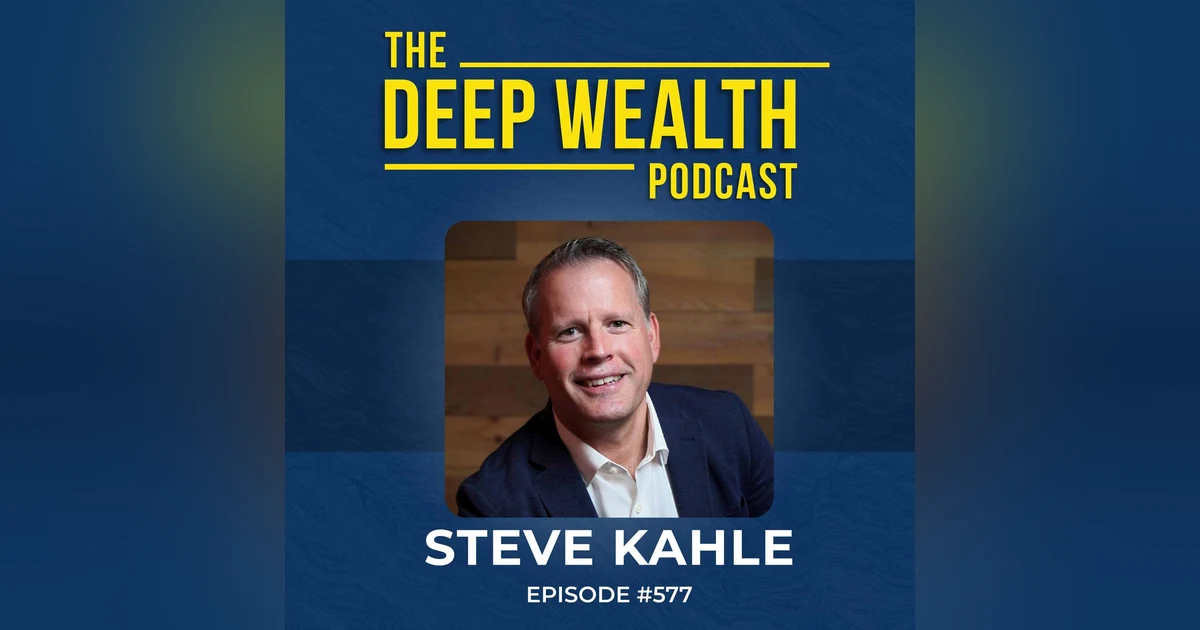
Leadership Expert Steve Kahle Reveals How To Remember What Most Forget Under Pressure (#577)

Send us Fan Mail “Never give up, but also know when to quit.” -Steve Kahle Exclusive Insights from This Week's Episodes Founders lose valuable ideas and insights when pressure hits. Leadership Expert Steve Kahle reveals how intentional recall can sharpen decisions and strengthen leadership. Episode Highlights [00:08:03] Why AI is separating founders who adapt from those quietly falling behind [00:11:27] The 83% forgetting problem eroding leadership confidence and performance [00:16:37] Steve’...
 Apple Podcasts Apple Podcasts
  Spotify Spotify
  RSS Feed RSS Feed
  Amazon Music Amazon Music
  Podcast Addict Podcast Addict
  iHeartRadio iHeartRadio
  Castro Castro
  PlayerFM PlayerFM
  Podchaser Podchaser
  Overcast Overcast
  RadioPublic RadioPublic
  PocketCasts PocketCasts
  Audible Audible
  Pandora Pandora
  YouTube YouTube
 “Never give up, but also know when to quit.” -Steve Kahle
Exclusive Insights from This Week's Episodes
Founders lose valuable ideas and insights when pressure hits. Leadership Expert Steve Kahle reveals how intentional recall can sharpen decisions and strengthen leadership.
Episode Highlights
[00:08:03] Why AI is separating founders who adapt from those quietly falling behind
[00:11:27] The 83% forgetting problem eroding leadership confidence and performance
[00:16:37] Steve’s Capture, Catalog, Recall system for turning information into usable knowledge
[00:20:33] How additive bias revealed the business value of remembering the right insight
[00:23:51] Why better recall can help a 10-person company compete with a 1,000-person incumbent
[00:41:14] How three minutes of daily recall fitness can compound into elite performance
[00:51:08] The “attention confetti” problem quietly destroying focus and deeper thinking
Full show notes, transcript, and resources for this episode:
https://podcast.deepwealth.com/577
The Deep Wealth Podcast
Most entrepreneurs do not fail.
They just carry too much for too long.
The business grows. Pressure grows faster. Profits get harder to predict. Decisions cost more energy. Over time, focus slips and health takes the hit.
The Deep Wealth Podcast and Deep Wealth Mastery are built from real experience. We're the only system based on a 9-figure exit. This system exists because guessing gets expensive.
🧠 Deep Wealth Mastery
This is for you if you want to:
• Grow a profitable business without becoming the bottleneck
• Build real value so selling is optional, not forced
• Optimize your health before it limits your business and life
One proven roadmap for real decisions.
⭐ Explore Deep Wealth Mastery
https://iapdw.com/idm
🎧 Subscribe
https://iapdw.com/podcast
📘 Free eBook
https://iapdw.com/ebook
💬 Have a question you keep circling back to?
Leave a short voicemail
https://podcast.deepwealth.com/voicemail/
Built by entrepreneurs. For entrepreneurs.
Loved this Deep Wealth Podcast episode?
You built your business from nothing.
Now make it pay off big.
📱 Subscribe Now
As a bootstrapper, every move counts. Subscribe on your favorite platform for Jeffrey Feldberg’s 9-figure exit strategies. From your morning grind to late-night planning, get insights from founders who did it without investors. These tips could change your future.
Drop a Quick Review
Got 30 seconds? Leave a 5-star review. It helps us make better episodes and reach entrepreneurs like you, hustling without a safety net.
Don’t Lose Your Exit (And Your Financial Freedom)
You’ve poured everything into your business. A bad exit could cost you millions. Most deals fail, and even “successful” ones lose half their value. The 90-day Deep Wealth Mastery program teaches you to make your business run without you and boost profits so you capture the best deal instead of any deal.
What Others Say
“Deep Wealth Mastery is pure gold. I wish I’d had it before my exit,” says Stacey C. “The value I’ve gained dwarfs the investment,” adds Sanjay S. “It makes my business great to own and sell,” shares William S.
📘 Grab Free Tools
Check out client success stories for proof. Master the Deep Wealth Strategy Map to plan your exit. Or snag the eBook, From 7 to 9 Figures: The Exit Playbook, for a clear guide.
Click here to start your legacy-defining exit today.
577 Steve Kahle
[00:00:00]
Why Leaders Forget
Jeffrey Feldberg: Most leaders are not short in information. They're drowning in it. Books, meetings, podcasts, conversations, ideas, frameworks, insights, introductions, and the list goes on and on as lessons learned the hard way. And yet, when the pressure is on, most of what should guide us is gone, forgotten, buried, or unused.
Steve Kahle has spent more than three decades solving that problem from the inside of real companies. He's a two-time CEO, co-founder, fractional CIO and CTO, and the author of Leadership Recall, a book built around a powerful idea. The best leaders are not simply the ones who learn more. They're the ones who remember, retrieve, and apply what matters when it matters most.
Steve describes his work as human-centered, technology-enabled operational excellence, and his Leadership Recall framework helps leaders capture, catalog, and recall high-value insight so it turns into action, [00:01:00] not intellectual clutter. What makes Steve's work so timely is that we're living in an AI-accelerated world where knowledge is everywhere, but wisdom under pressure is rare.
His message is direct, uncomfortable, and deeply practical. Forgetting is not just a learning problem. It's a leadership problem.
And before we hop into the podcast, a quick word from our sponsor, Deep Wealth and the Deep Wealth Mastery Program. We have William, a graduate of Deep Both Mastery, and he says, I didn't have the time for Deep Both Mastery, but I made the time and I'm glad I did.
What I learned goes far beyond any other executive program or coach I've ever experienced. Or how about Bruce? Bruce says, before Deep Wealth Mastery, the challenge I had with most business programs, coaches, or blogs was that they were one dimensional. Through Deep Wealth Mastery, I'm part of a richer community of other successful business owners.
The idea shared forever changed the trajectory of the business and best of all, the experience was fun. And we'll round things out with Stacey. [00:02:00]
Stacey said, I wish I had access to the Deep Wealth Mastery before my liquidity event, as it would have been extremely helpful. Deep Wealth Mastery exceeded my expectations in terms of content and quality.
And you know what, my Deep Wealth Nation, why they're saying this is because Deep Wealth Mastery, it's the only system based on a nine figure deal. That was my deal. And as you know, I said no to a seven figure offer, and I created a system that we now call Deep Wealth Mastery that helped myself and my business partners, welcome from a different buyer, a different offer, a nine figure exit.
So if you're interested in growing your profits, preparing for a future liquidity event, if that's two years away or 20 years away, and you want to optimize your post exit life, Deep Wealth Mastery is for you. Please email success at deepwealth. com. Again, that's success, S U C C E S S, at deepwealth. com. We'll send you all the information about Deep Wealth Mastery, otherwise known as Scale for Ultimate Sale. That's where you want to be. You want to be with other successful business owners, entrepreneurs, and founders just like [00:03:00] you who are looking to create market disruptions.
And they want to lock in their financial freedom and have success and fulfillment.
That's the 90 day Deep Wealth Mastery Program. It has your name on it. All you need to do is take the next step. Send an email to success at deepwealth. com.
Meet Steve Kahle
Jeffrey Feldberg: Deep Wealth Nation, welcome to another episode of the Deep Wealth Podcast. Well, Deep Wealth Nation, let me ask you this. You are the visionary for your company. You're the founder, maybe even a co-founder. How are you doing with that flood of information that's coming to you each and every day? Or those incredible ideas that you had just a moment ago, are you remembering them?
Or, geez, what was that idea? It could have created a market disruption. What do you do? Where do you begin? You've come to the right place. We have a very special guest in the House of Deep Wealth. We have a fellow founder and author, a thought leader about how we can really go within and take our ideas, our vision, our skill set to the next level.
So Steve, welcome to Deep Wealth Podcast. An absolute pleasure to have you with us. There is always a story behind the story. You've got an interesting one. [00:04:00] What's your story that you can share with Deep Wealth Nation? What got you from where you were to where you are today?
Steve Origin Story
Steve Kahle: Yeah. Thank you, Jeffrey. Glad to be on the podcast. And for me, it started when I was 12, and this is in Arlington, Texas, Dallas-Fort Worth area. And my dad said, "It's time for you to mow the lawn." And he said, "I'll pay you 20 bucks a week." And I'm like, "Hey, that's great." And I said quickly, I said, "Dad, can I use this equipment to mow other people's lawns?"
And that was the start of Precision Lawn Care. Ended up replacing all the gear with commercial grade equipment, hired two of my best friends, and went on this journey and just really fell in love with entrepreneurship. Clearly, it was hot mowing, lawns in the hot, Texas heat.
But learned a lot about, innovation, collaboration. And then fast-forwarding, I realized I needed to go to the next level. Decided to sell the business, get my degree, went to school in uh, in Florida, University of South Florida in Tampa, and then came back to Texas after I graduated, Jeffrey.
And the green of Florida got in my blood, [00:05:00] and it didn't feel right. Kinda felt brown and flat, and I checked out Austin and fell in love with the city, the energy, the rolling hills, and planted my flag. And then the next opportunity to get back into self self-employment was the web became a real commercial project, and decided I'm gonna start a company.
Co-founded it to create websites and started with simple websites to complex applications. And through that journey, I learned that as fast as things were moving then, not quite as fast as they're moving now, but there was a real need to keep up with what was coming next. And my buyer was typically an IT person selling websites, and I had to learn how to speak their language.
So I realized that creating a learning operating system would allow me to be able to better speak their language, stay up on trends so I can make sure I can maneuver the agency to make sure that we are positioned for ongoing growth. And then after that, I was able to sell that business and have done some fractional work since.
And I realized that along the [00:06:00] journey, Jeffrey, that I took a mindset of I wanna make sure that as a top-tier operator, that I can be able to truly lead with excellence. And I learned that I needed a system to be able to capture, catalog, and ultimately recall the things that mattered most
Jeffrey Feldberg: Absolutely love that story. And by the way, Deep Wealth Nation, before we jump into things, please go to the show notes. Everything we're talking about is in there, including Steve's book. Pick up a copy of it. There's no excuse. We have the Kindle, the paperback, the audiobook, and offline Steve was sharing, and again, we'll have all the links.
You can get the PDF. There's no reason not to get it. Leadership Recall: Master Memory, Harness Insights, Accelerate Innovation, Lead With Authority. Absolutely love that.
Web Era Lessons
Jeffrey Feldberg: Steve, let me ask you something though before we jump into the book because it's likely relevant, but would love to hear your thoughts, and a comment and a question.
So what I love about capitalism, and it's not perfect, yet I find the alternatives not so great, but I love how back in the day you're with a lawnmower and, hey, [00:07:00] I could maybe take the family mower and I'm gonna turn this into a business, make a few bucks on other people's lawns, and you built that up with your friends, and you got into a company, you got some early experience.
Wow. To me, we just need more of that and get back to our moral compass north star. That's a whole other episode. But let's go back to the web days, and I deliberately referencing that, and I'm sure we're gonna circle back. Back when the web was just out, it was this new thing, just like AI is today. There was a whole craze with the web, if you remember, and people didn't understand.
"Oh, it's a fad, it's gonna pass," or the doomsday or, yeah, the euphoria, it's gonna be absolutely everything. As you look back to what was going on when the web just came out and you're creating all these sites and you're dealing with all these businesses and these different characters, I'm sure, that are out there, and you compare that today as we go through AI, different technology, the human condition is likely the same.
So looking back so we look forward, what stands out from back in the web days as we now make our way through the AI [00:08:00] days? Anything memorable that you can share with us? Any patterns as you look back?
Steve Kahle: I remember when I started, Jeffrey the internet was so new that I had to take a big ski bag with wheels, and I had a large 15-inch CRT monitor that was like a boat anchor,
Jeffrey Feldberg: I remember those, yeah.
Steve Kahle: and I had to first... And I had like, a, a hundred feet of telephone cable so I could get to a dial-up connection so I could first sell the internet to then sell the benefits of having a website.
And then back around '97, we landed Dell as an account and that was a real big milestone in our development. But then also I realized ab- about that time, everyone understood what the internet was. and definitely there was this rate of change that I thought then was blistering. But now the rate of change with AI is, I'd say, as transformational, and I'd say in many ways probably more transformational, but the speed, the cycles are so much faster that as founders, as entrepreneurs, if we're not staying caught up, like when we look at our sort of buckets of knowledge, s- you know, we definitely industry and the environmental [00:09:00] landscape, what's happening in business is critical.
But understanding AI and AI tooling is no longer an option. I think the world is gonna be separated pretty quickly into two entrepreneurial camps: those who are AI forward and those who are left behind. And so definitely the big thing is it was exciting to see what was possible, and we were building things that created value, and that was a blast, and we're doing that now, but at a much faster rate.
Jeffrey Feldberg: Yeah. It's amazing with the whole change and jumping on that, and actually very topical in terms of what we're talking about, and it's a great segue. So today, even before AI, with social media, doesn't matter, pick your platform, we get so much thrown our way, and some of it probably not so great, but some of it actually interesting.
But as we'll talk about in your book, and as a founder, as a leader, ideas are great, but twofold. One, if I can only remember them, and then two, if I execute on those ideas. And I need both hand in hand and in a very specific order to do that. [00:10:00] And so I know very first chapter, you're going right into it, the case for leadership recall, why the insight without recall is wasted.
Very high level, and I'm sure since the book came out, things have only accelerated. What would you want Deep Wealth Nation to know of, I'm gonna call it the lost opportunity cost, because we're getting deluged with so much information, there's so much pressure on us. And on the one hand, we can know a lot of things surface level, but that's it.
It's kind of useless. We're like a jack of all trades, master of none, versus the one person who can do a deep dive on something. Almost like it was... Speaking to someone just actually over the weekend, I was like, "Jeffrey, I remember," I'm gonna date myself here a little bit, "back in the '70s, we didn't have this thing called the internet, and there was no podcast that you can listen to at two times the speed or three times the speed, and you just took your time.
You didn't have these phones in your pockets. You couldn't be reached, and it gave the time to actually enjoy the journey." Yeah, sure, there's pressure, [00:11:00] but you got to do a deep dive, and you became a master of a topic from a depth perspective. And that art seems to have been lost today with all of our digital marvels and technology.
So paint the picture for Deep Wealth Nation, because so many ways, as founders, it reminds me like with a frog in boiling water. This is happening to us, we don't even know it, and by the time we do, it's probably too late. It's already happened. So what's going on? Paint that picture for us.
The Forgetting Curve
Steve Kahle: Yes, I think first we have an enemy. The enemy is the forgetting curve. So there's been research done that shows that as founders, we're going to lose 83% of what we learn in the first week and most of the people we meet. And psychologists call this the forgetting curve, and it robs confidence, it slows promotions, erodes executive presence.
And so Leadership Recall I wrote as a way to overcome this forgetting curve. Like I realized it started, Jeffrey, when I was behind the bar. Going through college, I was a bartender, and I learned that if I remember Jeffrey's [00:12:00] name and I remember his drink and he comes in next time and I have that drink ready for him and I greet him by name, he's probably gonna go nowhere else, right?
I'm gonna really build community. And there's an element too in all of this is that we know how important it is to build relational equity, relational capital. I like how Porter Gale, she titled her book, Your Network Is Your Net Worth. So we have this relational capital component about recall and understanding and realizing that the VIPs in our life, for example, very important to understand.
You also look at leaders like Elon Musk. Certainly what a incredible milestone. Speaking of capitalism, it's really breathtaking. Elon Musk, Jeff Bezos, Jensen Huang, they all share this passion for first principles, and they run and build their organizations based on first principles thinking, understanding how their industries work, how their products work, breaking them down to the atomic levels, and then reasoning up, from the ground up.
And the thing I would challenge leaders on and founders is how can we lead from first principles [00:13:00] if we don't know the first principles? so it takes a lot of spaced repetition to be able to bake things in the long-term memory, and then also this idea of also making sure that we have a system where we can be able to go out and understand what's happening in the industry, in the business environment.
Finally, with AI and AI tooling, because kinda like back in the '70s, I mean, I kinda like think about how that must have been a lot easier because, things now are, they're multifaceted. I hear a lot of people too, I mean, my, learning operating system, as I would challenge anyone listening to this, should be tuned to be able to listen to a lot of the AI thinkers in the industry as well as those who are putting these ideas into practice.
And I hear continually that everyone feels like they're behind. And so I think we're g- we're gonna probably be behind, but the idea is we need to strive towards a level of being an AI generalist so that we can be able to understand how we can experiment and keep up. But all of this is about leading with excellence, it's about leading with purpose, and about leading from first principles and having a system that will [00:14:00] facilitate us to out-innovate and outperform our competition.
First Principles Explained
Jeffrey Feldberg: And Steve, as we're talking about this, someone who's new to Deep Wealth Nation, maybe they're even new as a founder, new to business, and they're hearing first principles. And okay, I understand the words first principles, but they don't really know what that means. What would you say first principle means for that first-time listener who's hearing this?
Steve Kahle: Yeah, and I'll give a great back- backstory to that. In this part of my career I just kind of fell into fractional leadership and then all of a sudden I had these two opportunities that I felt God dropped in my lap that would require to me a to be a fractional CIO. And I've been in technology all my career, understand, the, IT side of things, but this required me to really go deep.
So I had to understand IT from a first principle's perspective. So I immediately, Jeffrey tuned my learning operating system to now consume content from some of the IT leaders out there, cybersecurity experts. I had to really learn and relearn a complete new dictionary of terms so I could be able to understand how to [00:15:00] best protect and fortify an organization from the continual threats of the bad actors out there.
So I had to really come in and, with a fresh slate, understand and build on... And like, for example, like there's always new ideas like new concepts like in IT like a Neo Cloud is a new term that recently came out that I knew when I first heard that I realized I'm gonna need to capture that and put it into my recall system so I'm gonna get spaced repetition so I'm gonna bake it into long-term memory, so if someone asks me what a Neo Cloud is, in a high-stake situation, there probably wouldn't be one.
But if, if, know, if someone's asking me about a Neo Cloud, I can basically then clearly articulate that a Neo Cloud is a data center designed for AI inference or AI, artificial intelligence processing. And so it's all the understanding going down to the basic bare metal the core elements of a topic.
Like for example, with SpaceX, it was Elon really understanding rocket and, being a rocket scientist and breaking things down to the fundamental truths and then reason up from there to [00:16:00] basically build better systems
Jeffrey Feldberg: Okay. And Deep Wealth Nation, you heard it there. I love how you're explaining that. And actually, as you're talking about that, I'm jumping ahead, but we'll circle back and get back to the book.
CCR Capture Catalog Recall
Jeffrey Feldberg: So when you're talking first principles and we're talking basic kinds of systems, I love how for leadership recall, you really boiled it down to its essence with your CCR system, with the capture, the catalog, the recall.
And so very high level for Deep Wealth Nation, as we begin to do a deep dive on how we can really go within and elevate our memory and our ability to recall the CCR system, what would you want Deep Wealth Nation to know about that?
Steve Kahle: Yeah, so what we wanna make sure is that we are learning, and as we're learning, we're not just consuming content that's gonna be like a conveyor belt and it's gonna fall off in the back and we're gonna forget it, right? So how do we make sure that we are being intent about what we're learning? And then very importantly, how are we capturing the key insights?
And so for example, I recommend a tool if you're using an iPhone, it's called Email Me. Very simple app. You can speak your [00:17:00] notes and then decide which email box it goes into so you can process it for later. So for example, I remember listening to one of your recent podcasts, Jeffrey, of Devin Burke, and I thought it, really interesting.
I'm all about how to maximize sleep, and I like how he says that sleep is the check engine light in your life. And I thought, "What a power phrase." And I'm sure he probably, worked on that and memorized it, but it's a really great way to summarize what the work that he's doing. And so overall, like I captured that 'cause I wanted to make sure that I was able to build that into long-term memory because I do talk about sleep in part of my work.
And so the capture piece is really important. And then the catalog is, as we're going through, like a book that I highly recommend to your audience is Storyworthy by Matthew Dicks. I've read a lot of books about storytelling. All of us as leaders and entrepreneurs and founders, we are communicators and we are storytellers, and the human brain is wired for narrative.
It's wired for story. And I remember going through Matthew Dicks his book, and the [00:18:00] notes that I took from his book were incredible, and I realized, okay, it's gonna go into my Notion. I'm using Notion. I was Evernote. Notion is now really the kinda the popular tool for capturing knowledge to be able to easily find it and discover it later.
But then the key part that I did different this time with Matthew Dicks is I took, there were about 35 or 40 points that really stood out that I did not want to lose, so I added in my recall system using a digital flashcard system called Anki, A-N-K-I, which means memorization in Japanese, developed by a human developer using an open source framework.
And if we were pre-med, Jeffrey, we're gonna be using this tool to memorize anatomy, for example. And so I then what I did differently is I took these 35, 40 points, created a deck just for Storyworthy to make sure that my future self would be served by all of these key insights. So rather than the forgetting curve coming in and slowly eroding all of these wonderful insights about being a master storyteller, I was able [00:19:00] to take a little bit of effort, a little bit of time.
I take the five-hour rule. We should all be spending about five hours a week on average, about an hour a day, outside learning. I'm saying take a slice of that time, about 10%, to catalog, and then about 15% to recall what you've learned. And now all these Storyworthy insights, rather than being forgotten, are baked into long-term memory
Jeffrey Feldberg: And Deep Wealth Nation, as we're talking about this, you may be saying, "Oh my goodness, there's all these terms. How am I gonna remember?" Well, That's part of today's conversation. But again, go to the show notes, and one of the links, it's gonna be leadershiprecall.com website. And Steve is incredibly generous.
It's a terrible business model, but it's great for paying it forward and making a difference. You can get the PDF of the book. Just put your email in. Or you want the audio version, put your email in. And if you like it, go buy the official version. Help Steve out with what he's doing, but he's giving it away for free, so it's a try it if you like it, give it a go, and see where that's gonna take you because [00:20:00] again, an idea is just an idea, but one, you gotta remember it, and two, you gotta execute on it.
So you put the system together so we don't have the, "Oh my goodness, the I just forgot about that. What was that? Oh, it was such a good idea, but I can't remember," all these other kinds of things that, that are going on there.
Recall In Action
Jeffrey Feldberg: And tell us, Steve, in your own journey as you're putting together the system, how did it start making a difference for you?
Where did it begin to show up that you're having that light bulb, that eureka moment, "Wow, look at this. This happened because of the system. It wasn't happening prior to this, and look at where it's taking me"? Can you share any stories with us?
Steve Kahle: Yeah, I love that. I remember coming across, and I definitely, tune my system also towards psychology. A big part of business is psychology, especially with marketing. I remember recently I added, I heard about additive bias, and it makes so much sense that as humans, when we're looking at problem-solving, 'cause a lot of this about leadership recall is making better decisions and having better decision streams of decisions that build value faster.
And so I thought, I heard additive bias, it's basically the [00:21:00] human tendency when we look at a problem, we're thinking about what we can add to fix the problem, where we should be a lot of times asking, "What could we subtract to fix the problem?" And I thought, boy, I need to make sure that as an operator too, like many of us are, in the trenches building companies, and I wanna make sure that I have that baked into long-term memory.
And I knew, and I say this in the book a lot, listen to this, Jeffrey, time swiftly washes away the obvious. When I first heard additive bias, many would think, "How in the world would I forget that?" I guarantee you about an hour later, maybe six hours later, definitely the next day, you will probably have forgotten about it.
And so we need to make sure that we realize and we're constantly listening for things that can make us be better leaders, better operators. And I added that in and I was, going through you know, part of my walk in the morning, it's a prayer walk, and part of that is I allocate time for recall fitness.
I'm on my phone walking through the neighborhood, engaging with my neighbors, enjoying nature, and I'm using that time 'cause I could be sitting down when I'm, doing [00:22:00] my, I call them recall fitness sprints, but I prefer to be walking. And it's a wonderful two-for-one tandem tasking where you can, do two things at once well.
And I remember that I was going through my decks and this additive bias came up, and I realized I need to make sure that I resonate with that. And I was coming across a problem later that day and was able to apply this principle in the moment. And so when you do that to scale, like over time, I just started this with one simple deck many, many years ago.
Now I have about 6,000 cards that are in flight, and it allows me to operate and fly at a higher level. When I'm in meetings when I'm talking to other technologists there is just an element of confidence when there's, you know that there's nothing gonna be asked in the room that you don't already know about because you have a learning operating system and you have a recall system as well for the things that matter
Jeffrey Feldberg: That's amazing. I just picture you, you're in this room, you're having all these smart people around the table, and sure, people can put surface-level kinds of things out there, [00:23:00] but if you're able to do a deep dive and you're able to recall that, one, the respect that you must get, the credibility that it gives you, and then that affords you the opportunity to really, whatever direction you wanna take it into, either, okay, maybe perhaps make some new friends or establish yourself within a new industry group, or perhaps get some business or help other people out.
And as you're talking about this, I want to circle back to the phrase "harness insights" that you're talking about, because in the book and with what we're talking about right now, we can both agree, okay, I have an insight, but today, insights alone in and of themselves, they're okay, but it's not gonna be enough.
So you alluded to it of, okay, yeah, sure, I can collect some insights, but taking an insight and now converting it into an actual leadership leverage, what are we doing there? What would you want us to know?
AI Tools And Leverage
Steve Kahle: Yeah, I think also it kind of brings in this idea of disruption, because many founders are building businesses to disrupt others, while others may [00:24:00] be building businesses to disrupt them. And so how can we make sure that we are paying very close attention to new technology? And definitely on the AI side is how can we be able to use AI in a way that will allow us to be able to maintain a human element of creativity, but amplifying our human power so that, a 10-person operation can compete with a legacy 1,000-person organization.
And so being able to harness those insights requires, the founder, the entrepreneur to make sure that we-- that they are listening and they are learning from the outside world to be able to bring in those insights. I marvel at kind of the AI stack. One of the things that I was tipped off to was this tool called WhisperFlow.
uh, WhisperFlow is a way that you can be able to... Like, dictation is a really, a strong thing. I've always been trying to find the ultimate dictation tool. Back in the day, Nuance and Dragon Software, they had these versions that were okay and kind of clunky. But uh, WhisperFlow has now really taken the market where you can be able to speak rather than typing, and it's [00:25:00] listening and cleaning up your speech.
And and that has allowed me to gain back about five hours a month of my time because I am so much more effective by listening and hearing that point be triangulated by two or three sources. I realize I'm gonna need to now add that to my experimentation lab time which I did. And now, I think I've written almost like three hundred thousand words I've spoken.
The cognitive energy that saves me every single day is incredible. And so these are sometimes small ways to be able to allow that flywheel to turn a little bit faster. But definitely in the era of AI, how we're using agentic workflows safely and securely. I come at it from a CIO perspective, and so how can we make sure that we are able to have governance around these ideas?
But if we're not learning from the outside world and hearing how our peers are advancing and finding these pockets of innovation then we're gonna be slowed down as well. But if, the reverse happens, Jeffrey, if we are continually listening, learning, innovating ourselves, then our innovation cycles will continue [00:26:00] to improve, and we can also be on the lookout for disruptive opportunities that could cause peril in our organization and be able to pivot and avoid those and move towards bluer oceans.
Jeffrey Feldberg: Absolutely love that. You know, As you're talking about this, Steve, you're taking me back to the Deep Wealth 9-Step Roadmap. Actually, step one, big picture, where we're looking around for what's a bit of a whisper, a quiet problem. It's there, it's still in the small stages, not a lot of people are dealing with it, but now it's on my radar.
I can prepare my business, not necessarily for tomorrow, maybe not even next year, but when the problem begins to go mainstream, it gets larger, I'm there. I'm gonna create that market disruption because I've had the time to craft a solution. And while I'm talking about that, I also want to go back to something that you said.
It was very easy to miss, and absolutely love what you're doing. "Hey, Jeffrey, I'm doing this with my system, but I'm also going for a walk in the morning. I'm not sitting." And I love how you're combining our health in terms of health is our [00:27:00] first wealth, also with the business, and you're doing two at the same time.
You're outside for the circadian rhythm if you're doing it first thing in the morning. Sounds like you are. We're telling the, body, "Hey, wake up, body. I'm outside. It's the start of a day. Let's get our circadian rhythm in check. I'll have a better day, a better sleep ahead." But you're also learning at the same time.
Health Rhythms And RSS
Jeffrey Feldberg: And Deep Wealth Nation, are you buying into that myth that you don't have enough time in the day? That you're just glued to your desk too many hours a day? I think sugar, just like back in the day, and cigarettes, it's gonna be sitting at the desk is gonna be the new thing, just like sugar is today and cigarettes.
But you're doing some of the system while you're outside, while you're moving, while you're walking. Why don't you tie into us... And you talk about it as well, but tie into us fitness and movement and our health. It's all interrelated. It's not these different silos. Okay, leadership recall's over here, health is over here.
Actually, they're both together. Would love some of your thoughts on that.
Steve Kahle: Yeah, love that, Jeffrey. I think there's, there's something to it as well, like kind of going back to the five-hour rule. [00:28:00] When we zoom out we can all make an hour per day on average for outside learning. and part of my, learning as well is during lunchtime as well. A lot of times when I'm, I'm not having a face-to-face meeting, I'm listening to podcasts, and I've got a certain list of podcasts that I prioritize that I dial into.
So it's about creating these natural rhythms. And there really is something too about the physical health and like, and my son, Jeffrey like, you know, we both are fans of Andrew Huberman, and my son Zach, who's a special warfare operator in the Air Force, was like, "Why wouldn't you time your walk?"
So I was getting up at like 5:00 early, 5:00 AM, somewhere in that range naturally, without an alarm clock, and I would immediately start my prayer walk. He's what if you were to wait and start walking when the sun came up?" 'Cause Huberman's research definitely validates the importance of those low-angle sun rays getting in your eyes.
And I'm like, "That's a great idea." So but you know, now that it's summertime, I start at 6:00 AM and it works out great. The sun is rising. But a lot of this is about how can we [00:29:00] naturally add learning into the rhythms of our day. Now, I will say that in the afternoons, I allocate time on my calendar towards the end of the day for RSS.
RSS, Really Simple Syndication, is a power tool for any leader who wants to be able to scan the entire internet of all the top content and have in one dashboard, so you can be able to really understand what's happening and go deeper as you want to. There's a tool called Feedly that I mention in the book.
It's the top RSS aggregator. I'll allocate 20 to 30 minutes per day, doing on my Feedly account, identifying. I have all my categories set up from cybersecurity to business strategy, and it allows me to be able to very clearly intake what's happening. Another thing too that I see a lot of entrepreneurs and founders and leaders doing, they're saying I can just outsource all of that to AI."
And I would challenge that. There has to be cognitive ownership. when you're able to kind of skim through and you're seeing, and you can glean so much information from the headlines. You're able to triangulate [00:30:00] content just by looking at the headlines. And so rather than going out to all these websites, all the content's coming into you and using this, very powerful tool called Feedly, and it allows you to be able to skim and see what's happening and drill down so you can be more informed.
And a lot of those ideas, you may see an article that's posted, and you drill down deeper and you realize, "I need to know more of this," and you consume it, then you capture, you catalog it, and some may make it into your recall system. Like for example, I remember A video came up from RSS.
You can also use it to scan all your YouTube channels, which is really powerful. So I'm not having one feed. You have this... it's a multiplied effect, and it's so efficient and so fast. And Andrej Karpathy, who is a big leader in the AI space he was marveling. And I kind of marveled at his marveling, but he was marveling, Jeffrey, at this quote on X, and it said "You can outsource your thinking, but you can't outsource your understanding."
And I thought, what a smart quote. I said, so I, when, so when I heard that, I saw that [00:31:00] this video was available and I added it to my watch later list because I'm always gonna make sure that I'm listening to the AI leaders, the founders. They have insight into things that we don't have. So it's a way for us to be able to really gain competitive intelligence.
And then when I listen to that content, I capture that quote, and now it's in my Anki deck I'm actually able to, just like right now, able to quote it, 'cause I think it's such a powerful quote
Jeffrey Feldberg: And Deep Wealth Nation nudge, nudge, wink, wink, you do subscribe to the Deep Wealth Podcast, right? Of course you do. And shameless plug, if you haven't subscribed to the podcast... But why I'm mentioning that, when you subscribe to the podcast, whatever app you happen to be using, behind the scenes with what Steve's sharing with us, it's using the RSS system.
It's for podcasts. It could be for articles.
Curate Without Doomscrolling
Jeffrey Feldberg: And what I love about that, the Really Simple Syndication, RSS, regardless of if it's the written word, if it's a video, if it's an audio podcast, whatever the case may be, we avoid the doomsday scrolling, as the current term is, [00:32:00] and we're curating for ourselves thoughtfully ahead of time for the time that we do have what we want to be reading.
And sure, there's always two sides to a coin. Water is lifesaving, but if I drink too much water, I can actually literally kill myself because I'm losing all of the salts and everything else in my body that it can literally kill me. Too much water. And so anything to an extreme is not great. But what I love about your system, Steve, is first chapter, you're talking about, "Okay, here's why leadership recall is important.
I'm gonna give you a system for it. And now that you have the system, while the system on its own is great, but let me give you some practical real-world examples." And you're saying, "Okay well, how about some audiobooks? How about some podcasts?" You talk about some webinars or some videos a little bit later on, and you're just going down the list of how we begin to do this.
But I, I love how in a world full of technology, we can be very selective, and you're giving us the strategies, you're [00:33:00] giving us the tools. Now we fill in the blanks. We're curating it with what turns our crank. And I'm gonna go a little bit off script here, but I absolutely love it because anything goes here on the Deep Wealth Podcast.
Faith And Spiritual Journey
Jeffrey Feldberg: You've mentioned a few times prayer, and I know myself, I'm a man of God. Some people call it the universe or the creator. I call God. And Deep Wealth Nation, if that doesn't describe you and you're none of those things, hey, keep an open mind. Hear us talk about this. Maybe you'll get some new insights.
Talk to us about faith and spirituality in your journey, in your life, and how that fits in. Has it made a difference? What's that like for you?
Steve Kahle: Love that question, Jeffrey. Yeah, so for me, my mom drug us to church as kids, and I fought against it, fell asleep in church a lot. And then, I felt, though, there was something, about Christianity that made sense. And then fast-forwarding I marry a beautiful Christian woman who I knew she loved Jesus.
I know that was one, one of the main reasons why I was attracted to her. And [00:34:00] when we got married and when I learned that I was gonna be a dad I realized that my son is gonna count on me to point the way to true north, and I really didn't know. I wasn't really sure. And so I really wanted to take a step back and really study cause, you know, you've got, let's say with, there's about 4,200 religions.
You've got 19 world religions, three main religions. When you look at all of them and you're looking at these truth claims what stood out to me was Jesus Christ saying, "I am the way, the truth, and the life. No one comes to the Father except through me," a very exclusive truth claim. And I wanted to really test that and really understand the historicity of Christ, and I wanted to get it right for me and get it right for my son.
And now I'm blessed with three total. And so in that journey I remember, seeing a verse, Jeremiah 29:13, God says, "You will seek me and you will find me when you seek me with all your heart." And I definitely was seeking with the mind, and I really started to seek with the heart. And my wife ended up coming across a church.
It was a Bible church [00:35:00] here in Austin, and we ended up going. It was a lightning bolt moment, and I was continuing to test and explore. And the Apostle Paul says, "Test everything and hold on to what is good." And I continued to see more and more light, more and more purpose.
And there was a time when I decided to go all in. And absolutely to your point, Jeffrey, rewired. It's kind of like when you have a son or a daughter, your heart is rewired. When you truly accept Jesus Christ as your Lord and Savior there was a a beautiful rewiring that happened to me, and it just gave me this clear sense of purpose, direction, of anchoring.
And being fully surrendered, there's no regrets, and He's made all of us with a unique kingdom assignment. And so it, it has absolutely changed me in every way as a, dad, as a business leader, as a founder as a friend. Changed me in all aspects.
Jeffrey Feldberg: And Deep Wealth Nation, as you're listening to this, you might be completely turned off, "Hey, not my thing. Why are you even talking about that?" And that's exactly the point, because here on the podcast, we want to introduce [00:36:00] you to different ideas, different concepts, or reintroduce you. And I have to share with you, Deep Wealth Nation and Steve, so many founders that have taken their life, not just the business, but their life to the next level, they had some modicum of success.
But when they opened up their heart to spirituality and they really went down that path, life took on a whole new meaning. Business took on a whole new meaning. And looking from the outside in, call it a miracle, call it what you want, things began to happen. And so Deep Wealth Nation, where are you on that?
Were you once there and you're no longer? Maybe because of this podcast, you're listening for a reason. This is exactly where you should be. Why not go within? Why not take a look? And Steve is sharing his own journey. It doesn't have to be for you. That's Steve's journey. Every journey is different. I get that.
Steve, I'll share with you for myself, when I've walked away and God wasn't part of my life, some of the biggest mistakes have happened. Not to say that mistakes don't happen. Of course they do. And not to say that just because [00:37:00] God's at the center of my heart, everything's gonna be roses. Of course not.
I'm not saying that at all. But it's when we open up our hearts, and at least in my case, God's now at the center of my heart, incredible things begin to happen. The flow and the abundance and the prosperity and the success and the veil of protection. It's not perfect, not always easy. It's not supposed to be.
That promise was never made. But Deep Wealth Nation, where are you on that? And maybe it's time just to rethink and reevaluate and with the Leadership Recall, what a great system as you perhaps learn some new concepts or you're reintroducing yourself or different verses that you want to begin to remember.
What a great system to be able to do that. And so that journey really opens some things up for you, Steve.
One Recall Strategy That Matters
Jeffrey Feldberg: And now circling back to the Leadership Recall, as you're giving us the different tools, the different strategies, we've been all over the map but I promise you there's been a method to the madness here.
For someone in Deep Wealth Nation, they've heard us talk about, okay, maybe it's an RSS feed, or maybe [00:38:00] it's going through the system, or maybe it's turning to God, or maybe it's gonna be a video that I'm watching. It's a bit of an unfair question. If there was one strategy, and we've got to remember that strategy, so we're definitely using your system so we don't forget it, that 83% forget rate, coming out of here.
But if there was one strategy that could potentially move the dial for someone, you had to pick one, what would that be that before they go to the next activity, the meeting, the phone call, whatever it's gonna be, if they did this one thing from Leadership Recall, from your system, what could that be that could really make a difference for them?
Steve Kahle: Yeah, one thing. that's very challenging, Jeffrey, to think about one thing. It starts with Carol Dweck and having a growth mindset and knowing that there is always more to learn and to... And part of that growth mindset is the love of learning, discovering your love of learning many, it's the love of people.
Like I when [00:39:00] I, learned you know, applying my own tools, like when I go on my prayer walk, Jeffrey, I know almost all of my neighbors by name. I know the names of their dogs as well, and it's just a beautiful thing to be able to connect with your neighbors. So I think a lot of times, I mean, America's sort of lost that small town feel in some ways.
So I think overall the core thing is, is a love of learning and then realizing that from there the question is: How can we best architect? And I'd say there's many on this, podcast that are in pursuit of excellence, some in pursuit of elite, and they wanna be able to make sure that they remain at the top tier ranks in their industry or grow to that level.
I think when you have a mindset coupled with the right frameworks, and I'll say the learning operating system we talked about in good detail, and we start to make some steps towards improving that and having a system that works our ability to ultimately grow and serve others goes up exponentially
Recall Fitness For Elite Performance
Jeffrey Feldberg: And I'm gonna quote here before I go into the [00:40:00] question, because what you're sharing actually reminded me of chapter 10, Recall Fitness: Elevate to Elite Performance. By the way, I love at the end of each description for the chapter in the index or the table of contents, you're saying, "Hey, if you wanna skip this, but here's what you're gonna be missing."
I love how you did that. And you're saying, so firstly, Recall Fitness: Elevate to Elite Performance, and I'm quoting here, "The gap between average and elite comes down to this: recalling the right insight and acting on it at the right time." Makes a lot of sense. But then you say when you...
If and when you should bypass this chapter, it means you're going to stay average. You're gonna be outpaced by leaders who recall and act with precision. But I wanted to ask you, because in the chapter Recall Fitness, what I loved what you did, you're positioning the whole Recall Fitness.
It's not a, a hack. It's not this productivity kind of thing. It's really elite performance. It really is fitness for that. So share [00:41:00] what was going on with the whole recall fitness thinking and the idea and the notion that, hey, this isn't just a to-do thing. This is an actual elite performance. It's a fitness, it's a mind fitness that we're doing here.
Steve Kahle: Yeah, and I love too, Jeffrey, how you really preach that a lot of podcasts are talking about quick hacks, and oftentimes as we know as founders, as entrepreneurs, that you have to put in the reps. And what I'm talking about here too, though, is not necessarily, hey, let's, add in all this extra work.
I'm saying, hey, let's take the five-hour rule and let's make sure that we're allocating time every day for recall fitness. I would say three minutes a day you'll be able to absolutely move mountains in that time period. It could be like after you have your morning or maybe during your cup of coffee, you have your phone up and you're using this tool called Anki that every pre-med student and every doctor i- uses because it, it uses the science of memory memory science to be able to really bake in these long-term concepts.
So what I found is that there is something to when you learn... and I [00:42:00] like too how in Shawn Achor's book, The Happiness Advantage, he talks about how the Greeks define joy, and it's the happiness they feel moving towards their potential. And so a lot of this, when we're learning, we're trying to continually, Stephen Covey, sharpen the saw, right?
And getting better, and there's... it's something very gratifying. I think, too, when you have this love of learning, you realize you, you come across a new insight, and maybe it's one that goes and you're gonna catalog it, and then maybe one we're talking about here is you're gonna actually recall it 'cause it's so important.
Like I mentioned, additive bias is a really important concept to know as a leader, and you can feel this leveling up and all it takes is to be a little more disciplined and a little more intentional. So that three minutes, I'm right now at about 20 minutes a day on average.
I do 10 minutes 30 seconds for God memory and then about 10 minutes on personal and business while I'm walking. I'm walking a hilly neighborhood, and I do this right before I work out so that-- so I'm fully warmed up and ready to go. So it's just a wonderful rhythm. what I just [00:43:00] want others to experience is that once you're able to figure out the tool, and in the book I go step by step.
I wrote the book for my sons, so they could be able to very easily implement everything in the book on their own full DIY. I've got about 80 illustrations showing exactly how to architect cards for maximum learning, and I just want everyone to be able to experience the sense of getting better and renewing every single day and be able to show up knowing that we're prepared for battle.
Jeffrey Feldberg: And what's amazing about that, it's like compound interest because what you're sharing, you're saying, "Jeffrey, I'm not asking you to go find a cave and tuck yourself away for a year in a cave and remember all these different texts. Can you take a few minutes a day? Can, in the course of a day, maybe 30 minutes, 60 minutes, you're outside, you're walking or you're moving, you're listening, you're reading, you're learning."
That day over day, it's like compound interest. Day over day, it adds up to huge [00:44:00] results when it's consistent and we're taking our craft to the next level, how we view the world to the next level. We're not just surface level. We're going deep into different topics and subjects. And, And I would put the notion out there, you may agree or disagree, particularly because of AI and because of social media, so many people now are shallow.
Yeah, sure, they can tell you a sentence or two, something topical. If you ask them to go beyond that, it's silence. They can't tell you anything, as opposed to the person who, "Hey Jeffrey, let me tell you about that. Let's go back XYZ decades or years or centuries. That's where it began, and we're now this," back to your storytelling, "we're now this incredible storyteller."
We're fascinating. We're different. We're memorable. We stand out from the crowd, and we're not looking to gain anything from that. It's for our own legacy, our own enjoyment with our family, our colleagues, whatever the case may be. But that said, you've given us a framework, a system. We're doing the CCR, and we're now minutes a day, [00:45:00] every day though, taking our life, our learning, our insights to the next level.
Thoughts about that?
Steve Kahle: No, it's really good. I like too, and I love it, about mastering our craft. I think that there's part in our hearts. It's really, it's a heart thing, that we wanna master our craft. I think also, like chapter nine has been a breakaway hit. called Strategic Reading, and I break down the two styles of pinpoint versus power reading, which is essential for any leader, especially when we're communicating.
But overall, I think what you're talking about, Jeffrey is, right on. It's about how do we master our craft, and really how do we maximize this idea of innovation cycles, avoid being disrupted, being the one who is disrupting, thinking and leading from first principles, and allowing all of these concepts to be able to help us create a really powerful and productive decision streams.
That we're making decisions that benefit our teams our clients and customers, so that ultimately we can win in the marketplace.
Connect Dots Beat The Forgetting Curve
Jeffrey Feldberg: Now, what I love about this with your system, again, [00:46:00] that 83% of forgetting what we learn, that forgetting curve, is that we can take these disparate pieces of information and in a way that's novel, it's unique. We're likely, at least today, we're not gonna get that from AI. AI can give us all kinds of information.
It can bury us in information, but our ability to connect the dots seemingly from disparate kinds of areas, but we can connect the dots and now put some insights together in a different way. That's what business is all about. That's what life is all about. Hey, we've got this problem over here. Well, I remember this technology over there.
And Siva, I'm just talking out loud, a little bit of riffing here with you. Back in the day, I'm really dating myself I remember I was in my MBA program and I was struggling. You can see me. I used to have a lot more hair. Deep Wealth Nation, you don't really see it. You can check me online. I used to have a lot more hair until my first year of my MBA program, then I lost most of it from the stress.
But it was the problem that I was facing of how can I do less [00:47:00] time in meetings with my group, not having to travel as much. This is really before the internet, and it was really disparate pieces of information. Well, I remember this technology piece over there and this one over here, and I cobbled this thing together.
It was just for myself and my group. It worked so well, introduced it later to the school. Little did I know that would become a business later known as Embanet. But it wasn't so obvious. It wasn't a straight line, and it was taking different pieces of knowledge and stringing them together in a way that hadn't been done yet.
And this is exactly what you're talking about because when we don't have that forgetting curve, yeah, I remember that, and over there I remember that. Why don't I put that together? What's it gonna do? Maybe 9 times out of 10 I fail, but the one time I don't, wow, look at this. Let me now take that to market or we'll do a little experiment, see where it goes.
That's a gift that keeps on giving. That's what I love what you're sharing with us of what we could do. Thoughts about that?
Steve Kahle: Yeah, it's good. I mean, It's definitely never a straight line. And there is just something too, kind of back to the basics and [00:48:00] breaking it down to first principles, is we know that as founders, we have to learn, we have to be committed to understanding what's changing, the rate of speed, and how we can position our organizations for long-term success.
So like how strategy is really creating long-term value. How do we do that? so it really isn't optional, so we need to do it, and we need to do it well, and with the right mindset as well, and with the right tools. And that's why I'm excited to be able to be on this podcast, and I'm grateful for it, Jeffrey, because I know there's gonna be at least one person, I would pray, that l- goes, "Hey, you know what?
This makes a lot of sense." And as you mentioned, I designed the approach to where, look, I remember when I was starting off, I didn't have a whole lot of money to invest, and I wanted to make, zero friction. The PDF of the book is, as you mentioned, no cost. You can get the audio version as well at no cost.
Some would ask why are you doing that?" Many will upgrade and wanna get the Audible version or the hardcover or paperback. And also, I, lead leadership teams through this as well. There's, teams that are already committed to outside learning are a great fit to this because they realize, hey, [00:49:00] we may need to tune the way we are learning so that we're not just reading.
And I hear people, they go, "Hey, I'm gonna read 100 books this year." I'm like, "Is it better to read 100 books a year or read five and really understand and recall all of the key insights?" And there's something about being able to slow things down, to be able to absorb and really be intentional about what we are reading, how we're cataloging it, and very importantly, how we're gonna be able to recall it so that in that moment, in that maybe it's a high-stakes situation, you have this reservoir of knowledge, of wisdom that you can be able to pull from to be able to position yourself, for victory
Attention Confetti And White Space
Jeffrey Feldberg: And a- as you're talking about that, let me ask you this. Actually, it's very topical. Selfishly, I'll share a little bit of an insight. I was with my daughters just yesterday, and my youngest daughter, she just finished her first year at university. She's at an intern at a startup, and she was sharing with us, she said, "You know what?
It's so hard for me to pay attention in the company meetings and just speaking with people. I get [00:50:00] bored so easily, and my mind goes into la-la land, and it's hard concentrating." And then her older sister, my eldest, said "Well, yeah, that's because you're always on," name your social platform of choice, doesn't really matter, "and that's all you're doing, and you're listening at 2 times the speed.
Why don't you slow it down and play it at one times the speed? Or better yet, why don't you cut back how much you're listening and just engage in more conversations with your friends to get back to real life?" And I don't think she's out there on her own. I think she's a microcosm of what all of us as founders, just as a society, are going through.
And so when we zoom back for just a second, Steve, with what she's saying of she's consuming all this content, and it's these 60-second clips, and it's one after the other. She's swiping, "Okay, here's the next clip. Here's the next clip." And it's at such a fast pace, it's really a disconnect from life. What do we do about that?
How do we use the recall or the system or some strategies of getting back [00:51:00] to the more intentional life where it's a little bit slower, we're connecting at a deeper level, and making the most of it? Thoughts about that?
Steve Kahle: Yeah, I call it, Jeffrey, attention confetti, that a lot of times our attention is just getting shredded, and a lot of the short-form content is training our brain. We're looking for that next, you know, dopamine hit. And it really is a muscle that we need to be disciplined and learning how to be able to be in the moment.
And for me too, and I, talk about in the book a lot, that I am a fan of cranking up the speed because if I'm on, let's say a long distance drive, we drive from Austin to Durango for our spring vacation ski trips. Love it out there. And I will always buy a book for the way out there and an audiobook for the way back, and I'm listening at a higher rate.
Sometimes, I've gotten into the 3X. Usually it's around two. Some... Depends on the, voice. But what I find is, is it allows me to be able to... I can't mind drift as easy when it's at a higher rate. So that's an example of, of using a higher rate to be able to stay more engaged. I'm ma- I'm right on the edge of making sure I can be able to [00:52:00] listen well, but just like when I'm using, the Audible the app, is there's a bookmarking feature. So I'm constantly bookmarking things as I go, and then when I get back home, I'm then buying the Kindle version using the audio version to find and highlighting all the key content, and then Kindle does an amazing job where it's gonna then take all your highlighted notes and give you a summary, and that then goes into Notion.
But overall, there is a time for going higher speed. But like, in a meeting and even a business overall, that we need to make sure that we are architecting our lives. Like my prayer walk, I wanna make sure I'm being very intentional and not multitasking. I'm, you know, I'm walking, and I'm listening to usually a devotional, usually a chapter in the Bible.
I've got a prayer list for that day, and then I mentioned that I'm doing about, 20 minutes of recall fitness as well to wrap it up. And at the end, very important, Jeffrey, is I have... I try to allocate about two to three, sometimes five minutes at the end of what is usually about a 50-minute walk of just [00:53:00] silence, of just quiet.
And I'm just saying, "God, speak to me," and just listening and being still. I think we need more of those white space times, and that we need to be able to fight out all of the mental chaos so that when we're in a meeting, we can be a little more disciplined. But it's difficult and we need to make sure that as founders, we're continuing to improve our ability to maintain our attention before, we hear a squirrel or see a shiny object.
Jeffrey Feldberg: Absolutely love that, the white space, we're deliberately unplugging. It doesn't mean that technology is necessarily good or bad, those are just labels, but the white space that you're talking about is great advice in terms of, yeah, just unplug for a little bit. Take some time, just enjoy, look around you, and let it sink in the way that it's supposed to be.
And then sure, yeah, go enjoy the technology. It's a blending of the two.
Back To The Future Advice
Jeffrey Feldberg: It's some great advice, and actually speaking of advice, it's a great segue as we now go into wrap-up mode. It's a tradition here on the Deep Wealth Podcast. It's really my privilege and honor where every guest I ask the same question, [00:54:00] and it's a fun question.
Steve, let me set this up for you. When you think of the movie Back to the Future, you have that magical DeLorean car that will take you to any point in time. So Steve, the fun part is, it's tomorrow morning. You look outside your window. Not only is the DeLorean car curbside, the door is open, it's waiting for you to hop on in, which you do, and you're now gonna go to any point in time.
Steve, as a young child, a teenager, whatever point in time it would be, what would you tell your younger self in terms of life lessons or life wisdom, or, "Hey Steve, do this, but don't do that"? What would it sound like?
Steve Kahle: Oh, that's a good question. So yeah, back to the future. Telling my younger self I would say that definitely what I'd say to do is pursue entrepreneurship. there's certainly a lot of challenges that come along with it. Everyone knows that. There's a lot of blood, sweat, and tears.
I would say also, I would say no, and I really think there is in our culture that we are saying we never need to quit. There were some projects that I should have quit or acquitted a lot earlier, and knowing when to be able to say, "Hey, enough's enough," and putting a clear sunset [00:55:00] clause on projects and initiatives, I definitely would say that.
Yeah, say, "Okay, here, I'm gonna try something new. I'm gonna invest this amount of time and money, and after this date, if I haven't seen fruit, then we're gonna need to figure out a pivot." And making sure that other people know about that sunset clause
Sunset Clauses And Hard Pivots
Jeffrey Feldberg: Yeah, talk to me about that for just a moment because that's one of my character flaws, if I can use that term. It's on the one hand, hey, never give up, 'cause that's the ethos of a founder, of an entrepreneur. But I couldn't agree with you more. At the same time, a smart entrepreneur, a smart founder knows when it's time to quit, not necessarily the project, although it could be, but to use an overused term, to pivot.
"Hey, this isn't working. Let's not take this to the nth degree. Let's now change direction or thought." So when is it that, yeah, now would be the time perhaps to reconsider and maybe go in a different direction? That sunset clause that you're talking about what is that? What's that fine, delicate, not gonna use the word balance, but that harmony, if you will, of yeah, not quite working out the way that it, it should have.
Let me rethink this or redo this in a [00:56:00] different way.
Steve Kahle: Yeah, my web development agency went through a lot of business cycles, and I was really grappling because love my team and would die for my team, and the last thing I wanna do is make cuts and lay people off. And looking back, I should have made cuts a lot earlier and been brutally realistic.
I like how Jack Welsh would say, "Hey, it's very important to be brutally realistic with your business environment." And always thinking, hey, there's, you know, the pipeline is still growing, but we're seeing news that tells us that, things are happening.
There's a malaise mindset of the entire, economy. And so I think overall there's... That's a good example of when you're trying to make sure you've got enough runway, 'cause if you run out of runway, you're in really big trouble. You gotta have cash flow to be able to keep the business operational, and I think there's probably founders out there that would lean, their heart is in it.
They wanna make sure they protect their team, but there is a time when you have to make these hard decisions, very difficult, and I could have probably done every one a lot sooner.
Jeffrey Feldberg: Yeah. It is always that tension, that tightrope as [00:57:00] founders that we walk, but it's some great insights.
Where To Reach Steve
Jeffrey Feldberg: And that said, Steve, someone in Deep Wealth Nation, they have a question for you, they wanna speak with you, maybe even have you do a briefing or a keynote or talk with the team, a little bit of mentoring, even some coaching, where would be the best place online to reach you?
Steve Kahle: You can get me at leadershiprecall.com, as you mentioned, Jeffrey. Also I'm active on LinkedIn. Love to be connected on LinkedIn. So I'd probably say, yeah, LinkedIn would, would be my top spot
Jeffrey Feldberg: And again, Deep Wealth Nation doesn't get any easier. It's all a point and click. Go to the show notes. Steve, congratulations. It's official. This is a wrap. As we love to say here at Deep Wealth, may you continue to thrive and prosper while you remain healthy and safe. Thank you so much
Steve Kahle: You're very welcome. My honor
Subscribe And Final Sendoff
Jeffrey Feldberg: So there you have it, Deep Wealth Nation.
What did you think?
So with all that said and as we wrap it up, I have another question for you.
Actually, it's more of a personal favor.
Did you find this episode helpful?
Have you found other episodes of the Deep Wealth Podcast empowering and a game changer for your journey?
And if you said yes, and I really hope you did, I have a small but really meaningful way that you [00:58:00] can actually help us out and keep these episodes coming to you.
Are you ready for it?
The dramatic pause. I'll just wait a moment. Drumroll, please. Subscribe. Please subscribe to the Deep Wealth podcast on your favorite podcast channel. When you subscribe to the Deep Wealth Podcast, you're saving yourself time. Every episode automatically comes to you, and I want you to know that we meticulously craft Every one of our episodes to have impactful strategies, stories, expert insights that are designed to help you grow your profits, increase the value of your business, and yes, even optimize your post exit life and your life right now, whatever you want that to look like.
And every time you subscribe and a fellow entrepreneur subscribe, it's a testament to how together, Yes, we are. We are changing the social fabric of society. One business owner at a time, one liquidity event at a time. So don't let the momentum stop here. Subscribe now on your favorite podcast channel.
You'll never miss an episode. You'll be the first to hear from the top industry leaders, the innovators, the disruptors that are really changing and shaping the [00:59:00] business world, and maybe you're commuting, maybe you're at the gym, maybe you're taking a well deserved break that we spoke all about on this episode.
The Deep Wealth Podcast, it's your reliable source for the next big idea that could literally revolutionize your business. So once again, please hit that subscribe button, stay connected, inspired, and ahead of the curve. And again, your next big breakthrough moment, it might just be one episode away. Maybe it was even this episode.
So all that said. Thank you so much for listening. And remember your wealth isn't just about the money in the bank. It's about the depth of your journey and the impact that you're creating. So let's continue this journey together. And from the bottom of my heart, thank you so much for listening to this episode.
And as we love to say here at Deep Wealth, may you continue to thrive and prosper while you remain healthy and safe.
Thank you so much.
God bless.

2x CEO, co-founder, fractional CIO/CTO, author and speaker
Most leaders believe their advantage comes from how much they know. Steve Kahle believes the real advantage comes from what they can recall when the pressure is on.
Steve is a two-time CEO, technology and operations executive, fractional CIO and CTO, and the creator of Leadership Recall, a learning operating system designed to help leaders capture, retain, and apply the ideas that would otherwise disappear beneath meetings, messages, and daily noise. Across more than three decades, he has built organizations, advised executives, developed high-performance teams, and helped leaders turn knowledge into disciplined execution.
His book, Leadership Recall: Master Memory. Harness Insights. Accelerate Innovation. Lead with Authority, challenges an uncomfortable assumption: that reading more, listening more, and consuming more information automatically makes us better leaders. Steve argues that insight without recall is wasted, and that forgetting is not merely a personal inconvenience. It can weaken relationships, slow innovation, erode executive presence, and cause leaders to relearn the same expensive lessons.
At a time when AI is accelerating the speed of information, Steve’s work asks a deeper question: are we becoming more intelligent, or simply more overwhelmed?
This is a conversation about memory, leadership, faith, identity, and what happens when a relentless optimizer turns his attention to the hidden operating system behind human performance.


